
Fabricate authentic Moroccan zellij mosaics by starting with 10cm glazed terracotta tiles made from Fez grey clay. Artisans trace geometric shapes and hand-chisel each tessera (*piece*) using a heavy steel hammer (*manqash*) at a 45-degree bevel. Pieces are assembled face-down on a flat bed like a puzzle, backed with poured cement mortar, and lifted as rigid monolithic panels.
At a Glance: Key Takeaways
- Fez Grey Clay Mineralogy: Unique calcareous clay that fires into a soft, easily chiseled terracotta biscuit with zero glaze chipping.
- The Manqash Chisel Hammer: Heavy 2-lb double-bladed steel hammer used to slice glazed tiles into precise geometric shapes.
- 45-Degree Beveled Undercut Edges: Chamfering the underside allows tile glazed faces to touch edge-to-edge with zero grout gap.
- Reverse Face-Down Assembly (*Qashla*): Master artisans place hundreds of colorful pieces face-down on the floor entirely from memory.
- 16-Point Star Islamic Geometry: Intersecting geometric proportional grids representing cosmic infinity and divine harmony.
1. Ceramic Metallurgy: Fez Grey Clay & The Manqash Beveling Technique
Modern porcelain or red quarry tiles shatter into jagged shards when struck with a chisel. Authentic Moroccan zellij requires Natural Grey Calcareous Clay mined exclusively from the hills of Fez.
The clay is kneaded, glazed with natural mineral pigments (cobalt blue, copper green, iron saffron), and fired in olive-pit fueled kilns. Master artisans (*Maalem*) use a Heavy Steel Hammer (*Manqash*) to chisel each piece with a 45-Degree Undercut Bevel. This allows the glazed front edges to touch seamlessly with Zero Visible Grout Line (Hairline Joint <0.5mm). Learn plaster carving in carved gypsum plaster geb.

2. Sacred Geometry Math & Reverse Face-Down Panel Fabrication
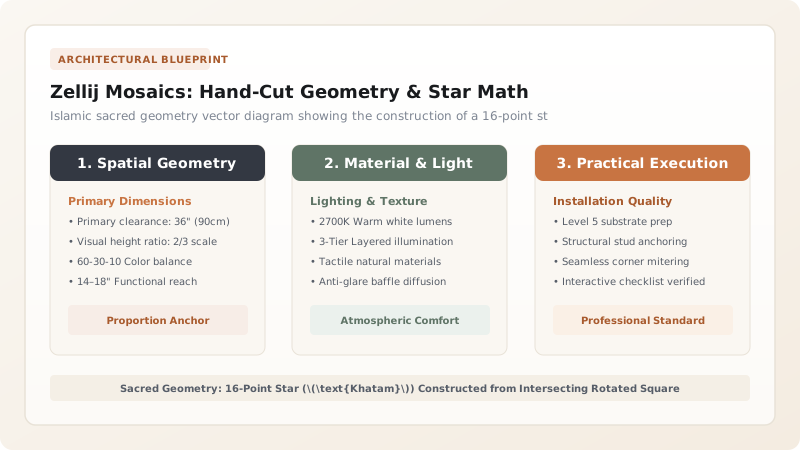
Zellij patterns are governed by Islamic Sacred Geometry based on rotating squares and circles to generate 8, 12, 16, and 24-Point Star Hubs (*Khatam*).
Artisans layout pieces Face-Down on the Floor Bed, sprinkle dry cement over the joints, and pour a 1-inch Fiber-Reinforced Mortar Backing. The cured rigid panel is lifted and set on walls. Review fountain design in central marble fountains and explore Moroccan Riad hub.
Zellij Tesserae Shapes and Proportions
Use this reference table to calculate exact physical dimensions, ratios, and specifications before purchasing:
| Zellij Piece Name | Geometric Shape | Color Role | Position in Mosaic Star |
|---|---|---|---|
| Khatam (The Star Hub - Optimal) | 8 or 16-Point Symmetrical Star | Deep Cobalt Blue / Emerald Green | Central Focal Point of Panel |
| Mouthemna (The Rhombus) | Diamond / Elongated Rhomboid | Pure White / Antique Cream | Radiates outward from star points |
| Farasha (The Butterfly) | Symmetrical Winged Triangle | Saffron Yellow / Black | Bridges gaps between star rays |
| Saq (The Border Ribbon) | Linear Interlocking Ribbon | Contrasting Black & White | Perimeter framing frieze |
Thick Sanded Grout Destruction Constraints
Every successful decoration project must account for physical and environmental constraints:
Contractor Grouting Zellij with Standard 1/8" Sanded Floor Grout Ruining Mosaic Geometry
Standard grout coats the delicate hand-beveled edges with wide grey sand lines, completely destroying the seamless geometric jewel aesthetic; zellij must be installed with hairline contact joints, back-buttered with pure white Portland cement slurry or non-sanded epoxy grout.
How to Cut, Assemble, and Install Zellij Mosaic Panels
Execute this professional sequence to achieve flawless results without backtracking:
Score Geometric Shapes on 10x10cm Glazed Tile Faces
Use metal template and steel scribe to mark star points and diamonds onto glazed tile faces.
Chisel Out Shapes with 45° Undercut Bevel (*Manqash*)
Rest tile on iron anvil block; strike along scribe lines with angled manqash blade to create beveled edges.
Fine-Tune Edges with Flat Anvil Chisel (*Khabba*)
Trim fine glass irregularities from glazed edges using small trimming hammer to ensure tight fit.
Assemble Tesserae Face-Down on Dead-Flat Working Bed
Place cut pieces upside-down following the geometric star grid, interlocking thousands of pieces tightly.
Dust Joints with Dry Cement and Pour Mortar Backing
Dust reverse side with dry cement powder; pour 1" layer of fiber-reinforced Portland cement mortar over panel.
Allow Panel to Cure for 48 Hours and Flip Over
Let mortar set rock-solid; lift monolithic mosaic panel; wash front face with water to reveal flawless mosaic.
Mount Mosaic Panel to Wall with Polymer-Modified Thin-Set
Butter wall with polymer thin-set mortar; set zellij panel, tapping flush with wooden mallet.
Common Mistakes & Countermeasures
Avoid these costly errors that compromise aesthetics, ergonomics, and budget:
Cutting Modern Hard Ceramic Tiles with a Tile Wet Saw
Project Execution Checklist
Track your physical progress. Checkboxes persist automatically on this device:
Frequently Asked Questions
Why is authentic Moroccan zellij slightly irregular in color and surface flatness?
Zellij tiles are hand-molded from natural clay and fired in wood-burning kilns where temperatures vary across the kiln. These subtle variations in tone, glaze depth, and planar undulation give genuine zellij its captivating shimmering texture.


