
Execute authentic Renaissance Sgraffito exterior stucco by applying a dark pigmented lime basecoat (black charcoal or terracotta red), followed immediately by a contrasting white slaked lime finish coat. While the topcoat is damp, carve through the white layer using steel loop and chisel tools at a 45-degree angle to reveal the dark background design.
At a Glance: Key Takeaways
- Renaissance Scratch Technique (*Graffiare*): High-contrast architectural relief carved directly into wet lime stucco.
- Multi-Layer Contrast Stratigraphy: Dark charcoal/iron-oxide base layer (2–3mm) covered by pure white lime skim (1–2mm).
- Damp *Buon Fresco* Etching Window: Plaster must be etched within a 4 to 8-hour window before carbonation petrifies the lime.
- Steel Loop and Ribbon Carving Tools: Precision wire loop tools peel away top plaster ribbons with crisp 45-degree chamfered edges.
- Weatherproof Outdoor Durability: High-calcium lime carbonation forms an exterior facade that resists 500+ years of weather.
In-Depth Guides in this Directory
Explore specialized subtopic blueprints, technical dimensions, and execution checklists:
Sgraffito Strata: Pigmented Lime Stucco Basecoats
Master multi-layer Sgraffito plaster formulation: NHL 3.5 hydraulic lime scratch coats, charcoal and iron oxide intonaco pigmentation, thickness calibrating, and suction suction control.
Sgraffito Tools: Steel Loops, Chisels & Pounce Transfers
Master Renaissance Sgraffito carving tools: forged steel ribbon loops, angled spade chisels, pounce wheel cartoon transfer techniques, and chamfered bevel cutting.
Sgraffito Chemistry: Fresco Curing & Petrification
Master Sgraffito fresco curing science: wet *buon fresco* vs dry *secco* etching windows, atmospheric CO2 carbonation kinetics, calcite crystal interlocking, and rain protection.
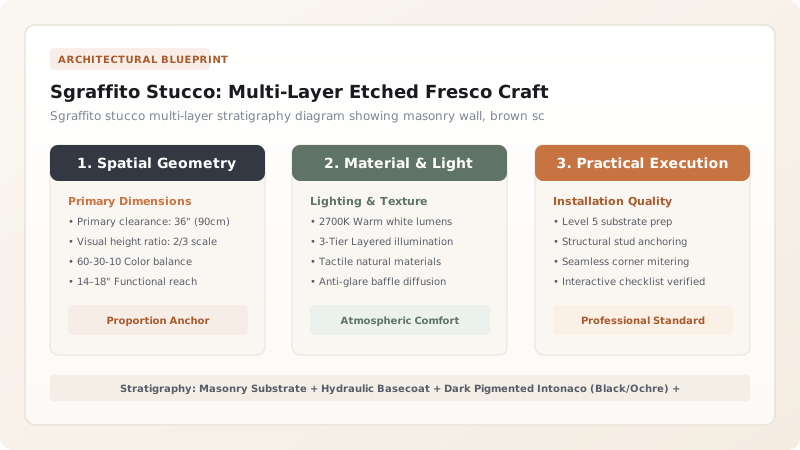
1. Architectural History: Multi-Layer Pigmented Lime Stratigraphy
Developed during the 15th-century Italian Renaissance (prominently on Florentine palazzos and Bohemian castles), Sgraffito (from Italian sgraffiare, to scratch) combines plaster craftsmanship with fine printmaking.
A dark basecoat pigmented with Vine Charcoal or Red Iron Oxide is covered by a Pure White Slaked Lime Skim. Master layer formulas in multi-layer pigmented lime stucco coats and coordinate with Tudor timber framing and stucco infill.

2. Steel Loop Etching Tools & Chemical Fresco Petrification
Carving must be executed during the Damp *Giornata* Window before the lime hardens.
Select professional blades with steel loop and chisel sgraffito tools and understand the petrification kinetics in fresco curing and carbonation hardening.
Sgraffito Exterior Finishes vs Painted Murals
Use this reference table to calculate exact physical dimensions, ratios, and specifications before purchasing:
| Facade Art Technique | Material Depth & Relief | Weather Resistance & Lifespan | Authenticity Rating |
|---|---|---|---|
| Authentic Multi-Layer Sgraffito (Optimal) | 1.5mm to 3mm Carved 3D Relief | 500+ Years (Petrified calcium carbonate) | 5 / 5 (Historic Renaissance Masterwork) |
| Single-Layer Incised Stucco | 0.5mm Shallow Grooves | 100+ Years | 3 / 5 (Modern decorative) |
| Exterior Acrylic Mural Paint | 0.0mm Flat surface paint film | 5 to 10 Years (Peels and fades in UV) | 1 / 5 (Prone to flaking) |
| Stenciled Concrete Stain | Stain absorption | 15 Years | 2 / 5 (Lacks carved tactile depth) |
Etching Window Timing Constraints
Every successful decoration project must account for physical and environmental constraints:
Topcoat Curing Rock-Hard Before Carving is Completed Chipping Ragged Edges
If the plaster dries past the leather-hard stage (after 8 hours in dry winds), chisel blades chip jagged chunks rather than peeling smooth ribbons; work in manageable daily sections (*giornate* of 15–20 sq ft), shading the wall from direct sun with scaffolding tarps.
How to Execute an Exterior Multi-Layer Sgraffito Mural
Execute this professional sequence to achieve flawless results without backtracking:
Apply Hydraulic Lime Scratch Basecoat to Masonry
Trowel 1/2" NHL 3.5 natural hydraulic lime basecoat onto brick/stone; score surface with comb for mechanical key.
Apply Dark Pigmented Intonaco Underlayer (Black/Red)
Trowel 3mm dark charcoal-pigmented lime layer; float flat with wood float; let firm up for 2 hours.
Apply Contrasting White Slaked Lime Topcoat
Trowel 1.5mm pure white lime putty skim over dark layer; smooth with stainless steel trowel.
Transfer Cartoon Design via Pounce Wheel and Charcoal
Pin perforated 1:1 paper cartoon to damp wall; dab charcoal pounce bag over holes to transfer design dots.
Carve Design Outlines with Steel Sgraffito Loops at 45°
Cut along pounce lines with steel loop tool, peeling away white topcoat to expose dark underlayer.
Bevel Cut Edges and Brush Away Plaster Crumbs
Chamfer all cut margins to 45° to shed rainwater; gently sweep away loose plaster dust with soft badger brush.
Allow Natural Carbonation Petrification
Mist lightly with clean water daily for 7 days while lime absorbs atmospheric CO2 to petrify into solid stone.
Common Mistakes & Countermeasures
Avoid these costly errors that compromise aesthetics, ergonomics, and budget:
Cutting Vertical 90° Square Edges Into the Top Plaster Layer
Project Execution Checklist
Track your physical progress. Checkboxes persist automatically on this device:
Frequently Asked Questions
Can Sgraffito be created with three or four different colored layers?
Yes! Advanced Renaissance masters applied 3 to 4 colored layers (e.g., black base, red middle, yellow highlight, white topcoat). Carving to different depths reveals rich multi-color polychrome relief artwork.


