
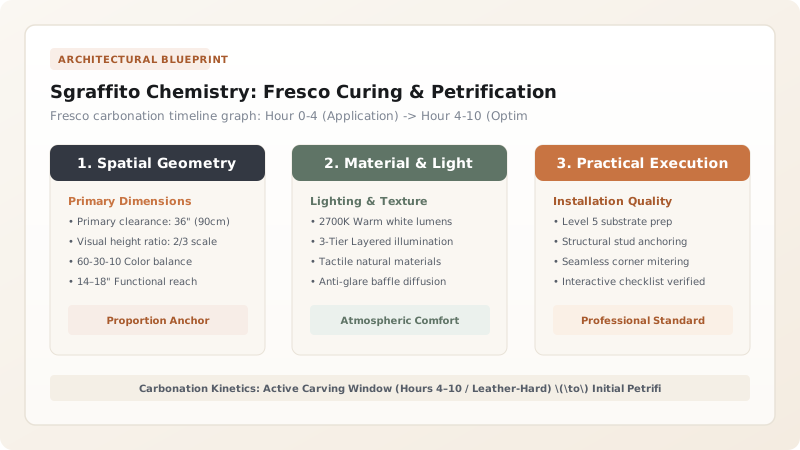
Sgraffito cures through wet *buon fresco* carbonation, where calcium hydroxide (\(\text{Ca(OH)}_2\)) reacts with atmospheric \(\text{CO}_2\) to form interlocking crystals of solid calcite limestone (\(\text{CaCO}_3\)). Execute carving strictly during the 4 to 10-hour 'leather-hard' window when the plaster is firm enough to slice cleanly but damp enough for crystal petrification.
At a Glance: Key Takeaways
- The 4 to 10-Hour *Giornata* Window: The exact physical window when slaked lime is leather-hard and yields glass-smooth carved ribbons.
- Chemical Fresco Bonding: Slaked lime crystals interlock across layer boundaries, eliminating risk of interfacial delamination.
- Carbonic Acid Dissolution Kinetics: Atmospheric \(\text{CO}_2\) dissolves in pore water to form \(\text{H}_2\text{CO}_3\), driving calcite stone growth.
- Rain Protection Scaffolding Tarps: Driving rain during the first 72 hours dissolves un-carbonated lime, creating white runoff streaks.
- Frost Protection (>40°F / 5°C): Freezing water inside curing lime expands 9%, shattering the microscopic crystal lattice.
1. Chemical Physics: *Buon Fresco* Interfacial Crystal Growth
In true *Buon Fresco* and Sgraffito, colors and layers are not held together by glue or resin. As the damp lime layers dry together, Hexagonal Calcium Hydroxide Platelets knit across the boundary interface.
When carbonation completes, the dark underlayer and white topcoat become a Single Continuous Monolithic Block of Crystalline Calcite (\(\text{CaCO}_3\)) that cannot delaminate. Learn tool carving in steel loop carving tools.

2. Environmental Protection: Rain Shields & 28-Day Carbonation
Un-carbonated calcium hydroxide is water-soluble. A heavy rainstorm within the first 48 hours will dissolve the white lime, creating milky streaks across the dark etched background.
Protect exterior walls with Scaffolding Weather Tarps for a minimum of 7 to 14 days. Review layer recipes in multi-layer pigmented lime stucco and explore Sgraffito stucco hub.
Sgraffito Curing Stages & Physical Characteristics
Use this reference table to calculate exact physical dimensions, ratios, and specifications before purchasing:
| Curing Phase | Time Elapsed | Physical Plaster State | Artisan Action Allowed |
|---|---|---|---|
| Plastic Wet Stage | 0 to 2 Hours | Soft paste / Finger indents easily | Layer application & smoothing only |
| Leather-Hard Fresco Window (Optimal) | 4 to 10 Hours | Firm / Non-sticky / Shaves smoothly | 100% Sgraffito Loop Tool Carving |
| Early Carbonation Stage | 24 to 72 Hours | Rigid stone / Resistant to light rain | Misting with clean water / Rain protection |
| Full Petrification | 28 to 90 Days | 100% Solid Calcite Limestone | Permanent centuries-long exposure |
Sun Wind Surface Crusting Constraints
Every successful decoration project must account for physical and environmental constraints:
Direct Sunlight and Wind Baking Outer 0.5mm into a Hard Crust While Base Remains Soft
Brisk dry wind flash-dries the outer surface, forming a brittle crust that tears off in jagged chunks when carved; hang breathable shade mesh over scaffolding to block direct sunlight and wind, keeping the wall in uniform humid shade.
How to Protect and Cure an Exterior Sgraffito Facade
Execute this professional sequence to achieve flawless results without backtracking:
Enclose Scaffolding with Weatherproof Mesh Tarps
Install continuous tarps around scaffolding to block direct sun, high winds, and driving rain.
Execute All Carving Within 10-Hour Window
Complete all sgraffito etching while plaster remains in the leather-hard damp state.
Cover Finished Wall with Plastic Sheeting for First 48h
Hang plastic drape 2 inches off the wall to maintain 80%+ relative humidity without touching fresh plaster.
Mist Wall Gently with Clean Water After 48 Hours
Spray fine water mist over cured sgraffito daily for 7 days to facilitate deep chemical carbonation.
Maintain Ambient Temperatures Above 45°F (7°C)
In winter, install indirect space heaters under scaffolding tarps to prevent freezing during the 28-day cure.
Remove Weather Tarps After 14 Days
Take down protective tarps after initial carbonation is complete; wall is now 100% weather-resistant.
Common Mistakes & Countermeasures
Avoid these costly errors that compromise aesthetics, ergonomics, and budget:
Allowing Freezing Temperatures During the First 14 Days of Curing
Project Execution Checklist
Track your physical progress. Checkboxes persist automatically on this device:
Frequently Asked Questions
Can you touch up a Sgraffito mural if a mistake is carved?
Yes, but ONLY during the active 6-hour wet window. Simply press fresh damp white plaster paste into the mistake using a small artist spatula, smooth flush, let firm for 30 minutes, and re-carve the line.


