
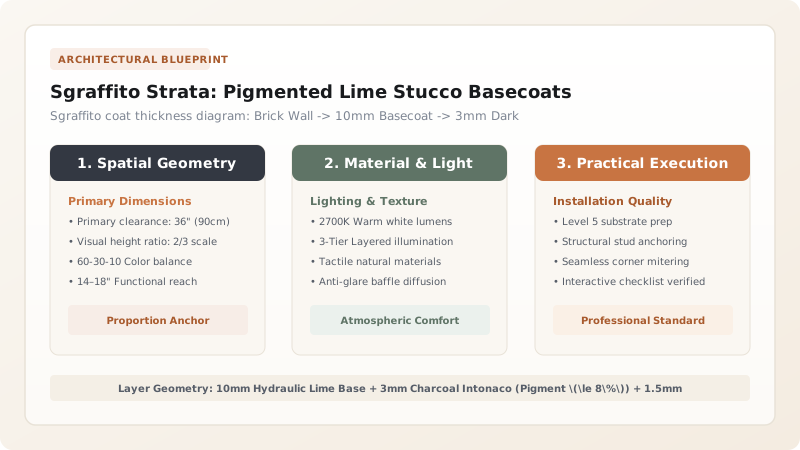
Build multi-layer Sgraffito stucco by applying a 10mm NHL 3.5 hydraulic lime scratch basecoat, followed by a 3mm dark intonaco layer pigmented with 5%–8% natural vine charcoal or red iron oxide by weight. Finish with a 1.5mm pure white lime putty skim, maintaining uniform suction between wet-on-wet layers to prevent delamination.
At a Glance: Key Takeaways
- NHL 3.5 Natural Hydraulic Lime Base: Provides initial hydraulic set for exterior weather resistance and frost proofing.
- 5%–8% Maximum Pigment Loading: Adding over 10% dry mineral pigment weakens the lime binder crystal matrix.
- 3mm to 1.5mm Layer Thickness Ratio: 3mm dark base gives depth for shadows; 1.5mm white top allows effortless wire loop carving.
- Wet-on-Wet (*Fresco*) Interfacial Bonding: Applying layers while damp allows calcium hydroxide crystals to knit across boundaries.
- Suction Control Misting: Pre-wetting substrate masonry prevents dry brick from sucking moisture out of fresh intonaco.
1. Material Formulations: NHL 3.5 Binders & Mineral Oxide Loading
Exterior Sgraffito facades must withstand centuries of freezing rain, driving wind, and solar UV radiation. Master plasterers formulate the base using Natural Hydraulic Lime (NHL 3.5 or NHL 5.0).
The dark intonaco layer is tinted using UV-Stable Natural Mineral Oxides (German Vine Black or Spanish Red Iron Oxide) loaded at strictly 5% to 8% of binder weight. Over-pigmenting creates soft, chalky plaster that crumbles when carved. Learn tool selection in steel loop carving tools.

2. Interfacial Suction Control & 1.5mm Skim Calibrating
If the dark underlayer dries completely before the white topcoat is applied, the layers will delaminate and peel in winter freeze-thaw cycles.
Apply the white topcoat Wet-on-Wet (within 2 to 3 hours) at a Uniform 1.5mm Thickness. Explore carbonation kinetics in fresco curing chemistry and review Sgraffito stucco hub.
Sgraffito Plaster Layer Formulations
Use this reference table to calculate exact physical dimensions, ratios, and specifications before purchasing:
| Layer Name | Binder & Aggregate Ratio | Thickness | Function in Sgraffito |
|---|---|---|---|
| 1. Scratch Basecoat | 1 Part NHL 3.5 : 2.5 Parts Coarse Sand (0–3mm) | 10mm to 12mm | Structural bond to brick / Leveling plane |
| 2. Dark Intonaco | 1 Part Lime Putty : 2 Parts Fine Sand + 6% Black Oxide | 3mm to 4mm | Background shadow relief layer |
| 3. White Finish Skim | 1 Part Aged Grassello : 1 Part Carrara Marble Dust | 1.5mm | Carved top surface layer |
| 4. Intermediate Accent (Optional) | 1 Part Lime : 2 Parts Sand + 6% Red Ochre | 2mm | Middle color tier for 3-color Sgraffito |
Interfacial Delamination Freeze-Thaw Constraints
Every successful decoration project must account for physical and environmental constraints:
Smooth Troweled Underlayer Causing White Topcoat to Sheet Delaminate in Winter
Leaving the dark intonaco layer smooth like glass prevents mechanical bonding with the white topcoat; finish the dark layer with a coarse sponge float or wood float to leave open mineral tooth before applying the white skim.
How to Formulate and Apply Multi-Layer Sgraffito Plasters
Execute this professional sequence to achieve flawless results without backtracking:
Saturate Masonry Substrate with Water
Spray brick/stone wall with clean water until masonry is damp but free of standing surface sheen.
Apply 10mm Hydraulic Lime Scratch Coat
Trowel NHL 3.5 mortar; score horizontal wavy grooves with plasterer's comb; let cure 48 hours.
Mix Dark Charcoal Intonaco Mortar
Blend 1 part slaked lime, 2 parts fine sand, and 6% vine black pigment by weight; mix to smooth paste.
Trowel 3mm Dark Intonaco and Wood-Float Flat
Apply 3mm dark layer; float with wood float to leave open porous tooth; let firm for 2 hours.
Trowel 1.5mm White Marble Flour Finish Skim
Apply ultra-thin 1.5mm coat of white Grassello and Carrara marble dust; level with stainless trowel.
Begin Carving Immediately While Damp
Transfer paper cartoon pattern and begin loop-tool carving within the active 4 to 6-hour wet window.
Common Mistakes & Countermeasures
Avoid these costly errors that compromise aesthetics, ergonomics, and budget:
Making the White Finish Topcoat Too Thick (>3mm)
Project Execution Checklist
Track your physical progress. Checkboxes persist automatically on this device:
Frequently Asked Questions
What pigments are safe for exterior Sgraffito lime plaster?
Only use natural mineral oxides and earth pigments (such as vine charcoal, iron oxides, chromium oxide green, and cobalt blue). Never use organic dye pigments, which bleach white within months under lime alkalinity and sunlight.


