
Execute Sgraffito murals using specialized carbon steel carving tools: use teardrop-shaped steel wire loops for outline contour grooves, wide flat ribbon scrapers for clearing large background areas, and angled spade chisels for sharp corner details. Transfer 1:1 master drawings to damp plaster using a pounce wheel and charcoal dust bag.
At a Glance: Key Takeaways
- Forged High-Carbon Steel Ribbon Loops: Retains razor sharpness when slicing through abrasive silica sand and marble dust.
- 45° Beveled Cutting Edges: Ground with single-sided bevels to slice plaster ribbons without tearing surrounding damp mortar.
- Pounce Wheel & Cartoon Transfer (1:1 Scale): Perforates full-size paper drawings; charcoal powder dusted through holes maps the artwork.
- Large Background Clearance Scrapers: 1-inch wide flat scrapers peel away background white plaster at uniform 1.5mm depths.
- Badger Hair Soft Dusting Brushes: Sweeps away loose carving crumbs without smudging damp white plaster margins.
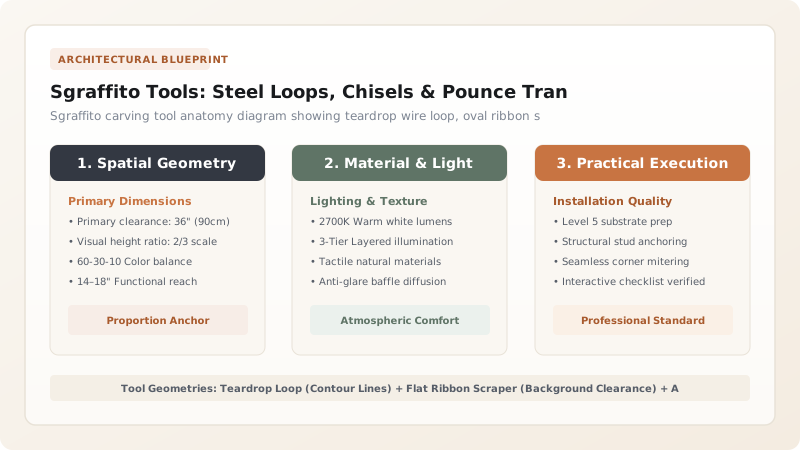
1. Tool Metallurgy: Carbon Steel Wire Loops & Scraper Profiles
Standard pottery clay modeling tools are made from soft brass or unhardened wire that dulls after just 10 inches of cutting through abrasive marble plaster. Master sgraffitisti forge their tools from Hardened High-Carbon Spring Steel (58–60 HRC).
The primary tools include Teardrop Loops (for outlines), Oval Ribbons (for curves), and Wide Flat Scrapers (for background clearing). Learn coat preparation in multi-layer pigmented lime stucco.

2. The Pounce Transfer Technique & 45° Chamfer Slicing
Because wet plaster cannot be drawn on with pencils, artists create a Full-Scale 1:1 Paper Cartoon. Rolling a Spiked Pounce Wheel perforates the lines. The paper is taped to the damp wall and dabbed with a Charcoal Pounce Bag.
Hold the steel loop at a 45-Degree Angle to slice clean ribbons. Explore hardening kinetics in fresco curing chemistry and review Sgraffito stucco hub.
Sgraffito Carving Tools & Their Functions
Use this reference table to calculate exact physical dimensions, ratios, and specifications before purchasing:
| Tool Name | Blade Shape / Geometry | Primary Function | Cutting Technique |
|---|---|---|---|
| Teardrop Steel Loop (Optimal) | Pointed teardrop spring steel | Fine contour outlines & lettering | Pulling stroke along line at 45° |
| Flat Oval Ribbon Scraper | 1" Wide flat ribbon loop | Clearing large background fields | Flat shaving strokes across area |
| Triangular V-Gouge | V-shaped 60° chisel point | Deep geometric border grooves | Push chisel stroke |
| Pottery Wire Tool (Avoid) | Soft unhardened wire | FAILS: Bends and dulls immediately | Unsuitable for lime plaster |
Pounce Bag Smudging Wet Plaster Constraints
Every successful decoration project must account for physical and environmental constraints:
Heavy Charcoal Dusting from Pounce Bag Smudging White Damp Plaster
Banging a charcoal pounce bag hard against wet plaster deposits excess black soot that smears into the damp white finish; use fine powdered vine charcoal tied in double-layer silk cheesecloth, tapping lightly and blowing away excess dust with a rubber hand bulb blower.
How to Transfer and Carve a Sgraffito Mural with Steel Loops
Execute this professional sequence to achieve flawless results without backtracking:
Create 1:1 Full-Scale Paper Drawing Cartoon
Draw complete design on heavy kraft paper at exact full-size facade dimensions.
Perforate Design Lines with Spiked Pounce Wheel
Roll pounce wheel along all drawing contours over a felt backing board to punch small needle holes.
Position Cartoon on Wet Finish Plaster Coat
Tape paper cartoon to damp white plaster wall using blue painter's tape; verify alignment with level.
Dab Charcoal Pounce Bag Over Perforated Holes
Gently tap charcoal bag along hole lines; carefully lift paper to reveal black dot pattern on plaster.
Carve Primary Contour Lines with Teardrop Loop
Pull teardrop steel loop along dotted lines, cutting 1.5mm deep through white coat to expose black layer.
Clear Background Areas with Flat Ribbon Scraper
Shave away unwanted white background fields using 1" wide flat scraper held parallel to wall surface.
Sweep Debris with Soft Natural Badger Hair Brush
Gently brush loose plaster curls away from carved trenches; inspect and sharpen lines with micro-chisel.
Common Mistakes & Countermeasures
Avoid these costly errors that compromise aesthetics, ergonomics, and budget:
Pushing the Loop Tool Forward Instead of Pulling
Project Execution Checklist
Track your physical progress. Checkboxes persist automatically on this device:
Frequently Asked Questions
How often do Sgraffito steel loop tools need sharpening?
High-carbon steel tools should be honed on a 1000/6000 grit Japanese water stone every 2 to 3 hours of active carving. Sharp tools slice through damp plaster with zero tearing or dragging.


