
Travertine impluvium basins and sloped mosaic drainage are classical architectural water elements designed to capture and drain high water volumes in Roman bath suites. Sculpted from dense Roman travertine (Tivoli calcarenite) with radiused wave-breaking weir copings, the frigidarium basin is flanked by mosaic floor surrounds sloped at a continuous 2.0% (1:50) grade toward concealed linear slot drains, preventing water puddling and eliminating slip hazards.
At a Glance: Key Takeaways
- Roman Classico Travertine: Dense marine sedimentary limestone featuring rich natural vug textures unfilled or slurry-grouted with epoxy.
- Wave-Breaking Weir Coping: Radiused bullnose profile with recessed underside drip-groove absorbing water surge without floor flooding.
- 2.0% Uniform Drainage Slope: Precise transit-leveled floor gradients directing water swiftly away from heated walking zones to linear slot drains.
- Uncoupled Capillary Drainage Fleece: Geocomposite drainage mat installed beneath mosaic tiles allowing water penetrating grout to drain freely.
- Epoxy Mortar Anti-Efflorescence: 100% solids epoxy setting adhesives preventing white mineral salt leaching through porous marble.
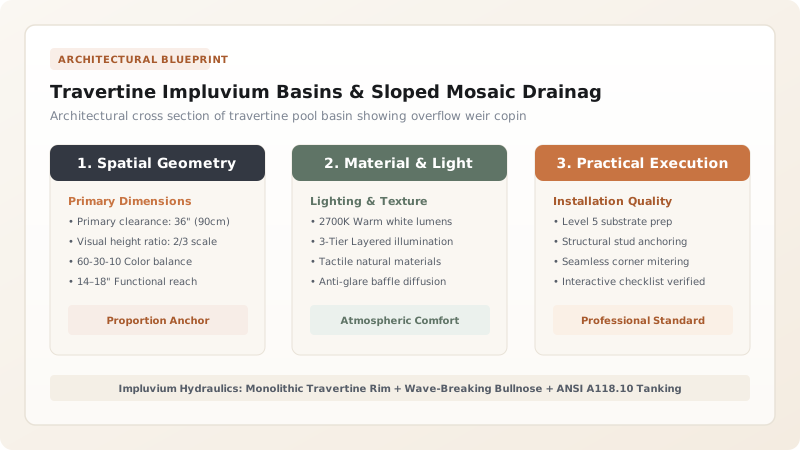
1. Stone Geology: Roman Travertine Characteristics & Carving
The iconic stone of classical Rome is Travertine (Lapis Tiburtinus), quarried for over two millennia in the plain of Tivoli near Rome. Travertine is a terrestrial sedimentary limestone deposited by geothermal mineral springs saturated with dissolved calcium bicarbonate (\(\text{Ca(HCO}_3\text{)}_2\)):
As spring waters de-gas carbon dioxide, calcium carbonate precipitates in delicate banded ribbons around organic reed reeds and algae, forming travertine's distinctive cellular voids (vugs). In cold plunge frigidarium pools:
- Density & Compressive Strength: First-choice Roman Classico travertine possesses a bulk density of \(2,450\text{ kg/m}^3\) and compressive strength exceeding \(85\text{ MPa}\), resisting structural hydro-fatigue.
- Vug Slurry Filling: In wet plunge environments, open surface vugs on the pool interior are filled with matching stone-dust epoxy resin polished to a honed satin finish (400-grit), ensuring an ultra-smooth, cleanable basin surface that resists algae attachment. Outside the pool, honed unfilled travertine provides natural wet-slip resistance (R11 rating). Review whole suite design in our Roman bath suites hub.

2. Hydraulic Coping: The Wave-Breaking Overflow Weir
When a bather plunges into a 1,000-liter frigidarium pool, their body displaces \(70\text{ to } 90\text{ liters}\) of water instantly, generating an aggressive hydrodynamic surge wave.
In standard pools, this displacement floods surrounding walking paths. Roman impluvium pools solve this with Wave-Breaking Weir Coping Stones:
- Inward-Sloped Bullnose: The top surface of the coping stone slopes inward toward the pool at \(3^\circ\), causing minor surface ripples to drain back into the pool.
- Concealed Perimeter Spillway Slot: A continuous 15mm perimeter slot drain is integrated immediately behind the coping. Displaced surge waves spill cleanly into this slot rather than flooding the heated mosaic floors.
- Recessed Anti-Capillary Drip Groove: A 6mm semi-circular groove cut into the coping underside breaks surface tension, preventing water from creeping backward along stone bed joints. Learn hypocaust integration in modern hypocaust heating.
3. Floor Drainage Engineering: Slopes & Capillary Drainage Mats
In a thermal suite, bathers drip water continuously as they walk from caldarium to frigidarium. If water ponds on the floor, it creates dangerous slip hazards and cools the heated hypocaust floor:
- 2.0% (1:50) Floor Drainage Gradients: Floors are formed with a continuous, precision screeded fall of \(20\text{ mm}\) per 1.0 meter run leading to continuous perimeter linear slot drains concealed along wall baseboards.
- Sub-Mosaic Capillary Drainage Fleece: Water naturally penetrates cementitious mosaic grout lines. To prevent trapped water from rotting the adhesive bed, a dimpled geocomposite drainage mat (Schluter Ditra-Drain) is installed beneath the tile. Water that seeps through grout enters the dimpled air channels and gravity-drains harmlessly to the slot drain.
- 100% Solids Epoxy Setting: Tiles are bedded exclusively with ANSI A118.3 Chemical-Resistant Epoxy Mortar. Unlike Portland cement which effloresces unsightly white calcium crusts, epoxy is completely impervious to chemical breakdown. Discover steam ceiling dynamics in barrel-vaulted steam ceilings.
Roman Bath Basin Materiality Comparison
Use this reference table to calculate exact physical dimensions, ratios, and specifications before purchasing:
| Basin Material | Monolithic Roman Classico Travertine | Cast-in-Place Shotcrete with Glass Mosaic | Solid White Carrara Marble Slabs |
|---|---|---|---|
| Thermal Tactile Warmth | Natural travertine absorbs/retains warmth | Cold glass tile feel | Cool, dense stone surface |
| Wet Slip Resistance (PVR) | High (natural micro-texture R11) | Very High (numerous grout joints R11) | Low to Moderate (requires honed finish) |
| Joint Integrity | Large monolithic slabs (minimal seams) | Thousands of grout lines (biofilm risk) | Large slabs with precision seams |
| Historical Authenticity | 100% Authentic to Imperial Rome | Authentic Byzantine/Roman | High Renaissance & Imperial Rome |
| Installation Weight | Heavy (requires crane rigging) | Extremely Heavy (structural pool shell) | Heavy (solid stone blocks) |
Stone Basin & Drainage Constraints
Every successful decoration project must account for physical and environmental constraints:
Acidic Cleaning Chemicals Dissolving Travertine
Commercial bathroom cleaners containing phosphoric, hydrochloric, or sulfamic acids react violently with travertine (calcium carbonate), dissolving the stone and etching deep white scars in minutes. Maintenance staff must use exclusively neutral pH (7.0–8.0) stone soaps.
Linear Drain Trap Siphoning from Steam Extraction
High-volume mechanical exhaust fans in the caldarium create strong negative pressure that can suck the water seal out of floor P-traps, venting sewer gases directly into the bath suite. Drains must incorporate deep 100mm water seals with trap primers.
Uneven Subfloor Settling Cracking Mosaics
If the screed bed deflects by even 1mm across a 2-meter span, rigid stone mosaics will crack along grout lines. The subfloor must meet strict deflection criteria (L/720) with uncoupling membrane underlayments.
Travertine Impluvium & Mosaic Drainage Installation Protocol
Execute this professional sequence to achieve flawless results without backtracking:
Basin Formwork & Hydraulic Shell Pour
Pour reinforced C35/45 waterproof concrete basin shell with waterstop seals around all suction and return plumbing penetrations.
2.0% Floor Screeding & Linear Drain Setting
Cast floor screed with laser-calibrated 2.0% fall toward perimeter walls; embed 316 stainless steel linear slot drain troughs flush with screed line.
Dual-Coat ANSI A118.10 Tanking Membrane
Apply two coats of elastomeric liquid waterproofing membrane across basin interior and entire room floor; flood-test basin for 48 hours.
Capillary Drainage Fleece Placement
Install uncoupling drainage fleece over floor membrane using thin-set mortar; verify free drainage paths into slot drain troughs.
Travertine Slab Setting with Epoxy Mortar
Set 30mm travertine basin slabs and perimeter coping stones using ANSI A118.3 epoxy mortar; align wave-break bullnose with 3-degree inward slope.
Mosaic Grouting & Neutral pH Sealing
Grout floor mosaics with stain-resistant epoxy grout; clean stone faces with warm water and micro-fiber sponges; apply breathable fluoro-chemical stone impregnator.
Common Mistakes & Countermeasures
Avoid these costly errors that compromise aesthetics, ergonomics, and budget:
Using Acidic Silicone Caulking on Travertine
Failing to Install an Uncoupling Drainage Mat
Leveling the Coping Inward Without an Overflow Slot
Project Execution Checklist
Track your physical progress. Checkboxes persist automatically on this device:
Frequently Asked Questions
What is the historical meaning of an 'Impluvium'?
In an ancient Roman domus (villa), the impluvium was the sunken square basin in the center of the atrium designed to collect clean rainwater falling through the open compluvium skylight in the roof. In thermal bath architecture, the term was adopted for the ornamental sunken cold plunge basins located in the center of the frigidarium.
Can travertine withstand freezing water temperatures in cold plunge pools?
Yes. Dense Roman travertine from primary quarries has certified frost resistance (tested under EN 12371). Because indoor plunge pools operate between 10°C and 14°C (above freezing), the stone is never subject to freeze-thaw expansion cycles.
How do you keep mosaic tile grout clean in a high-steam Roman bath?
Traditional cement grout absorbs moisture and body oils, rapidly breeding orange biofilm and black mold. Modern installations utilize 100% solids epoxy grout (such as Laticrete SpectraLOCK). Epoxy grout cures into a non-porous, plastic-like ceramic resin that is completely impermeable to water, mold, and stains, requiring only periodic wipe-downs with mild soap.


