
Modern hypocaust subfloor radiant heating is an engineered thermal system that adapts ancient Roman floor-and-wall heating principles using closed-loop hydronic PEX technology. By circulating 50°C–60°C heated water through 16mm oxygen-barrier PEX-AL-PEX tubing embedded on 100mm centers inside high-density screeds and behind vertical wall plaster assemblies, it stores immense thermal energy in stone floors and benches, radiating pure uniform infrared heat (40°C–45°C) without drafts or scorched air.
At a Glance: Key Takeaways
- Hydronic Subfloor Thermal Mass: 60mm fiber-reinforced cementitious screed storing up to 45 kWh of thermal energy for uniform all-day release.
- PEX-AL-PEX Multi-Layer Tubing: Cross-linked polyethylene with continuous aluminum core maintaining rigid bends without spring-back.
- 360-Degree Radiant Envelope: Floor, bench, and vertical wall loops heating the room uniformly under the Stefan-Boltzmann radiation law.
- Closed-Loop Modulating Manifolds: Stainless steel distribution manifolds with electronic thermal actuators balancing zone flows.
- High-Temperature Water Sizing: Operating at 55°C supply temperatures to maintain travertine surface temperatures at 40°C–42°C in the caldarium.
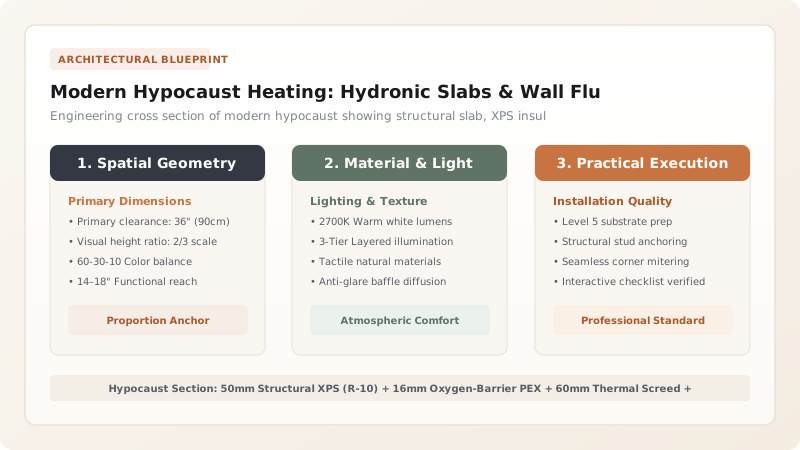
1. Thermal Engineering: Ancient Suspensurae to Modern Hydronic Slabs
The ancient Roman hypocaust operated by lifting the floor on square brick pillars (pilae) and venting furnace gases (praefurnium) through the subfloor void and up hollow terracotta wall pipes (tubuli). While monumental, the ancient system suffered from toxic carbon monoxide leaks and soot accumulation.
Modern architectural engineering recreates this 360-degree radiant thermal envelope using Closed-Loop Hydronic Multi-Layer PEX:
- Oxygen-Barrier Composite Tubing: 16mm PEX-AL-PEX (cross-linked polyethylene / aluminum / cross-linked polyethylene). The internal aluminum layer prevents oxygen diffusion into heating circuits, protecting copper boilers and stainless pump impellers from oxidation.
- Screed Thermal Inertia: Tubing is embedded within a \(60\text{ mm}\) thick fiber-reinforced thermal screed (thermal conductivity \(k \approx 1.4\text{ to } 1.8\text{ W/m K}\)). The thermal storage mass \(M_{\text{screed}}\) absorbs heat during off-peak hours and releases it with smooth, draft-free stability. Review overall suite architecture in our Roman bath suites hub.

2. Heat Transfer Physics: Surface Flux & Floor Conduction
To maintain a caldarium at 45°C with 100% steam saturation, the radiant heat flux from the floor and walls must overcome the latent heat losses of steam condensation.
The total heat flux \(q''\) delivered per square meter of marble surface is governed by combined radiation and convection:
Where \(h_c\) is the convective heat transfer coefficient (\(\approx 2.8\text{ W/m}^2\text{K}\)), \(\epsilon\) is marble emissivity (\(\approx 0.93\)), and \(\sigma\) is the Stefan-Boltzmann constant. By running a fluid supply temperature of \(55^\circ\text{C}\) through tubing spaced on \(100\text{ mm}\) centers, the marble surface reaches an optimal \(40^\circ\text{C} \text{ to } 42^\circ\text{C}\) (104°F–108°F)—delivering up to \(120\text{ W/m}^2\) of pure radiant warmth directly to bathers' bodies without hot spots. Learn stone basin craft in travertine impluvium basins.
3. Wall Flue Joinery: Heated Ergonomic Benches & In-Wall Flues
A true Roman caldarium does not have cold walls. Cold masonry surfaces cause steam to condense too rapidly, dropping room temperature:
- Vertical Wall Heating Loops (Modern Tubuli): PEX tubing is routed vertically up wall studs on 150mm centers, embedded in structural cement plaster behind marble revetment slabs. This eliminates cold-wall radiation chill.
- Monolithic Heated Ergonomic Benches: Benches are formed from structural aerated concrete blocks (AAC), carved into ergonomic S-curve recliners, wrapped in PEX loops, and clad in 20mm bookmatched Roman travertine. Bathers recline on warm, stone beds that soothe muscular aches within minutes. Discover ceiling arch dynamics in barrel-vaulted steam ceilings.
Caldarium Heating Technology Comparison
Use this reference table to calculate exact physical dimensions, ratios, and specifications before purchasing:
| Heating Architecture | Modern Hydronic Hypocaust (PEX in Screed) | Electric Floor Warming Cables | Steam-Only Direct Injection |
|---|---|---|---|
| Thermal Enclosure Coverage | 360° (Floor, Benches, and Walls) | Floor and bench only | None (heats air only; surfaces stay cold) |
| Operating Cost Efficiency | Very High (heat pump / gas boiler source) | Low (pure electric resistance is costly) | Moderate (steam boiler duty) |
| Surface Temperature Uniformity | Flawless (continuous hydronic flow) | Good (can develop hot wire lines) | Poor (surfaces remain colder than steam) |
| Longevity & Durability | 50+ years (PEX tubing embedded in screed) | 10 to 15 years (cable burnout risk) | Boiler requires frequent descaling |
| Sensory Bathing Experience | Authentic radiant warmth + soft steam | Warm floor + cool walls | Wet, soggy air + cold dripping walls |
Hypocaust Mechanical & Thermal Constraints
Every successful decoration project must account for physical and environmental constraints:
Thermal Expansion Shear Cracking in Marble Slabs
Heating large-format travertine or marble slabs from 20°C to 42°C causes thermal expansion (\(\Delta L = L_0 \cdot \alpha \cdot \Delta T\)). If slabs are grouted tightly against walls without perimeter expansion joints, compressive stress buckles slabs off the floor. 8mm silicone-filled perimeter expansion joints are mandatory.
Downward Thermal Loss to Ground Slab
If radiant tubing is poured directly over uninsulated concrete foundations, 40% of the heating energy conducts uselessly downward into the Earth. A continuous layer of 50mm high-density extruded polystyrene (XPS, compressive strength > 300 kPa) must decouple the heated screed from the subfloor.
PEX Puncture from Travertine Anchor Screws
Contractors drilling into the heated screed to anchor door thresholds or stone bench supports can puncture PEX lines, causing catastrophic subfloor water leaks. All tubing layouts must be photographed with reference grid dimensions and surveyed with thermal imaging cameras before drilling.
Modern Hypocaust Installation Sequence
Execute this professional sequence to achieve flawless results without backtracking:
Subfloor Cleaning & XPS Thermal Decoupling
Clean concrete foundation; lay 50mm interlocking high-density XPS insulation boards (R-10); tape all board seams with vapor-tight tape.
Reinforcing Welded Wire Mesh Placement
Lay 100mm x 100mm welded steel wire mesh (6mm gauge) over insulation, elevated on plastic screed chairs.
PEX-AL-PEX Loop Tying & Spacing
Fasten 16mm PEX-AL-PEX tubing to mesh in serpentine patterns at 100mm spacing using plastic zip ties; route loop tails to manifold location.
Wall Flue & Bench PEX Integration
Fasten PEX loops across vertical wall frames and sculpted concrete bench carcases; connect to dedicated manifold balance ports.
Hydrostatic Pressure Test
Fill loops with water; pressurize to 60 PSI with hydraulic test pump; maintain pressure continuously for 24 hours during screed pour.
High-Density Thermal Screed Pour
Pour 60mm fiber-reinforced sand-cement thermal screed; consolidate with vibratory screed; wet cure for 28 days before activating heat.
Common Mistakes & Countermeasures
Avoid these costly errors that compromise aesthetics, ergonomics, and budget:
Activating Radiant Heat Before Screed Cures
Using Electric Floor Cables in a 100% Steam Caldarium
Omitting Tubing from Wall Assemblies
Project Execution Checklist
Track your physical progress. Checkboxes persist automatically on this device:
Frequently Asked Questions
What water temperature is circulated through a caldarium hypocaust?
Unlike residential radiant floors (which circulate water at 35°C–40°C to achieve 26°C floor warmth), a Roman caldarium circulates water at 50°C to 55°C (122°F–131°F) to overcome heavy steam condensation losses and maintain floor and bench surface temperatures at a soothing 40°C to 42°C (104°F–108°F).
Can the hypocaust heat the caldarium without an active steam generator?
Yes! When operated with hypocaust radiant heat alone (without steam injection), the caldarium functions as an ancient 'Laconicum'—a dry hot stone sweating chamber (similar to a Roman sauna at 48°C and 30% RH). When the steam generator is switched on, it transforms into a humid steam caldarium.
How long does it take for a modern hypocaust slab to heat up?
Because of the immense thermal mass of the 60mm concrete screed and 20mm marble tiles, thermal response time is approximately 3 to 4 hours from a cold start. In luxury residential spas, the system is kept on a continuous low idle setting (30°C) and ramped up to bathing temperature (42°C) in about 45 minutes via automated smart thermostats.


