
Low-temperature titanium heat pump chillers are specialized refrigeration units engineered to pull down and maintain water temperatures at 38°F (3.3°C) without freezing the heat exchanger. Utilizing non-corrosive Grade 2 pure titanium coaxial counter-flow evaporators, DC variable-speed inverter compressors, electronic expansion valves (EEVs), and mechanical paddle flow switches that interlock compressor power with water circulation, they extract heat reliably with high Coefficient of Performance (COP > 3.2).
At a Glance: Key Takeaways
- Coaxial Titanium Heat Exchangers: Spiral fluted Grade 2 titanium inner tubing delivering extreme turbulence and heat transfer without chemical corrosion.
- Sub-Zero Evaporating Physics: Operating at -2°C refrigerant temperatures while preventing laminar ice-layer formation on the water side.
- Variable-Speed DC Inverter: Ramping compressor displacement smoothly from 20% to 100% capacity to maintain water within ±0.2°C.
- Electronic Expansion Valves (EEV): Micro-stepping refrigerant metering to maintain precise 4.0°C superheat across wide ambient load swings.
- Safety Interlock Flow Protection: Calibrated magnetic or mechanical paddle switches instantly shutting down compressors if water flow drops below 15 L/min.
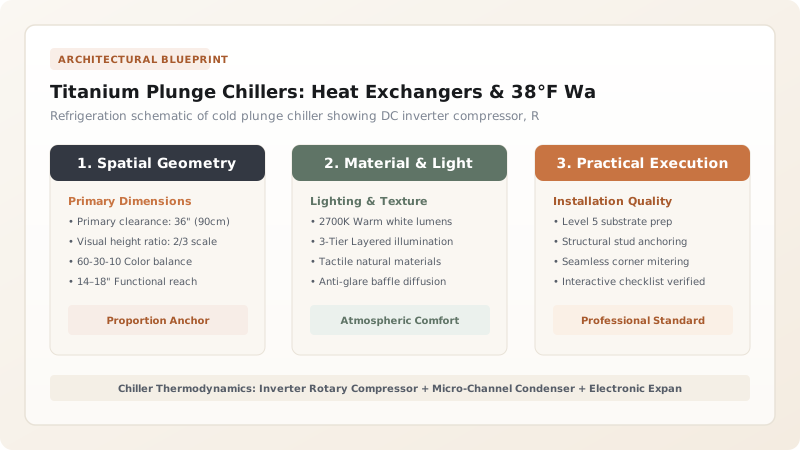
1. Refrigeration Physics: Counter-Flow Titanium Evaporators & Enthalpy
Maintaining a swimming pool at 28°C requires an evaporating refrigerant temperature of ~12°C. But maintaining a cold plunge at \(3.3^\circ\text{C}\) (38°F) requires the refrigerant inside the evaporator barrel to evaporate at \(-2^\circ\text{C} \text{ to } -4^\circ\text{C}\)—dangerously close to water's freezing point.
If water flow slows down or stagnates, an ice shell forms instantly on the evaporator tube surface. Ice has low thermal conductivity (\(k = 2.22\text{ W/m K}\)), acting as an insulator that chokes heat transfer. If uncorrected, water inside the barrel freezes solid, bursting the heat exchanger barrel under \(200\text{ MPa}\) of ice expansion pressure.
To eliminate freeze-up, modern chillers employ Coaxial Counter-Flow Titanium Evaporators:
- Spiral Fluted Geometry: The inner titanium tube is deeply fluted with helical convolutions. This forces water into violent turbulent vortex flow (Reynolds number \(Re > 10,000\)), scrubbing the boundary layer and eliminating localized laminar freezing pockets.
- Logarithmic Mean Temperature Difference (LMTD): Operating in counter-flow (refrigerant and water flowing in opposite directions) maximizes heat transfer:
This allows compact titanium heat exchangers to transfer up to \(3.5\text{ kW}\) of cooling in a barrel barely 450mm long. Review whole pool systems in our cold plunge pools hub.

2. Compressor Mechanics: DC Inverter Modulation & Electronic Valves
Traditional single-speed on/off compressors operate crudely: they run at 100% blast, overshoot the setpoint, and shut off, causing water temperature to saw-tooth between 3°C and 7°C.
High-performance plunge chillers utilize Brushless DC Inverter Rotary Compressors:
- Modulating Capacity (20% to 100%): Driven by a variable-frequency inverter drive, the compressor speeds up during the initial pull-down phase (drawing 1,500 Watts), and throttles down to a quiet \(250\text{ Watts}\) once the water stabilizes at 38°F, consuming less power than a home desktop computer.
- Electronic Expansion Valve (EEV) Micro-Stepping: A 500-step stepper motor regulates refrigerant mass flow in real time based on temperature and pressure transducers, maintaining a rock-steady \(3.5^\circ\text{C} \pm 0.3^\circ\text{C}\) superheat, preventing liquid refrigerant from slugging back into the compressor. Learn tub manufacturing in 316 stainless tub shells.
3. Hydraulic Integration: Flow Rates & Dual Safety Freeze-Stats
A cold plunge chiller must never be operated without active, guaranteed water flow:
- Required Flow Velocity: The circulation pump must deliver minimum \(25\text{ to } 40\text{ Liters/minute}\) (6.5 to 10 GPM) through the heat exchanger barrel to maintain turbulent flow.
- Hardware Safety Interlock: A magnetic paddle flow switch is wired in series with the compressor contactor. If a bather blocks the suction drain or the pump trips, the flow switch opens within \(0.2\text{ seconds}\), cutting compressor power before ice can form.
- Microprocessor Freeze-Stat: An electronic temperature sensor mounted directly on the titanium barrel shuts the unit off if barrel temperature drops below \(0.5^\circ\text{C}\), providing secondary failsafe protection. Discover water chemistry in ozone and micron water chemistry.
Cold Plunge Chiller System Comparison
Use this reference table to calculate exact physical dimensions, ratios, and specifications before purchasing:
| Chiller Technology | Dedicated Low-Temp Titanium Inverter (1 HP) | Modified Aquarium Chiller (1/3 HP) | Ice Dump / Manual Ice Bags |
|---|---|---|---|
| Minimum Water Temp | 3°C (37°F) continuous hold | 8°C - 10°C (cannot reach 38°F) | Depends on ice quantity (fluctuates wildly) |
| Compressor Modulation | DC Inverter (stepless 20% - 100%) | Single-speed on/off relay | N/A (manual labor) |
| Titanium Coil Warranty | 10+ years (impervious to ozone) | 2 to 3 years (thin titanium grade) | N/A |
| Operating Noise Level | 42 - 48 dBA (ultra-quiet whisper) | 56 - 65 dBA (loud compressor hum) | Zero machine noise |
| Daily Electricity Cost | $0.40 - $0.85 / day (highly efficient) | $0.70 - $1.20 / day (runs continuously) | $15 - $25 / day (buying bagged ice) |
Chiller Installation & Environmental Constraints
Every successful decoration project must account for physical and environmental constraints:
High Ambient Heat Derating
Operating a plunge chiller outdoors in summer ambient temperatures above 40°C (104°F) reduces cooling capacity by up to 35% and raises condensing pressure. Chillers must be sized with a 1.5x safety multiplier in hot climates and installed under shaded louvers.
Line Pressure Drop Across Long Hose Runs
Routing thin 1/2-inch plumbing hoses over runs exceeding 5 meters creates excessive head loss, reducing water flow below the minimum 20 L/min threshold and triggering flow-switch shutdowns. Long runs require 1-inch (25mm) smooth-bore Schedule 40 PVC pipe.
Winter Freezing Hazard When Located Outdoors
If the chiller is placed outdoors in sub-zero winter climates and turned off, water inside the titanium barrel will freeze from freezing ambient air, destroying the unit. Chillers must feature automatic anti-freeze cycling or be drained for winterization.
Titanium Plunge Chiller Commissioning Protocol
Execute this professional sequence to achieve flawless results without backtracking:
Location Selection & Airflow Clearances
Position chiller on vibration dampener rubber pads outdoors or in ventilated plant room; verify minimum 500mm air clearance on all sides.
Insulated Schedule 40 Plumbing Hookup
Connect 1-inch Schedule 40 PVC lines from tub return, through pump, filter, and chiller barrel; insulate all exposed pipes with 19mm elastomeric foam.
Water Priming & Air Bleed
Fill tub; open bleed valves on pump and filter housing until all air is expelled and water flows continuously with zero bubbling.
Flow Switch Verification Test
Power circulation pump; check digital flow meter to verify flow exceeds 30 L/min; verify paddle switch contact closes cleanly.
Chiller Power-Up & Setpoint Configuration
Power chiller; set digital controller to 38°F (3.3°C); observe soft-start compressor ramp-up and verify suction line gets cold within 3 minutes.
Pull-Down Curve Datalogging
Log water temperature every 30 minutes to verify pull-down rate of approx. 4°C per hour; confirm automatic inverter throttling at target setpoint.
Common Mistakes & Countermeasures
Avoid these costly errors that compromise aesthetics, ergonomics, and budget:
Using a Domestic Aquarium Chiller
Plumbing the Chiller Before the Filter
Running the Chiller Without Pipe Insulation
Project Execution Checklist
Track your physical progress. Checkboxes persist automatically on this device:
Frequently Asked Questions
How much electricity does a 1 HP cold plunge chiller consume?
During the initial pull-down phase from 20°C to 4°C, a 1 HP inverter chiller draws approximately 800 to 1,000 Watts for 3 to 4 hours (approx. 3.5 kWh). Once the target 38°F temperature is reached and the tub is covered with an insulated lid, the inverter throttles down, drawing an average of only 150 to 250 Watts to maintain temperature, costing roughly $0.60 to $1.00 per day in electricity.
Can a cold plunge chiller also heat the water for use as a hot tub?
Yes! Many modern architectural plunge chillers are 'reversible heat pumps' equipped with a 4-way reversing valve. With a touch on a smartphone app or wall controller, the system can switch from chilling at 3°C (38°F) to heating water up to 40°C (104°F) for dual hot/cold therapy versatility.
Can the water freeze solid if the chiller is set too cold?
High-end chillers feature dual software and hardware freeze-stats that prevent the water from dropping below 36°F (2.2°C). Because water continues circulating rapidly through the titanium barrel, localized ice crystal formation is physically prevented, ensuring water remains in a liquid state right down to near-freezing temperatures.


