
316 marine stainless steel tub shells and closed-cell spray insulation provide the structural vessel and thermal barrier for luxury cold plunge pools. Fabricated from 2.5mm low-carbon 316L stainless steel (with 2.5% molybdenum to resist pitting corrosion), precision brake-formed and TIG welded with full argon back-purging, the shell is electro-polished to an Ra < 0.4 µm finish and sprayed with 75mm of 32 kg/m³ closed-cell polyurethane foam (R-21) to eliminate condensation sweating.
At a Glance: Key Takeaways
- Low-Carbon 316L Alloy: Carbon content restricted to < 0.03% to prevent chromium carbide precipitation and intergranular corrosion during welding.
- Argon Back-Purge TIG Seams: Shielding the root side of welds with 99.99% argon to eliminate oxide sugaring and microscopic crevice corrosion.
- Surface Electro-Polishing: Electrochemical bath dissolving surface iron atoms, enriching chromium to create a sterile, mirror-smooth passivated layer.
- Seamless Closed-Cell Insulation: 75mm high-density polyurethane spray foam with 95%+ closed-cell content, eliminating thermal bridging and condensation.
- Neoprene Vibration Decoupling: 50 Durometer elastomeric base pads preventing acoustic pump hum transmission through residential floor structures.
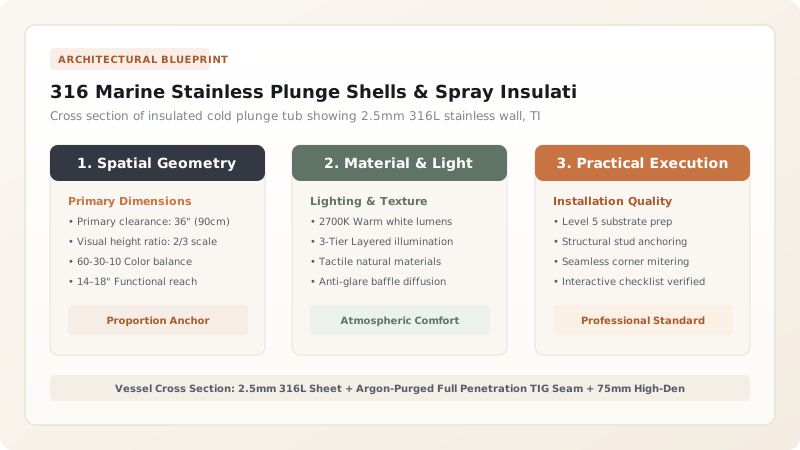
1. Stainless Metallurgy: 316L Alloy Chemistry & Sensitization Prevention
In hydrotherapy environments where water is continuously treated with ozone, sodium chloride, or hydrogen peroxide, standard 304 stainless steel fails rapidly through Chloride Stress Corrosion Cracking (CSCC) and localized pitting corrosion.
Bespoke plunge pools mandate Low-Carbon 316L Marine Stainless Steel (UNS S31603 / W.Nr. 1.4404):
- Chemical Composition: \(16.5\% \text{ to } 18.5\%\text{ Cr}\), \(10.0\% \text{ to } 13.0\%\text{ Ni}\), and \(2.0\% \text{ to } 2.5\%\text{ Mo}\). The addition of molybdenum raises the critical pitting temperature (CPT) and stabilizes the passive oxide layer.
- Low-Carbon (0.03% Max) Sensitization Prevention: In standard 316 (carbon > 0.08%), welding temperatures between 450°C and 850°C cause carbon to combine with chromium, forming Chromium Carbides (\(\text{Cr}_{23}\text{C}_6\)) along grain boundaries. This depletes chromium adjacent to the weld, causing catastrophic intergranular weld decay. 316L limits carbon to \(< 0.03\%\), completely eliminating carbide precipitation and preserving 100% corrosion resistance at all welded seams. Review master plunge design in the cold plunge pools hub.

2. Fabrication Craft: Full-Penetration TIG Welding & Electro-Polishing
To withstand the hydrostatic weight of water (400 to 600 kg) and dynamic occupant movement without flexural fatigue:
- CNC Press-Brake Forming: Tub walls and ergonomic interior benches are CNC-formed from large \(2.5\text{ mm}\) (12-gauge) sheets, minimizing welded seams by 60% through continuous radiused bends.
- Argon Back-Purged TIG Welding: All corner joints are welded using Tungsten Inert Gas (TIG) welding with matching 316L filler rod. The back of the weld joint is sealed with heat-resistant foil tape and purged with continuous 99.99% pure argon gas. Without back-purging, oxygen in the air causes the root side of the weld to burn into porous black slag ('sugaring'), creating crevice corrosion sites that leak water within years.
- Electrochemical Passivation & Polishing: Post-welding, the vessel is submerged in an electro-polishing electrolyte bath. Electrical current removes microscopic surface peaks, leaving a microscopically flat finish with surface roughness \(R_a < 0.38\, \mu\text{m}\) (15 micro-inches). Bacteria, algae, and mineral scale cannot grip this glass-like surface. Connect to titanium chillers in our guide to titanium heat pump chillers.
3. Thermal Insulation: Closed-Cell Spray Foam & Condensation Physics
Stainless steel has high thermal conductivity (\(k \approx 16\text{ W/m K}\)). Without insulation, maintaining 3°C water in a 24°C room would require continuous chiller compressor cycling, burning massive electricity while dripping liters of condensation onto subfloors.
- 32 kg/m³ (2.0 lb/cu ft) Closed-Cell Spray Polyurethane Foam (SPF): Applied in multiple passes to a continuous thickness of \(75\text{ mm}\) (3 inches) across the entire exterior shell, providing an insulation rating of \(R-21\).
- Moisture Vapor Impermeability: With a closed-cell content exceeding \(92\%\) and water vapor permeance below \(0.8\text{ perms}\), closed-cell SPF functions as its own continuous vapor barrier. Warm ambient humid air cannot contact the cold steel surface, completely eliminating the dew point boundary and ensuring 100% dry floor conditions. Learn water filtration in ozone and micron water chemistry.
Cold Plunge Vessel Insulation System Comparison
Use this reference table to calculate exact physical dimensions, ratios, and specifications before purchasing:
| Insulation Method | 2.0-lb Closed-Cell Spray Polyurethane Foam | Expanded Polystyrene (EPS) Foam Boards | Open-Cell Spray Foam (0.5-lb) |
|---|---|---|---|
| Thermal Performance per Inch | R-6.8 to R-7.1 per inch (Superior) | R-3.8 to R-4.0 per inch (Moderate) | R-3.5 per inch (Low) |
| Water Vapor Absorption | < 1.0% by volume (Hydrophobic) | 2.0% - 4.0% (Can absorb moisture) | High (> 5.0% absorbs water like sponge) |
| Seamless Air-Barrier Seal | 100% Monolithic (expands into all voids) | Requires tape (seams leak air) | Expands into voids but transmits vapor |
| Structural Shell Stiffening | Adds immense structural rigidity to tub | Zero structural contribution | Soft / spongy (zero reinforcement) |
| Sweating & Condensation Risk | Absolute Zero sweating | High risk along board seams | Severe condensation behind foam |
Vessel Fabrication & Thermal Constraints
Every successful decoration project must account for physical and environmental constraints:
Heat Distortion During TIG Welding
Austenitic stainless steel has high thermal expansion and low thermal conductivity, making large thin sheets buckle and warp severely under weld heat. Fabricators must use copper heat-sink chill bars and intermittent stitch-welding to keep tub walls flat.
Foam Shrinkage Pulling Steel Walls Inward
Applying closed-cell polyurethane foam in passes thicker than 50mm in a single lift generates high exothermic heat, causing the foam to shrink as it cools, warping thin stainless steel tub walls. Foam must be applied in controlled 25mm to 35mm lifts.
Chemical Attack from Bromine Tablets in Direct Contact
Resting concentrated chemical sanitizer tablets directly on the stainless steel floor creates extreme localized chloride concentrations (>10,000 PPM), which will pit through 2.5mm stainless steel within weeks. Sanitizers must be dosed strictly through in-line erosion feeders.
316L Stainless Plunge Shell Fabrication & Foaming
Execute this professional sequence to achieve flawless results without backtracking:
Laser Cutting & CNC Press-Brake Folding
Laser cut 2.5mm 316L stainless sheets; fold sidewalls and ergonomic interior steps with precision CNC press brake, maintaining true square within 0.5mm.
TIG Welding with Argon Back-Purging
Fit joints; seal exterior seams with aluminum backing tape; flood interior cavity with 99.99% argon purge; execute continuous full-penetration TIG welds.
Dye Penetrant Weld Inspection
Apply red dye penetrant to all welded seams; develop with white chalk powder developer to confirm 100% absence of pinholes or micro-cracks.
Surface Electro-Polishing Bath
Submerge tub shell in phosphoric/sulfuric electro-polishing bath; run electrical passivation cycle to achieve Ra < 0.4 µm mirror-satin finish.
Plumbing Bulkheads & Pressure Test
Install 316 stainless suction and return bulkhead fittings; plug ports and hydrostatically pressure-test vessel at full water load for 24 hours.
Multi-Lift Closed-Cell Spray Foam Application
Spray 2.0-lb closed-cell polyurethane foam in two 38mm lifts to achieve total 75mm continuous thickness (R-21); trim flush around plumbing connections.
Common Mistakes & Countermeasures
Avoid these costly errors that compromise aesthetics, ergonomics, and budget:
Welding Stainless Without Argon Back-Purging
Using Low-Density Open-Cell Spray Foam
Using Steel Wire Brushes to Clean Welds
Project Execution Checklist
Track your physical progress. Checkboxes persist automatically on this device:
Frequently Asked Questions
How does 316L stainless steel feel to bare skin at 3°C?
Because stainless steel has moderate thermal conductivity compared to aluminum or copper, sitting against a smooth electro-polished stainless bench feels cold initially, but as skin makes contact, a thin thermal boundary layer forms quickly. High-end custom plunge pools often incorporate smooth natural teak or thermal-treated ash headrests and rim caps for enhanced tactile comfort.
Can a stainless steel cold plunge tub be installed outdoors?
Yes! Grade 316L is the exact alloy specified for marine yacht fittings and offshore coastal structures. It is completely immune to rain, snow, freezing weather, and intense UV sunlight, making it far superior to acrylic or vinyl outdoor tubs that crack and fade under sun exposure.
Why is closed-cell spray foam better than fiberglass batts for a plunge tub?
Fiberglass batts are completely permeable to air. In a cold plunge, warm indoor air easily passes through fiberglass fibers, hits the freezing metal tub, and condenses into gallons of stagnant water, ruining the insulation. Closed-cell spray foam forms an airtight, vapor-tight monolithic skin directly bonded to the metal, making condensation physically impossible.


