
Western red cedar tongue-and-groove cladding and reflective aluminum foil vapor barriers form the high-performance thermal envelope of authentic Finnish saunas. Clear vertical-grain cedar (11mm–15mm thick) provides low thermal conductivity (0.11 W/m K) and pitch-free comfort, blind-nailed with stainless steel brads over 19mm vertical furring battens that establish a rear drainage gap over a continuous 0.05mm pure aluminum foil membrane reflecting 95% of radiant infrared heat.
At a Glance: Key Takeaways
- Clear Vertical Grain (CVG) Heartwood: Dimensionally stable timber with annual growth rings perpendicular to face, resisting warpage at 100°C.
- Thujaplicin Natural Antimicrobial: Natural cedar extractive preventing mildew, mold, and bacterial rot in high-humidity bath environments.
- Reflective Infrared Shielding: 0.05mm unbacked pure aluminum foil bouncing radiant heat back into the bathing space under Stefan-Boltzmann law.
- Rear Ventilation Drainage Gap: 19mm vertical air cavity allowing condensation behind boards to evaporate without saturating timber.
- Blind Stainless Steel Fastening: Type 304 or 316 stainless brad nails driven at 45° through the tongue, concealing metal from human contact.
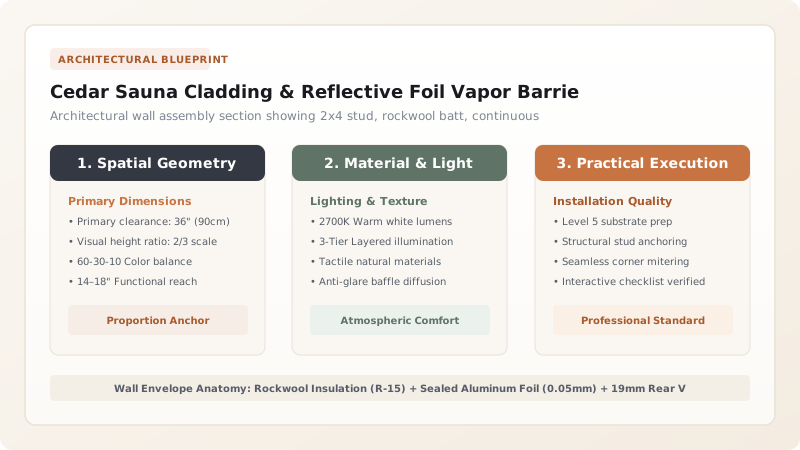
1. Wood Anatomy: Vertical Grain Growth Rings & Pitch-Free Stability
In a sauna where temperatures cycle between 20°C and 100°C with humidity swings from 10% to 90%, wood undergoes violent hygroscopic stress. Plain-sawn lumber (flat grain) cups and splits because tangential shrinkage is roughly twice radial shrinkage.
Authentic saunas specify Clear Vertical Grain (CVG) Western Red Cedar Heartwood:
- Growth Ring Orientation: Cut perpendicular to the tree's growth rings (angle >45°, ideally 80°–90°). Radial shrinkage in CVG cedar is only \(2.4\%\), compared to 5.0% for flat-sawn boards, ensuring tongue-and-groove joints stay tight without gaps or buckling.
- Zero Pitch & Resin: True cedar heartwood contains zero resin canals. Wood species like pine or fir contain pockets of rosin that liquefy at 65°C and drip scalding resin onto bathers.
- Thujaplicin Bio-Preservatives: Cedar contains natural tropolone compounds called thujaplicins, which exhibit potent natural fungicidal and antibacterial properties, inhibiting mold growth and creating cedar's legendary therapeutic aroma. Review whole sauna systems in our Finnish cedar saunas hub.

2. Thermal Shielding: Aluminum Foil Radiation Mechanics & Sealing
Standard building vapor barriers (6-mil plastic polyethylene) deteriorate rapidly when subjected to 100°C temperatures, emitting volatile plasticizers. Saunas mandate Heavy-Duty Pure Aluminum Foil (0.05mm / 50 microns):
- Low Emissivity & High Reflectivity: Polished aluminum has an emissivity coefficient of \(\epsilon = 0.05\) and reflectivity of \(\rho = 0.95\). According to Kirchhoff's Law, it reflects 95% of radiant infrared heat back into the sauna, functioning as a continuous thermal mirror that cuts heater energy consumption by up to 25%.
- Zero Permeance Envelope: Aluminum foil is a true Class 1 vapor barrier with a water vapor permeance of \(0.00\text{ perms}\). It completely blocks high-pressure steam generated during löyly bursts from penetrating exterior wall cavities.
- High-Temperature Foil Taping: Every horizontal and vertical foil lap must be overlapped by 100mm and sealed with high-temperature aluminum tape rated to 120°C (such as 3M 3340). Never use standard duct tape, which turns brittle and unglues within days. Learn rock physics in peridotite stone thermodynamics.
3. Cladding Installation: 19mm Furring Air Gap & Stainless Secret-Nailing
Nailing wooden cladding directly over aluminum foil creates a dangerous moisture trap: condensation running down the foil will soak into the rear of the cedar boards, causing black mold and rot.
- Vertical Furring Battens: 19mm x 38mm (1x2) treated or cedar battens are fastened vertically over the foil at 400mm stud centers. This creates a continuous \(19\text{ mm}\) rear air gap. Convection air circulating behind the boards keeps the back of the cedar dry and allows boards to equilibrate without bowing.
- Blind Stainless Steel Nailing: Because metal conducts heat 400 times faster than wood, an exposed screw head in a 90°C sauna will instantly burn bather skin. Boards are fastened using Type 304 or 316 Stainless Steel 18-Gauge Brad Nails driven at a 45-degree angle through the tongue (secret-nailing). The groove of the mating board covers the nail head completely, leaving zero exposed metal. Connect to bench design in our guide to tiered floating bench ergonomics.
Sauna Vapor Barrier Material Specification Matrix
Use this reference table to calculate exact physical dimensions, ratios, and specifications before purchasing:
| Vapor Barrier Type | Pure Aluminum Foil (0.05mm) | Kraft-Paper-Backed Foil | Standard 6-mil Polyethylene Plastic |
|---|---|---|---|
| Operating Temperature Rating | Up to 300°C (completely fireproof) | Up to 90°C (paper can scorch near heater) | Max 65°C (melts/off-gasses at 90°C) |
| Radiant Infrared Reflectivity | 95% - 97% reflective | 92% - 95% reflective | 0% (transmits radiant heat directly) |
| Vapor Permeance | 0.00 Perms (absolute zero vapor transmission) | 0.02 Perms (near zero) | 0.06 Perms (low) |
| Toxic Off-Gassing Risk | Zero (pure elemental metal) | Low (adhesive can emit faint odor) | Severe (releases toxic phthalates) |
| Installation Tear Resistance | High (requires careful handling) | Very High (paper adds tear strength) | High (stretches and sags) |
Envelope Installation Hazards & Constraints
Every successful decoration project must account for physical and environmental constraints:
Foil Tears from Heavy Furring Screws
Driving coarse screws through furring strips can twist and tear large holes in the aluminum foil barrier. Installers must use smooth-shank screws and tape over every screw head with aluminum tape to maintain airtight integrity.
Galvanic Corrosion of Fasteners
Using standard electro-galvanized brads or carbon steel screws in high-humidity cedar will cause rapid galvanic corrosion due to cedar's natural acidic extractives (tannins). Fasteners must be strictly Type 304 or 316 marine stainless steel.
Floor Water Wicking into Wall Boards
If cedar cladding extends all the way down to the wet tiled floor, end-grain will suck water upward via capillary action, rotting bottom boards. Cladding must terminate 100mm above the floor over a perimeter ceramic tile baseboard.
Cedar Sauna Cladding Installation Protocol
Execute this professional sequence to achieve flawless results without backtracking:
Cavity Rockwool Packing & Wall Prep
Pack stud cavities with 90mm mineral wool batts; verify rockwool sits flush with stud faces with zero gaps around electrical conduits.
Horizontal Foil Barrier Hanging
Roll out 0.05mm pure aluminum foil horizontally from floor to ceiling; overlap seams by 100mm; fasten with stainless staples at 300mm centers.
High-Temp Aluminum Seam Taping
Tape all horizontal laps, vertical seams, and perimeter corners with certified 50mm high-temp aluminum foil tape; burnish flat with plastic squeegee.
Vertical Furring Batten Installation
Screw 19mm x 38mm vertical cedar furring battens over foil directly into studs at 400mm centers using countersunk stainless screws.
Blind Tongue-and-Groove Cladding
Start cladding from bottom, tongue facing up, 100mm above floor tile; blind-nail through tongue at 45-degree angle using 18ga stainless brads.
Ceiling Cladding & Corner Trimming
Clad ceiling boards perpendicular to wall boards for visual contrast; install clean 19mm x 19mm cedar cove molding in all interior corners.
Common Mistakes & Countermeasures
Avoid these costly errors that compromise aesthetics, ergonomics, and budget:
Installing Cladding with Tongue Facing Downward
Using Face-Driven Screws on Benches or Walls
Applying Wood Stain or Water Sealers
Project Execution Checklist
Track your physical progress. Checkboxes persist automatically on this device:
Frequently Asked Questions
Why is Western red cedar better than white cedar or aromatic red cedar?
Eastern white cedar is knotty and soft, while Eastern aromatic red cedar (used for closet liners) has an overpowering pungent smell that causes respiratory irritation and eye burning in an 85°C sauna. Western red cedar (Thuja plicata) has a mild, pleasant aroma, dense vertical grain, zero pitch pockets, and unmatched dimensional stability under high heat.
Should sauna cladding be installed horizontally or vertically?
Horizontal cladding is traditional and practically superior: in a sauna, the highest thermal and moisture gradient occurs vertically. With horizontal boards, if a bottom board is ever damaged by floor water, only that single board needs replacement. Vertical cladding requires horizontal furring, which can restrict vertical rear ventilation convection.
How do you clean cedar sauna walls after years of use?
Never use bleach, harsh chemical detergents, or pressure washers. Clean cedar walls by scrubbing lightly with warm water mixed with a mild, eco-friendly oxygen bleach or baking soda, followed by a rinse with clean water. For stubborn body oil stains on benches, lightly hand-sand the wood with 120-grit sandpaper to reveal fresh, fragrant cedar timber.


