
An architectural cold plunge pool is a high-performance hydrotherapy vessel engineered to maintain constant sub-ambient water temperatures between 3°C and 8°C (37°F–46°F) for rapid physical recovery and vascular vasoconstriction. Constructed from electro-polished 316L marine-grade stainless steel enveloped in 75mm of high-density closed-cell polyurethane spray foam (R-21), it is driven by an outdoor titanium heat exchanger chiller unit paired with continuous magnetic-drive circulation, 20-micron pleated filtration, and CD corona discharge ozone sanitization.
At a Glance: Key Takeaways
- 316L Marine Stainless Shell: 2.5mm thick low-carbon austenitic stainless steel with molybdenum additions resisting pitting corrosion from sanitizer salts.
- Closed-Cell Thermal Envelope: Seamless 75mm spray-applied polyurethane foam preventing surface sweating and thermal heat gain from ambient room air.
- Titanium Coaxial Heat Exchangers: Pure titanium cooling barrels immune to chemical chlorine/ozone erosion, maintaining steady 38°F (3.3°C) water.
- Chemical-Free Corona Ozone: High-output corona discharge ozone generator dissolving O3 via Venturi injectors to destroy bacteria and body oils without chlorine smell.
- Continuous Low-Wattage Circulation: Whisper-quiet magnetic-drive pump providing laminar, non-turbulent water flow (sound < 32 dBA) at 45 Watts.
In-Depth Guides in this Directory
Explore specialized subtopic blueprints, technical dimensions, and execution checklists:
316 Marine Stainless Plunge Shells & Spray Insulation
Vessel manufacturing guide for luxury cold plunges: 316L austenitic stainless steel sheet metal forming, TIG argon purge welding, electro-polishing, and R-21 closed-cell polyurethane foam.
Titanium Plunge Chillers: Heat Exchangers & 38°F Water Physics
Thermodynamics guide for cold plunge chillers: coaxial titanium heat exchangers, variable inverter compressors, anti-freeze freeze-stat protection, and 38°F (3°C) water enthalpy.
Cold Plunge Water Chemistry: Ozone & Micron Filtration
Water quality engineering guide for cold plunge pools: corona discharge ozone oxidation potential (ORP), Kynar Venturi injectors, 20-micron pleated core filtration, and biofilm eradication.
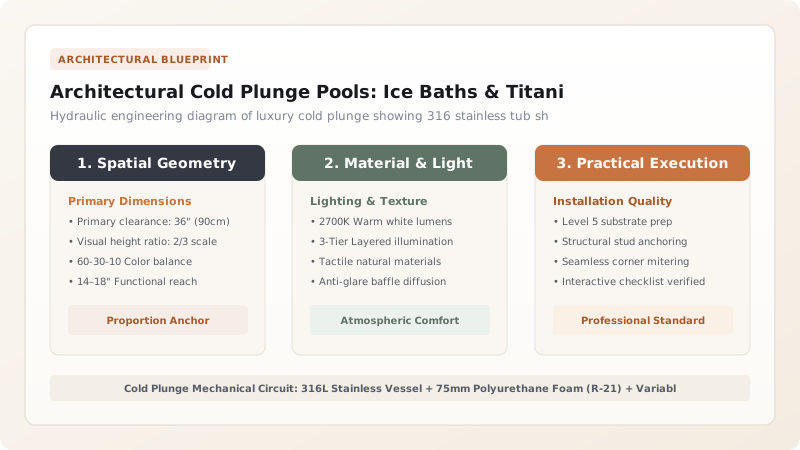
1. Vessel Architecture: 316L Marine Stainless Steel & Thermal Shells
Unlike portable acrylic or plastic tubs that scratch, degrade under UV exposure, and harbor bacterial biofilms in porous joints, permanent architectural cold plunge pools utilize 316L Low-Carbon Marine Stainless Steel (EN 1.4404 / UNS S31603):
- Molybdenum Passivation Layer: 316L contains \(2.0\% \text{ to } 2.5\%\) molybdenum and 17% chromium. This forms a self-healing passive chromium-molybdenum oxide film (\(\text{Cr}_2\text{O}_3\)) that resists chloride pitting corrosion (Pitting Resistance Equivalent Number \(\text{PREN} \ge 24\)).
- TIG Fusion Welding & Electro-Polishing: Vessel seams are fully TIG-welded using 316L filler rod under 99.99% argon gas backing purge. The interior is electro-polished to an architectural satin or mirror finish (\(R_a < 0.4\, \mu\text{m}\)), leaving a non-porous surface where bacteria cannot adhere.
- 75mm High-Density Closed-Cell Spray Foam: Holding 400 liters of 3°C water in a 22°C room creates an immense thermal gradient. Without insulation, the metal tub will sweat gallons of condensation, rotting surrounding subfloors. The tub exterior is enveloped in \(75\text{ mm}\) of closed-cell polyurethane foam (R-21 minimum), completely isolating the steel shell. Learn shell fabrication in our guide to 316 stainless tub shells and insulation.

2. Thermal Engineering: Titanium Heat Pumps & 38°F (3°C) Water Physics
Cooling water to near-freezing requires substantial thermodynamic lift. Standard residential pool heat pumps cannot operate below 15°C (59°F) because their evaporator coils freeze into a solid block of ice.
Dedicated cold plunge chillers utilize Low-Temperature Titanium Inverter Chillers:
- Coaxial Titanium Heat Exchangers: Titanium (Grade 2) has zero chemical reactivity with ozone, bromine, or salt-based sanitizers. Inside the heat exchanger barrel, water flows through a spiral fluted titanium tube surrounded by evaporating R410A refrigerant.
- Thermal Heat Pull-Down Formula: The required cooling capacity \(Q_{\text{chill}}\) to pull down a tub volume \(V = 400\text{ L}\) from ambient \(T_1 = 20^\circ\text{C}\) to plunge setpoint \(T_2 = 4^\circ\text{C}\) over \(t = 4\text{ hours}\) is:
Modern chillers employ variable-speed DC inverter compressors that ramp down to 250 Watts once target temperature is reached, maintaining water within \(\pm 0.2^\circ\text{C}\) indefinitely. Discover chiller mechanics in our deep dive on titanium heat pump chillers. Contrast with Finnish hot saunas in Finnish cedar saunas.
3. Water Purity: Corona Discharge Ozone & Micron Filtration
Cold water inhibits bacterial growth compared to warm hot tubs, but skin oils, sweat, and dead skin cells accumulate rapidly. However, bathers dislike entering water that smells like harsh swimming pool chlorine.
Architectural cold plunge installations maintain crystal-clear water using an advanced Dual-Stage Non-Chemical Sanitation Loop:
- High-Output Corona Discharge (CD) Ozone: Atmospheric air passes through an electric arc corona cell, generating ozone (\(\text{O}_3\)). Injected into the plumbing via a Kynar Venturi injector, ozone is one of the most powerful oxidizers known—reacting 3,000 times faster than chlorine to lyse bacterial cell walls and oxidize dissolved organic oils. It breaks down back into pure oxygen (\(\text{O}_2\)), leaving zero chemical residue or odor.
- 20-Micron Pleated Core Filtration: High-capacity pleated polyester cartridge filters capture fine suspended particulate matter down to 20 microns. Supplemented by an auxiliary 254nm germicidal Ultraviolet (UV-C) sterilizer, the water remains sterile and crystal-clear for 3 to 6 months per water fill. Learn water chemistry in ozone and micron filtration.
Cold Plunge Tub Shell Material Comparison
Use this reference table to calculate exact physical dimensions, ratios, and specifications before purchasing:
| Vessel Construction | 316L Marine Stainless Steel | Custom Concrete & Glass Mosaic Tile | Rotomolded Polyethylene Plastic |
|---|---|---|---|
| Lifespan & Durability | 50+ years (indefinite marine life) | 25 to 40 years (grout requires maintenance) | 5 to 8 years (cracks, fades, warps) |
| Aesthetic Integration | Luxury architectural satin/mirror steel | Monumental stone/spa aesthetic | Commercial portable ice tub look |
| Condensation Control | Seamless spray foam prevents sweating | Requires thick exterior insulation | Thin single-wall; sweats heavily |
| Sanitizer Resistance | Impervious to ozone, salt, and peroxide | Grout can dissolve under acidic sanitizers | Absorbs odors and body oils over time |
| Weight (Empty 400L Tub) | 75 - 95 kg (lightweight installation) | 450 - 700 kg (heavy structural dead load) | 35 - 50 kg (lightweight) |
Hydraulic & Condensation Engineering Constraints
Every successful decoration project must account for physical and environmental constraints:
Subfloor Condensation Damage from Cold Bridging
If any metal mounting bracket or uninsulated plumbing pipe directly contacts the wooden floor framing, cold conduction chills the wood below the room dew point, creating hidden pools of water that rot structural joists. Every structural mount must incorporate high-density neoprene thermal break pads.
Chiller Ice-Block Freezing Hazard
If water circulation pump fails while the chiller compressor continues running, water inside the titanium heat exchanger barrel will freeze solid. Water expands 9% upon freezing, bursting internal pipes. The chiller must have a mechanical paddle flow switch interlocked to shut down compressor power instantly if flow drops below 15 L/min.
Indoor Chiller Heat Rejection
A cold plunge chiller does not destroy heat; it extracts heat from water and rejects it into the surrounding air (typically 2.5 kW of heat). Operating a chiller inside a small unventilated bathroom will overheat the room to 35°C. Chillers must be ducted to the exterior or located outdoors.
Architectural Cold Plunge Installation Sequence
Execute this professional sequence to achieve flawless results without backtracking:
Subfloor Reinforcement & Drainage Core
Reinforce floor joists to support 600 kg operating weight (water + tub + bather); core drill 50mm floor penetration for gravity drain line.
316L Stainless Vessel Placement & Leveling
Position electro-polished stainless steel vessel on 15mm neoprene vibration isolation pads; level vessel with digital transit to within 1.0mm.
Closed-Cell Polyurethane Foam Spray
Spray 75mm of 32 kg/m³ high-density closed-cell polyurethane foam across the entire exterior shell underside and plumbing stub-outs.
Plumbing Circuit & Titanium Chiller Tie-In
Run insulated Schedule 40 PVC plumbing loops to exterior or plant-room chiller; install magnetic-drive pump, 20-micron filter, and Venturi injector.
Ozone Generator & UV-C Integration
Mount corona discharge ozone unit with check-valve loop above water level; wire into continuous 24/7 auxiliary circulation circuit.
Hydraulic Pressure Test & Pull-Down Commissioning
Fill with fresh water; pressure-test piping at 30 PSI for 2 hours; activate chiller; log pull-down curve from 20°C to 4°C (39°F) and calibrate PID thermostat.
Common Mistakes & Countermeasures
Avoid these costly errors that compromise aesthetics, ergonomics, and budget:
Using 304 Stainless Steel Instead of 316L
Locating Chiller in an Enclosed Cupboard Without Airflow
Using Standard Hot-Tub Foam Insulation
Project Execution Checklist
Track your physical progress. Checkboxes persist automatically on this device:
Frequently Asked Questions
What is the optimal water temperature for cold plunge therapy?
Clinical hydrotherapy and sports science studies show that water temperatures between 3°C and 10°C (38°F–50°F) provide maximum physiological benefits: rapid vasoconstriction, norepinephrine release, dopamine elevation, and systemic inflammation reduction. For experienced practitioners, 3°C to 5°C (38°F–41°F) for 2 to 3 minutes is the recognized benchmark.
How often does the water in a cold plunge pool need to be changed?
With a high-performance continuous sanitation system (continuous 20-micron pleated filtration combined with corona discharge ozone and UV-C sterilization), water remains clean and clear for 3 to 6 months between drain-and-refill cycles, requiring only occasional top-offs for evaporative loss.
Why is stainless steel preferred over tiled concrete for cold plunge tubs?
Stainless steel cools down quickly, provides an ultra-hygienic non-porous surface that inhibits biofilm growth, and is completely immune to tile popping caused by thermal expansion stress. Furthermore, a stainless steel vessel weighs only 80 kg empty (versus 600+ kg for concrete), making it much easier to install on upper residential floors or timber decks.


