
Submerged recirculating water pumps and anti-turbulence baffles are the mechanical hydraulic systems that circulate water through formal rills without surface disturbance. Utilizing low-voltage variable-speed brushless magnetic-drive pumps operating at low head pressures, water enters a submerged calming chamber fitted with perforated 316 stainless steel flow-straightening baffles (40% porosity) that dissipate kinetic vortex energy, ensuring water enters the canal in a subcritical laminar regime (Froude number < 0.3) for a glassy, mirror-like reflection.
At a Glance: Key Takeaways
- Laminar Streamline Transition: Flow baffles converting chaotic rotating pump vortices into smooth, parallel hydraulic vectors.
- Subcritical Froude Number (Fr < 0.3): Operating well below critical velocity to eliminate standing waves and surface rippling.
- Brushless Magnetic-Drive Pumps: Rare-earth permanent magnet impellers eliminating motor drive shafts and mechanical seals for 50,000+ hour life.
- Subterranean Pump Vault Decoupling: Housing pumps in dedicated recessed vaults isolated on rubber dampeners to achieve inaudible sound (<28 dBA).
- Variable-Frequency Drive (VFD) Calibration: Dialing in water velocity down to 0.1 m/s with digital potentiometer accuracy.
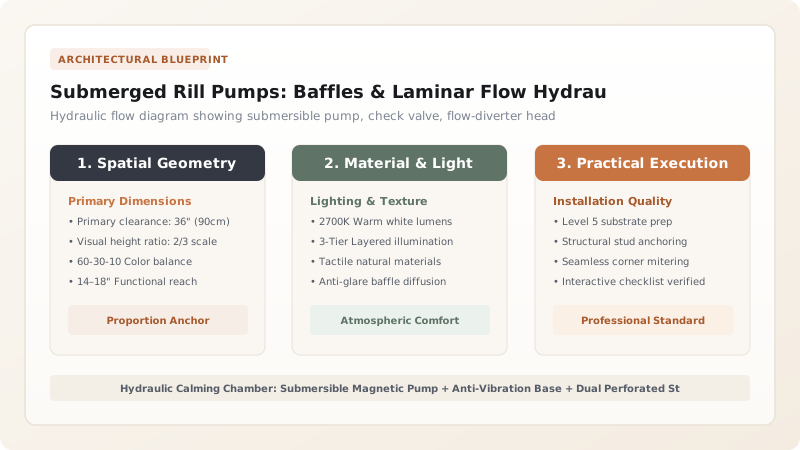
1. Hydrodynamics: The Froude Number & Laminar Streamline Equations
In open channel fluid mechanics, the flow regime is categorized by the dimensionless Froude Number (\(Fr\))—the ratio of flow inertia to gravitational wave speed:
Where \(V\) is water velocity (m/s), \(g\) is gravity (\(9.81\text{ m/s}^2\)), and \(D_h\) is hydraulic depth (flow area divided by top water surface width). Three distinct hydraulic regimes exist:
- Supercritical Flow (\(Fr > 1.0\)): High velocity; creates standing shockwaves, surface boiling, and white-water rapids. Disastrous for a formal rill.
- Critical Flow (\(Fr = 1.0\)): Unstable flow; causes hydraulic jumps and oscillating surface waves.
- Subcritical Laminar Flow (\(Fr < 0.3\)): Gravitational wave speed exceeds flow velocity. Any small ripple created by a leaf or insect moves faster than the flow and dissipates instantly into the water mass. In a formal rill with depth \(D = 0.2\text{m}\), the critical wave speed is \(c = \sqrt{g D} \approx 1.4\text{ m/s}\). Calibrating water velocity to \(V = 0.10\text{ to } 0.15\text{ m/s}\) yields \(Fr \approx 0.08\text{ to } 0.11\)—producing a completely glassy, undisturbed mirror surface. Review master rill design in the formal rills hub.

2. Baffle Design: Flow Straighteners & Porous Plate Hydraulics
A water pump discharges water as a high-velocity jet surrounded by turbulent rotating vortices. If pumped directly into a rill, this jet erupts as a boiling surface mound.
This kinetic energy is neutralized in an engineered Submerged Calming Chamber:
- Expansion Chamber: Water enters an oversized head basin (width = 1.5x rill width, depth = 2x rill depth), immediately cutting jet velocity by 60% through volumetric expansion.
- Dual Perforated Baffles: Two parallel plates of 316 stainless steel (2.0mm thick) with staggered 6mm perforations (\(40\%\) open area porosity) are placed 150mm apart across the flow path.
- Vortex Shedding & Dissipation: As turbulent water passes through the thousands of micro-orifices, the large rotating eddies are shattered into microscopic micro-eddies that dissipate kinetic energy as heat (viscous dissipation). Water emerges from the second baffle as a perfectly uniform, parallel velocity profile. Learn weir leveling in precision basalt rill troughs.
3. Pump Mechanics: Brushless Magnetic Drives & Acoustic Vaults
In luxury landscape gardens, mechanical motor whine or humming destroys tranquility. Pump systems must be completely silent:
- Brushless Magnetic-Drive Technology: Traditional pumps have drive shafts passing through mechanical rubber seals that eventually leak and rattle. Magnetic-drive pumps use an encapsulated synchronous motor that drives the impeller through magnetic attraction across a hermetic ceramic barrier. With only one moving part riding on a Silicon Carbide (SiC) hydrodynamic bearing, sound emissions stay below \(26\text{ dBA}\).
- Subterranean Equipment Vault: The pump, pre-filter, and check valves are housed in a separate underground concrete vault located 3 to 5 meters away from the rill, fully decoupled via flexible reinforced EPDM rubber pipe couplers that block structural vibration transmission. Discover fiber optic integration in aquatic lily pockets and fiber optics.
Water Feature Pump Technology Comparison
Use this reference table to calculate exact physical dimensions, ratios, and specifications before purchasing:
| Pump Technology | Submersible Magnetic-Drive Pump | Direct-Drive Sump / Fountain Pump | External Flooded-Suction Centrifugal Pump |
|---|---|---|---|
| Acoustic Noise Level | < 28 dBA (virtually inaudible) | 48 - 60 dBA (loud mechanical hum) | 52 - 68 dBA (requires acoustic enclosure) |
| Laminar Flow Control | Excellent (smooth variable DC speed) | Poor (fixed speed; turbulent surge) | Excellent (via variable frequency drive) |
| Electrical Efficiency | Very High (40W - 120W DC brushless) | Moderate (180W - 450W AC motor) | Moderate (350W - 750W induction) |
| Shaft Seal Leak Risk | Zero (100% hermetically sealed) | High (mechanical seal wears out) | High (seal leaks over time) |
| Operating Lifespan | 50,000+ hours continuous duty | 8,000 - 15,000 hours | 20,000 - 35,000 hours |
Hydraulic Installation Hazards & Constraints
Every successful decoration project must account for physical and environmental constraints:
Baffle Clogging from Filamentous Algae
Fine 6mm holes in perforated baffle plates can become blanketed in string algae within 3 weeks during summer, restricting flow and starving the rill. Baffle plates must be mounted in slide-out U-channels for tool-free removal and pressure-washing.
Air Sucking into Pump Suction (Vortex Ingestion)
In shallow discharge sumps, the pump intake can form a spinning vortex (whirlpool) that sucks air into the impeller, causing cavitation rattle and blowing frothy air bubbles down the rill. An anti-vortex baffle plate must sit over the suction port.
Pipe Friction Loss in Long Return Runs
Pumping water back 30 meters through narrow 1-inch pipe creates high dynamic head loss, forcing pumps to run at high RPMs that generate noise. Return lines must be upsized to minimum 50mm (2-inch) smooth-wall Schedule 40 PVC.
Submerged Pump & Baffle Commissioning Sequence
Execute this professional sequence to achieve flawless results without backtracking:
Baffle Channel Mounting & Level Verification
Anchor 316 stainless steel U-channels to head pool concrete walls using stainless wedge anchors; verify vertical plumb with level.
Perforated Baffle Plate Insertion
Slide dual 2.0mm perforated stainless baffle plates (40% porosity) into U-channels; verify 150mm separation distance between plates.
Subterranean Pump Vault Plumbing
Set magnetic-drive pump on 25mm thick neoprene vibration isolation mat in vault; plumb 50mm Schedule 40 PVC supply and return lines with flexible rubber unions.
Cartridge Pre-Filter & Check Valve Installation
Install 50-mesh washable pre-filter and spring-loaded silent check valve on pump discharge line; verify direction of flow.
Water Filling & Air Purging
Fill rill system with water; open bleed valves on pump housing to purge all trapped air; verify prime before starting motor.
VFD Tuning & Froude Number Calibration
Power pump; adjust digital speed controller until water velocity in the rill stabilizes at 0.12 m/s; verify zero surface ripples and mirror reflection.
Common Mistakes & Countermeasures
Avoid these costly errors that compromise aesthetics, ergonomics, and budget:
Discharging Pump Directly into the Rill Channel
Using Undersized Return Pipe
Omitting Anti-Vibration Isolators Under the Pump
Project Execution Checklist
Track your physical progress. Checkboxes persist automatically on this device:
Frequently Asked Questions
How much electricity does a rill circulation pump consume?
Because architectural rills operate at very low flow velocities and minimal head pressure (typically 1 to 2 meters of head), high-efficiency magnetic-drive DC pumps consume only 50 to 120 Watts—equivalent to a standard incandescent light bulb, costing less than $0.35 per day in continuous operation.
What happens if a power failure occurs?
When power cuts, water flow ceases and water in the rill settles into a stationary reflecting pool. High-end systems feature spring-loaded check valves that prevent water in the elevated rill from siphoning backward into the subterranean pump vault, ensuring the rill remains full at all times.
How do you control water speed in the rill?
Water speed is regulated using an electronic Variable Frequency Drive (VFD) or 0–10V DC potentiometer connected to the pump motor. By turning a dial in the pump vault (or via smartphone automation), you can adjust water velocity from an imperceptible 0.05 m/s glassy drift up to a gentle 0.20 m/s flow.


