
Submerged linear fiber optics and aquatic water lily pockets integrate illumination and botanical life into formal rill canals without disrupting their crisp linear geometry. Continuous 10mm side-emitting glass fiber optic cables (carrying zero electrical voltage in water) are concealed in stone coping rebates to cast a continuous, uniform horizontal light beam across the water, while cast concrete planter pockets recessed into the canal floor allow dwarf water lilies (Nymphaea) to flourish without obstructing surface water flow.
At a Glance: Key Takeaways
- Zero In-Water Electrical Voltage: Pure light transmitted through optical glass fibers; all electrical drivers and lamps located in remote dry vaults.
- Side-Emitting 10mm Solid Core: Continuous 360-degree linear light discharge eliminating spotty LED point sources along the canal edge.
- Recessed Sub-Floor Planter Boxes: 200mm deep concrete recesses in rill beds keeping plant containers completely flush with the floor.
- Dwarf Water Lily (Nymphaea) Cultivars: Miniature non-invasive varieties maintaining floating pads that do not crowd the narrow linear water sheet.
- Heavy Clay Substrate with Gravel Cap: High-density aquatic loam capped with washed river basalt gravel preventing soil clouds in the water.
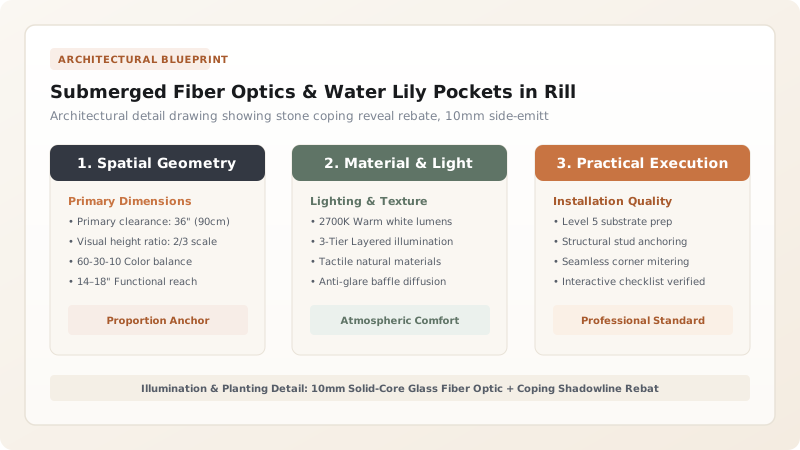
1. Optical Engineering: Side-Emitting Glass Fibers & Zero-Voltage Safety
Traditional underwater lighting relies on 12V or 120V LED niche fixtures. In narrow formal water rills, LED fixtures are unsightly, create blinding focal glare, and present electrical shock hazards if water seals fail.
Architectural rills utilize Side-Emitting Solid-Core Fiber Optics:
- Zero In-Water Electricity: Fiber optic cables carry pure photons of light—zero electricity, zero heat, and zero voltage in the water. The light source (a high-CRI 3000K LED or metal-halide illuminator) is located in a dry plant room up to 20 meters away, completely eliminating any risk of electrocution.
- Side-Emitting Core Physics: Unlike telecommunications fibers that transmit light longitudinally via total internal reflection, side-emitting cables utilize a \(10\text{ mm}\) flexible optical polymer or glass core doped with microscopic scattering particles. Light rays scatter continuously along the entire cable length, creating a continuous, seamless neon-like ribbon of light.
- Coping Rebate Integration: The cable is clipped into a continuous \(15\text{ mm} \times 15\text{ mm}\) shadowline rebate cut into the underside of the black basalt coping stones 25mm below the water surface, shining horizontally across the water with zero upward glare. Review rill stonecraft in precision basalt rill troughs.

2. Biophilic Engineering: Submerged Planter Pockets & Soil Capping
If aquatic plants are placed in standard plastic pots resting on the rill floor, the pots look cluttered, get knocked over by water flow, and leak muddy compost into the clean water.
Formal rills incorporate Cast-in-Place Planting Pockets:
- Flush Floor Depressions: During concrete trough casting, square recesses (\(400\text{ mm} \times 400\text{ mm} \times 200\text{ mm}\) deep) are cast into the floor slab. Removable heavy stainless mesh planting baskets fit flush into these pockets, leaving the main rill floor completely flat and unobstructed.
- Heavy Mineral Aquatic Loam: Never use potting soil, peat moss, or organic compost—they float, rot, and release massive nitrogen loads that trigger catastrophic green algae blooms. Plants are potted in heavy, unfertilized alluvial clay loam mixed with 20% coarse sand.
- Heavy Basalt Pea Gravel Cap: The soil surface is sealed with a \(30\text{ mm}\) layer of double-washed 10mm basalt gravel. This heavy stone cap prevents water currents and fish from disturbing the soil, keeping the water crystal-clear. Learn flow dynamics in submerged recirculating pumps.
3. Botanical Selection: Miniature Nymphaea Cultivars & Surface Balance
Standard pond water lilies grow enormous pads (300mm–450mm across) with 2-meter spreads that will choke a narrow 600mm rill within weeks. Restorers select exclusively Pygmy / Dwarf Water Lily Cultivars:
- Nymphaea 'Pygmaea Helvola': Tiny sulfur-yellow star-shaped blossoms with miniature mottled green-bronze leaves barely \(50\text{ mm}\) in diameter. Thrives in shallow water (150mm–250mm depth).
- Nymphaea 'Pygmaea Rubra': Deep ruby-red miniature blossoms that open in morning sunlight and float flat on the water surface.
- The 30% Surface Coverage Rule: Aquatic plants must never cover more than \(25\% \text{ to } 30\%\) of the total rill water surface. The remaining 70% must remain open water to preserve the mirror reflection that defines formal water architecture. Review whole canal systems in our formal rills hub.
Rill Waterway Lighting Technology Comparison
Use this reference table to calculate exact physical dimensions, ratios, and specifications before purchasing:
| Lighting Technology | Solid-Core Side-Emitting Fiber Optics | Submersible Low-Voltage LED Tape (IP68) | Traditional 12V LED Spotlights |
|---|---|---|---|
| Electrical Current in Water | Absolute Zero (100% optical light) | 12V / 24V DC running in water | 12V AC/DC running in water |
| Visual Lighting Effect | Continuous, seamless glowing ribbon | Continuous (can show diode hot spots) | Harsh localized spot cones |
| Cable Profile Dimensions | 10mm slim circular flexible cable | 12mm x 6mm rectangular ribbon | 75mm - 120mm bulky fixture canisters |
| Maintenance Accessibility | Change lamp in remote dry vault | Requires draining rill to replace tape | Requires pulling fixture from niche |
| Expected Service Life | 25+ years (glass fiber never degrades) | 3 to 5 years (water seals degrade) | 5 to 8 years |
Lighting & Botanical Constraints
Every successful decoration project must account for physical and environmental constraints:
Fiber Optic Attenuation Over Long Runs
Side-emitting fiber optic cables lose light intensity over distance. If a single run exceeds 15 meters, the far end of the cable will appear significantly dimmer than the light-source end. Runs longer than 15 meters must be illuminated from both ends using dual-port illuminators.
Deoxygenation Under Heavy Lily Coverage
Allowing water lily pads to completely cover the rill prevents atmospheric oxygen exchange and sunlight penetration, causing stagnant water and foul odors. Pads must be trimmed back monthly to maintain 70% open reflective water.
Winter Frost Freezing Planting Crowns
In severe freezing zones, a shallow 200mm rill will freeze solid to the bottom, killing tropical or tender water lily rhizomes. Dwarf hardy lilies must be selected, or planting baskets lifted out in autumn and stored in cool damp peat moss.
Fiber Optic & Aquatic Planting Installation Sequence
Execute this professional sequence to achieve flawless results without backtracking:
Subterranean Illuminator Vault Installation
Install weatherproof, ventilated equipment box in adjacent garden bed; mount high-output 150W LED fiber optic illuminator with DMX controller.
PVC Conduit Sweeps & Fiber Pulling
Run 32mm smooth-bore rigid PVC conduit with sweeping 90-degree bends from vault into rill head; pull 10mm side-emitting fiber cable using nylon fish tape.
Coping Rebate Track Clipping
Fasten UV-stable clear polycarbonate mounting track inside stone coping rebate 25mm below waterline; snap fiber optic cable into track securely.
Concrete Planting Pocket Preparation
Clean recessed planting pockets in rill floor; place geotextile lining fleece inside stainless steel wire aquatic baskets.
Aquatic Loam & Rhizome Potting
Pot dwarf Nymphaea rhizomes at 45-degree angle in heavy clay loam; press slow-release aquatic fertilizer tab into soil; cap with 30mm washed basalt gravel.
Submersion & Nocturnal Lux Verification
Lower baskets into recessed floor pockets; fill rill; illuminate fiber optics at dusk; verify continuous shadow-free linear glow along both stone coping edges.
Common Mistakes & Countermeasures
Avoid these costly errors that compromise aesthetics, ergonomics, and budget:
Using Organic Garden Potting Soil for Lilies
Bending Fiber Optic Cable Around Sharp 90° Corners
Selecting Standard Full-Size Water Lily Cultivars
Project Execution Checklist
Track your physical progress. Checkboxes persist automatically on this device:
Frequently Asked Questions
Can fish (such as koi or goldfish) live in an architectural rill with water lilies?
Small ornamental fish (such as minnows, Japanese Medaka ricefish, or small comets) thrive in formal rills and provide natural mosquito control by eating insect larvae. Large koi, however, should be avoided: they grow up to 60cm long, require deep water (minimum 1 meter), and will aggressively dig up water lily roots, muddying the water.
How long does a fiber optic illuminator bulb last?
Modern solid-state LED fiber optic illuminators have an operating lifespan of 50,000 to 70,000 hours. In typical evening use (4 to 5 hours per night), the LED light engine will operate reliably for over 30 years without bulb replacement.
Do water lilies need full sun to produce flowers?
Yes. Most Nymphaea cultivars require at least 5 to 6 hours of direct, unfiltered sunlight per day to produce abundant blooms. In shaded courtyard rills, water lilies can be replaced with shade-tolerant aquatic foliage plants, such as miniature sweet flag (Acorus gramineus) or dwarf water clover (Marsilea quadrifolia).


