
Precision-level basalt-edged rill troughs and surface tension weirs are high-tolerance civil masonry assemblies engineered to create glass-smooth linear water sheets. By setting dense, flame-textured black basalt coping stones with optical rotary laser transits to a tolerance of ±0.5mm across runs up to 30 meters, the water level rises to the exact stone edge, where capillary surface tension forms an unbroken meniscus that spills silently without splashing.
At a Glance: Key Takeaways
- ±0.5mm Surveying Tolerance: Rotary laser transits establishing absolute level across long garden axes to eliminate dry weir zones.
- Flame-Finished Black Basalt: Dense volcanic rock (2,900 kg/m³) with fine crystalline texture providing micro-surface tension grip for water sheets.
- Underside Capillary Drip Kerfs: 6mm saw-cut grooves on the stone underside breaking capillary tracking and preventing water from weeping down wall faces.
- Two-Part Epoxy Setting Beds: Non-shrink high-bond structural epoxy mortar resisting water submersion without efflorescence or bond failure.
- Pure Polyurea Seamless Lining: Hot-spray polyurea membrane bridging across concrete hairline cracks with 400% elongation capacity.
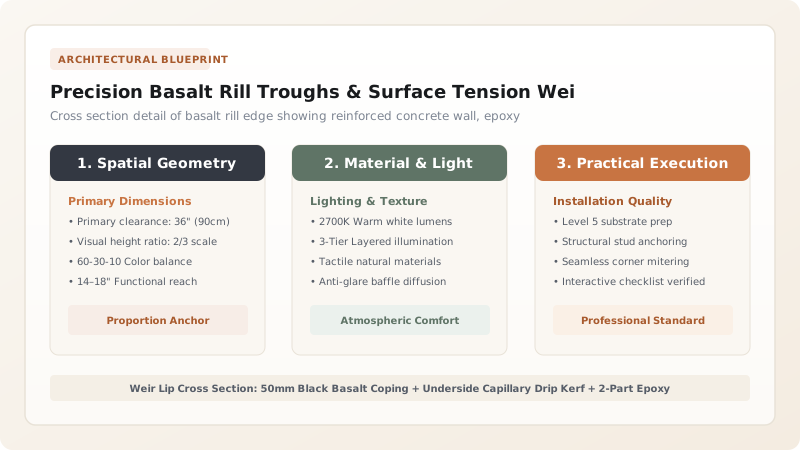
1. Fluid Mechanics: Capillary Meniscus & Surface Tension Weir Physics
An architectural infinity weir functions by balancing gravitational head against the Surface Tension of Water (\(\gamma = 0.0728\text{ N/m}\) at 20°C). As water gently rises to the edge of a flat stone coping, the water molecules adhere to the hydrophilic mineral surface of the stone, forming a convex Meniscus:
The maximum height \(h_{\text{max}}\) that water can rise above the stone lip before spilling over is governed by the Young-Laplace Equation:
Where \(R\) is the radius of curvature of the water meniscus. Because \(h_{\text{max}}\) is barely \(2.0\text{ to } 3.0\text{ mm}\), any deviation in the stone level exceeding \(0.5\text{ mm}\) will cause the water to spill prematurely at the low spot, while the high spot remains dry.
By achieving sub-millimeter level across the entire stone coping, the water forms a continuous, unbroken liquid sheet that flows uniformly along the entire perimeter. Review master rill planning in our formal rills hub.

2. Stone Stereotomy: Flame-Finished Basalt & Anti-Capillary Drip Kerfs
Selecting the coping stone is critical for long-term weir performance:
- Flame-Finished Black Basalt / Granite: Basalt is a dense igneous volcanic rock with compressive strength exceeding \(160\text{ MPa}\) and near-zero water absorption (\(< 0.3\%\)). The top face is thermal flame-finished, creating a delicate, micro-textured crystalline texture that grips the water film evenly.
- Precision Diamond-Sawn Weir Edges: The leading weir edge is precision diamond-sawn with a crisp \(2\text{ mm}\) pencil-round radius. A sharp 90° edge chips easily, while a large roundover creates unpredictable water tracking.
- Underside Anti-Capillary Drip Kerf: If water rolls over a stone edge, surface tension can cause it to track backward along the underside of the stone. A \(6\text{ mm}\) wide by \(6\text{ mm}\) deep saw-cut kerf is cut into the stone underside 20mm behind the leading edge. When water reaches this air gap, surface tension breaks, forcing water to drop straight down into the collection basin. Learn pump hydraulics in submerged recirculating pumps.
3. Structural Waterproofing: Monolithic Concrete & Polyurea Liners
A 30-meter long narrow canal expands and contracts seasonally. If built with standard masonry blocks, movement will open joint cracks, leaking thousands of liters into foundation subsoil:
- Monolithic C35/45 Concrete Trough: Cast as a continuous reinforced concrete channel with internal rebar cages tying the walls to the base slab. Hydrophilic bentonite waterstop cords are cast into all cold joints.
- Seamless Hot-Sprayed Polyurea: The trough interior is coated with a \(2.5\text{ mm}\) seamless pure polyurea elastomeric liner. Applied at 70°C under high pressure, polyurea cures in 30 seconds into a continuous rubbery skin with 400% elongation capacity, permanently bridging across any micro-cracks in the concrete. Explore aquatic lighting in aquatic lily pockets and fiber optics.
Water Rill Coping Stone Comparison
Use this reference table to calculate exact physical dimensions, ratios, and specifications before purchasing:
| Coping Stone Material | Flame-Finished Black Basalt | Honed Roman Travertine | Cast Architectural Concrete |
|---|---|---|---|
| Density & Porosity | 2,900 kg/m³ (< 0.3% porosity) | 2,450 kg/m³ (4% - 6% porosity) | 2,300 kg/m³ (porous without sealer) |
| Surface Tension Weir Uniformity | Superior (uniform micro-crystalline texture) | Moderate (vugs create uneven flow) | Poor (air pockets disrupt water film) |
| Algae Staining Visibility | Low (dark black stone hides organic film) | High (green algae stains white stone) | Medium (discolors gray cement) |
| Freeze-Thaw Resistance | Impervious (Class 1 severe frost) | High (honed grade) | Vulnerable to scaling without sealers |
| Long-Term Level Stability | Zero movement (rigid volcanic rock) | High stability | Prone to creep deflection over long spans |
Weir Leveling & Construction Constraints
Every successful decoration project must account for physical and environmental constraints:
Mortar Shrinkage Pulling Stones Out of Level
Setting heavy basalt stones on standard wet cement mortar allows mortar shrinkage to drop stones by 1mm to 2mm as water hydrates, ruining the laser level. Stones must be set using non-shrink, high-strength structural epoxy mortars with leveling shim blocks.
Soil Frost Heave Raising Rill Sections
In freezing climates, frost penetration beneath the rill foundation will heave sections of the trough upward by 10mm, cracking concrete and permanently destroying the weir level. Trough foundations must extend below the local regional frost line.
Wind-Blown Surface Tension Detachment
A gentle 10 mph breeze blowing against the weir edge exerts aerodynamic pressure that overcomes the water meniscus, pushing water away from the lip and causing dry weir gaps. Weir water depth must be tuned to at least 3mm over the crest.
Precision Basalt Rill Coping Installation Protocol
Execute this professional sequence to achieve flawless results without backtracking:
Foundation Benchmark Laser Setup
Erect high-precision rotary laser transit on rigid tripod; establish master level benchmark datum at the head of the rill trench.
Concrete Wall Preparation & Grinding
Grind top edges of reinforced concrete rill walls dead flat; clean with high-pressure air blast to remove all dust.
Shimming & Dry-Fit Layout
Dry-fit 1.0m basalt coping sections over non-compressible composite leveling shims; adjust shims until digital laser receiver reads 0.0mm at every joint.
Structural Epoxy Bedding Injection
Lift stone sections; butter wall top with two-part moisture-insensitive structural epoxy mortar; press stone firmly onto calibrated shims.
Micro-Joint Alignment & Clamping
Maintain 2mm joints between stones; inject flexible black polyurea joint sealant flush with stone surface; tool with soapy spatula.
Hydraulic Flood & Meniscus Test
Fill rill trough to overflow point; observe water meniscus development along all coping stones; verify continuous 100% sheet flow over weir lip.
Common Mistakes & Countermeasures
Avoid these costly errors that compromise aesthetics, ergonomics, and budget:
Using Sawn Coping Without an Underside Drip Kerf
Using a Standard Carpenter's Spirit Level
Setting Stones in Cold Weather Below 5°C
Project Execution Checklist
Track your physical progress. Checkboxes persist automatically on this device:
Frequently Asked Questions
Why is black basalt preferred over light-colored stone for water rills?
Black basalt provides two major advantages: aesthetically, black stone creates a dark, highly reflective pool bottom that turns shallow water into a flawless mirror of the sky and surrounding trees. Practically, black stone masks minor mineral deposits and organic dust, maintaining a pristine appearance between maintenance cleanings.
How thick should the basalt coping stones be?
Architectural rill coping stones should be at least 40mm to 50mm (1.5 to 2.0 inches) thick. Thinner stones (e.g., 20mm tile) lack structural mass, are prone to curling under thermal solar gain, and do not provide enough thickness for a proper underside capillary drip kerf.
Can you walk across a formal water rill?
Yes! In grand landscape architecture, formal rills are frequently crossed by 'floating stepping stones'—large monolithic slabs of matching basalt anchored on submerged concrete pedestals that sit 25mm above the water line, allowing pedestrians to traverse the water axis effortlessly.


