
Moroccan Tadelakt is an ancient seamless, waterproof lime plaster originating in the Marrakech plateau. Formulated from naturally hydraulic limestone, hand-troweled, compacted with polished hard river stones, and chemically burnished with potassium-rich black olive oil soap, it forms an insoluble calcium oleate hydrophobic membrane ideal for hammams, wet rooms, and sculptural baths.
At a Glance: Key Takeaways
- Marrakech High-Silica Lime: Mined exclusively in the Marrakech region, containing natural quartz and clay inclusions providing mild hydraulicity.
- River Stone Burnishing: Hard basalt or agate stones (hardness 6–7 Mohs) used to mechanically compress the crystalline lime matrix.
- Olive Soap Saponification: Reaction between potassium oleate in black soap and calcium hydroxide forming water-repellent calcium oleate.
- Seamless Monolithic Curves: Capable of cladding curved tubs, shower basins, sinks, and arched vaults without grout seams.
- High Vapor Permeability: Highly breathable surface resisting mold and mildew colonization through natural alkalinity (pH 12+).
In-Depth Guides in this Directory
Explore specialized subtopic blueprints, technical dimensions, and execution checklists:
Marrakech Plateau Limestone Calcination & Hydraulic Chemistry
Geology, mineral calcination, and hydraulic phase chemistry of authentic Moroccan Marrakech tadelakt limestone.
Black Olive Oil Soap Saponification & Stone Burnishing Mechanics
Physics and chemistry of river-stone burnishing and potassium black soap saponification in Moroccan Tadelakt plastering.
Curvilinear Hammam Basins & Waterproof Jointless Finishes
Architectural design of Tadelakt curved bathtubs, sculpted vanity basins, and jointless steam room hammams.
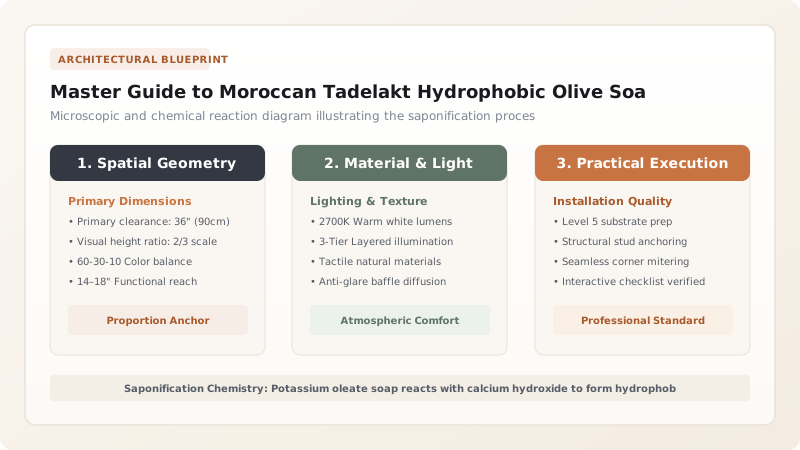
1. Geological Chemistry of Marrakech Hydraulic Lime
Authentic Tadelakt cannot be duplicated using standard industrial hydrated building lime or pure calcium hydroxide putty. Its extraordinary physical characteristics stem entirely from the geological deposits of the Marrakech plateau in Morocco.
The limestone quarried around Marrakech contains natural impurities of amorphous silica (\(\text{SiO}_2\), 8–12%), alumina (\(\text{Al}_2\text{O}_3\)), and fine uncalcined quartz grains. When burned in traditional wood-fired kilns at 900°C to 1,000°C, solid-state reactions between lime and silica yield dicalcium silicate (\(C_2S\), belite). When slaked with water on site, the material produces a naturally hydraulic lime paste containing both soluble calcium hydroxide and coarse micro-aggregates of unburned limestone and silica sand, providing exceptional compressive density and zero shrinkage fissuring.
2. The Chemistry of Black Soap Saponification
The waterproofing mechanism of Tadelakt is an irreversible chemical saponification reaction occurring directly within the wet lime pores. After the plaster has been flattened and compacted, the artisan applies savon noir (Moroccan black olive soap), rich in potassium oleate (\(\text{C}_{17}\text{H}_{33}\text{COOK}\)).
When the potassium oleate penetrates the damp plaster, it contacts free calcium hydroxide (\(\text{Ca(OH)}_2\)) in the lime matrix, triggering an immediate double-displacement reaction:
The resulting calcium oleate is a completely water-insoluble, hydrophobic metallic soap that crystallizes inside every capillary pore of the outer 1mm plaster layer, forming an ultra-dense, water-beading shield.
3. The Mechanical Action of River Stone Compaction
The hallmark tool of the tadelakt artisan is the galet—a flat, exceptionally smooth river stone composed of basalt, agate, or hard granite with a Mohs hardness of 6.0 to 7.0. Stone burnishing is performed in rhythmic, overlapping circular motions under heavy hand pressure (approx. 250 to 350 kPa), physically collapsing capillary voids and forcing plate-like calcium carbonate crystals into a mirror-smooth, light-reflecting alignment.
4. Monolithic Substrates & Curvilinear Hammam Detailing
Tadelakt transitions seamlessly from flat walls into curved ceiling vaults, arched doorways, bathtub surrounds, and sculpted sinks with zero silicone joints. Because Tadelakt cures into a rigid mineral stone shell, the underlying substrate must be completely rigid—such as fired terracotta brick, concrete masonry blocks, or fiber-cement backer board with zero deflection.
Moroccan Tadelakt Specifications vs Venetian Stucco & Microcement
Use this reference table to calculate exact physical dimensions, ratios, and specifications before purchasing:
| Feature / Metric | Authentic Moroccan Tadelakt | Italian Venetian Stucco | Modern Synthetic Microcement |
|---|---|---|---|
| Primary Binder | Marrakech hydraulic lime + silica | Slaked air-lime putty (CL90) + marble dust | Portland cement + acrylic / polyurethane resin |
| Waterproof Mechanism | Chemical saponification (calcium oleate) | Wax coating (hydrophobic wax film only) | Polyurethane or epoxy topical sealer coat |
| Wet Area Suitability | 100% waterproof for hammams, showers, tubs | Limited; moisture causes water spots; dry areas | Waterproof when sealer is intact; risk of peeling |
| Burnishing Tool | Handheld hard river stone (basalt/agate) | Flexible stainless steel Venetian trowel | Steel trowel, sanded with orbital sander |
| Vapor Breathability | High vapor permeability (μ ≈ 15–20) | High breathability in dry areas | Low breathability; acts as a synthetic vapor barrier |
Engineering & Operational Constraints
Every successful decoration project must account for physical and environmental constraints:
Labor Intensity
Tadelakt requires intense physical hand labor; an artisan can execute only 3 to 5 m² per day.
Curing Timeline
Full mineral carbonation takes 28 to 60 days; avoid standing hot water during this window.
Hard Water Scaling
In hard-water districts, mineral deposits must be wiped down with a squeegee to prevent calcium crust buildup.
Protocol for Installing Authentic Moroccan Tadelakt
Execute this professional sequence to achieve flawless results without backtracking:
Substrate Scratch Coat Preparation
Apply a 10mm coarse hydraulic lime and sand scratch coat over rigid brick or masonry; cure for 14 days.
Tadelakt Slaking & Slurry Resting
Mix authentic Marrakech tadelakt powder with clean water; rest for 24 hours to ensure full lime slaking.
First & Second Coat Trowel Application
Apply first coat at 2.5mm depth; immediately follow with a second 2mm coat (fresco on fresco).
Initial Wood Float Compression
Compress and flatten the surface using a small wooden float when the plaster reaches leather-hard consistency.
Stone Burnishing & Soap Saponification
Brush diluted black olive oil soap across the surface. Immediately burnish with circular passes of the smooth basalt river stone.
Final Olive Soap Capping & Curing
Apply a second diluted soap wash after 24 hours; buff gently with microfiber cloth. Allow 30 days of gradual carbonation.
Common Mistakes & Countermeasures
Avoid these costly errors that compromise aesthetics, ergonomics, and budget:
Applying Tadelakt over flexible plywood or drywall
Using commercial synthetic dish soap instead of authentic black soap
Cleaning finished Tadelakt with acidic bathroom descalers
Project Execution Checklist
Track your physical progress. Checkboxes persist automatically on this device:
Frequently Asked Questions
Is Moroccan Tadelakt truly 100% waterproof for showers and bathtubs?
Yes. When properly executed with Marrakech hydraulic lime and burnished with black soap, the resulting calcium oleate layer is completely insoluble in water. Water beads on the surface and cannot penetrate into the masonry.
How do you repair a chip or scratch in a finished Tadelakt wall?
Carefully gouge around the damaged area to create clean 90-degree edges, damp surrounding plaster, fill with freshly mixed color-matched tadelakt paste, burnish with a small river stone and black soap, and blend the perimeter smoothly.


