
Authentic Tadelakt owes its unique properties to the geology of the Marrakech High Atlas foothills. The local limestone naturally incorporates 8% to 12% amorphous silica and clay minerals. Fired in traditional wood kilns at 950°C, it forms dicalcium silicate (belite) alongside calcium oxide, resulting in a naturally hydraulic lime that hardens both through water reaction and atmospheric carbonation.
At a Glance: Key Takeaways
- Alluvial High Atlas Marl: Natural geological blend of calcium carbonate, reactive quartz, and aluminum silicates.
- Low-Temperature Kiln Firing: Firing at 900°C–1,000°C preserving active silica without dead-burning lime.
- Belite Phase Formation: In-situ synthesis of dicalcium silicate (C2S) providing hydraulic water-curing properties.
- Incomplete Slaking Particle Size: Presence of hard unslaked lime and limestone granules functioning as self-aggregates.
- High Chemical Alkalinity: Natural pH > 12.5 creating permanent antimicrobial resistance.
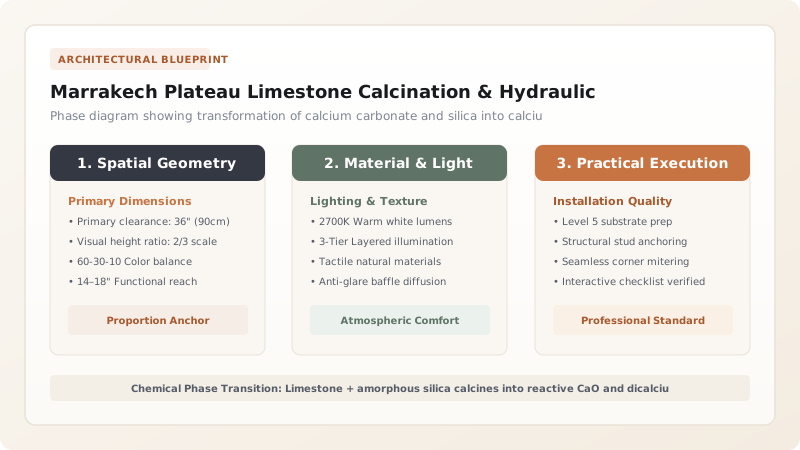
1. High Atlas Foothill Geology & Geological Impurities
The raw stone utilized for Tadelakt is quarried in the geological formation of the Haouz plains near Marrakech. Unlike pure calcite limestones, Marrakech limestone is an impure, marly sediment containing 78–84% CaCO3, 8–12% reactive silica (SiO2), and 3–5% alumina and iron oxide. These natural impurities act as internal pozzolanas, converting brittle air-lime into a tough, hydraulic stone matrix.
2. Thermal Calcination in Traditional Flare Kilns
Moroccan lime kilns are stone structures fueled with biomass like olive press cake and palm leaves, firing between 920°C and 980°C for 48 to 72 hours. This decomposes calcium carbonate into quicklime while synthesizing dicalcium silicate (C2S, belite) without forming rigid tricalcium silicate or dead-burning the lime.
3. Hydraulic Hydration & Self-Aggregating Matrix
When slaked, calcium oxide hydrates into calcium hydroxide, while belite grains hydrate slowly over months to form calcium silicate hydrates (C-S-H). Imperfect calcination leaves tiny unburned limestone grains (0.2–1.5mm) that serve as a natural self-aggregate, eliminating shrinkage without added river sand.
Mineralogical Comparison of Tadelakt Lime vs Standard Limes
Use this reference table to calculate exact physical dimensions, ratios, and specifications before purchasing:
| Lime Type | Silica Content (% SiO2) | Primary Curing Mechanism | Compressive Strength (28 days) |
|---|---|---|---|
| Marrakech Tadelakt Lime | 8% to 12% (natural) | Dual: Hydraulic (C-S-H) + Carbonation (CaCO3) | 3.5 to 5.5 MPa |
| Pure Slaked Air-Lime (CL90) | < 1.5% | 100% atmospheric carbonation (requires CO2) | 1.0 to 1.8 MPa |
| Industrial Hydraulic Lime (NHL 5) | 15% to 22% (engineered) | Predominantly hydraulic hydration | 5.0 to 8.0 MPa |
| Portland Cement | 20% to 25% (clinker) | Pure hydraulic crystallization | 25.0 to 45.0 MPa (too rigid for Tadelakt) |
Chemical & Sourcing Constraints
Every successful decoration project must account for physical and environmental constraints:
Regional Authenticity
True Tadelakt cannot be synthesized from ordinary lime and sand; verify Marrakech Haouz provenance.
Color Darkening
Pigmented Tadelakt darkens significantly upon stone burnishing; create physical test mockups.
Protocol for Slaking and Refining Raw Tadelakt Powder
Execute this professional sequence to achieve flawless results without backtracking:
Kiln Rock Sifting
Sort calcined lime rocks, rejecting glassy over-burned clinkers and un-calcined cores.
Hydration Slaking (Extinction)
Sprinkle measured water over lime rocks in covered masonry basins to slake into powder.
Sieving Coarse Inclusions
Pass slaked lime powder through a 1.5mm bronze mesh to remove oversized stone fragments.
Dry Pigment Blending
Blend alkali-resistant natural mineral oxide pigments into dry powder.
Paste Rehydration & Resting
Mix powder with clean water to a dense paste; seal in barrels for 24 hours.
Workability Testing
Spread a test patch on porous brick; verify paste holds a crisp edge without slumping.
Common Mistakes & Countermeasures
Avoid these costly errors that compromise aesthetics, ergonomics, and budget:
Adding white Portland cement to speed up drying
Using chlorinated or sulfurous mixing water
Project Execution Checklist
Track your physical progress. Checkboxes persist automatically on this device:
Frequently Asked Questions
Can I make Tadelakt using standard hydrated lime from a hardware store?
No. Standard hydrated lime is an air-lime with zero natural hydraulic silica. It lacks the internal limestone micro-aggregates and dicalcium silicate needed for stone burnishing, resulting in a soft plaster that dissolves under water.
Why does authentic Tadelakt feel so much harder than regular plaster?
The combination of hydraulic belite hydration, progressive atmospheric carbonation, and physical compaction reduces capillary porosity to under 5%, creating a density comparable to natural marble.


