
Stone burnishing and olive soap saponification form the dual core of Tadelakt execution. Compacting the wet lime with an agate or basalt stone (Mohs 7) physically collapses capillary voids, while the potassium oleate in Moroccan black soap chemically reacts with free calcium hydroxide to synthesize hydrophobic, insoluble calcium oleate.
At a Glance: Key Takeaways
- Agate/Basalt River Stones: Polished volcanic stones with rounded convex profiles providing localized high compressive force.
- Potassium Oleate Hydrolysis: Alkaline black soap penetrating 1mm into the lime paste to form water-repellent metallic soaps.
- Leather-Hard Timing Window: Initiating stone burnishing when plaster yields under thumb pressure without sticking (approx. 4–8 hours).
- Frictional Surface Heat: Circular stone strokes generating microscopic friction heat that accelerates carbonation.
- Self-Healing Microstructure: Small surface scratches naturally re-carbonating upon exposure to water and air.
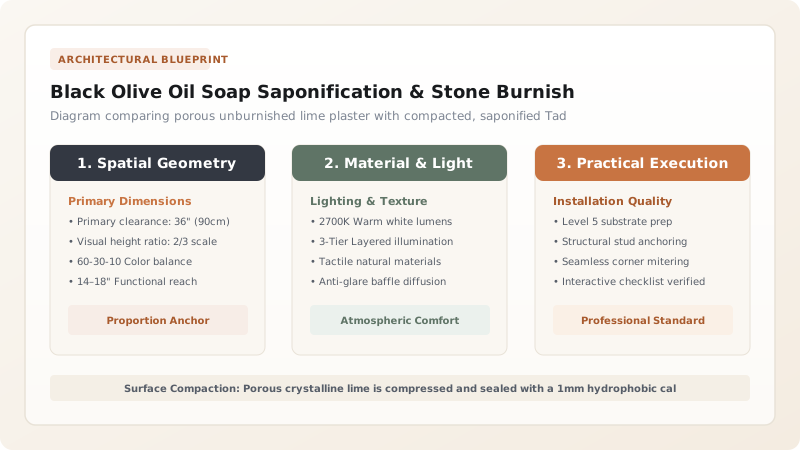
1. The River Stone as a Mechanical Engineering Tool
In Moroccan Tadelakt, the burnishing stone (galet) must be fine-grained igneous rock—such as black basalt, nephrite jade, or banded agate—with a Mohs hardness of 6.5 to 7.5. Its face must have a gently convex profile with rounded perimeter bevels to compress the mortar without gouging or tearing the surface.
2. Saponification: Calcium Oleate Synthesis
When authentic Moroccan black soap (rich in potassium oleate) penetrates the high-alkaline wet plaster (pH > 12.5), potassium ions exchange with calcium ions: \(2\,\text{C}_{17}\text{H}_{33}\text{COOK} + \text{Ca}^{2+} \longrightarrow (\text{C}_{17}\text{H}_{33}\text{COO})_2\text{Ca} \downarrow + 2\,\text{K}^+\). The insoluble calcium oleate precipitate lowers surface energy, causing water droplets to bead up with contact angles exceeding 110 degrees.
3. The Critical Leather-Hard Window
Stone burnishing must begin precisely when the plaster reaches the leather-hard state—when firm thumb pressure indents the surface by 0.5mm with zero wet paste sticking to skin. If begun too early, paste waves and drags; if too late, the stone scratches the hardened calcite without compacting pores.
Tadelakt Saponification & Burnishing Phases
Use this reference table to calculate exact physical dimensions, ratios, and specifications before purchasing:
| Execution Phase | Surface Moisture State | Tool Used | Target Physical Effect |
|---|---|---|---|
| Initial Leveling | Wet, plastic paste (0–2 hrs) | Plastic trowel or wooden float | Eliminates ridges; establishes uniform 4mm layer |
| First Stone Pass (Serrage) | Leather-hard (4–6 hrs post-trowel) | Dry basalt stone, light pressure | Closes open pores; aligns lime crystal plates |
| Soap Saponification | Damp-matte; no standing water | Soft bristle brush with 20% soap solution | Chemical synthesis of insoluble calcium oleate |
| Final Stone Burnish | Soapy, glossy surface (6–10 hrs) | Agate stone under heavy 300 kPa pressure | Fuses metallic soap; achieves deep mirror luster |
Physical & Ambient Constraints
Every successful decoration project must account for physical and environmental constraints:
Ambient Temperature
Never apply in hot drafty rooms (> 28°C or < 40% RH); rapid drying terminates the burnishing window prematurely.
Physical Fatigue
Hand-stone burnishing generates severe arm fatigue; rotate artisans on large wall sections to maintain uniform pressure.
Protocol for Stone Burnishing and Soap Application
Execute this professional sequence to achieve flawless results without backtracking:
Leather-Hard Verification
Press thumb firmly against plaster; verify surface resists indentation without paste transfer.
First Dry Stone Pass
Execute tight circular strokes with basalt stone to close shrinkage micropores.
Black Soap Dilution
Dissolve black soap in warm water at 1:5 ratio by weight to create a viscous wash.
Soap Wash Application
Brush soap solution evenly across the compacted plaster; allow 2 minutes absorption.
Wet Stone Polishing
Glide stone across soapy layer, increasing pressure to fuse calcium oleate crystals.
Microfiber Buffing
Wipe away excess soap scum with microfiber cloth; buff lightly for satin luster.
Common Mistakes & Countermeasures
Avoid these costly errors that compromise aesthetics, ergonomics, and budget:
Using a stone with sharp, angular edges or burrs
Applying neat, undiluted black soap directly from the tub
Project Execution Checklist
Track your physical progress. Checkboxes persist automatically on this device:
Frequently Asked Questions
Why can't a stainless steel trowel achieve the same finish as a stone?
Steel trowels leave metallic gray burnish marks on pale lime plasters under high pressure, whereas the smooth convex curvature of a river stone applies focused point compression that collapses pore networks far more effectively.
How do you know when the saponification reaction is complete?
The stone glides across the surface with virtually zero frictional drag, producing a characteristic humming sound, and water misted onto the wall beads instantly into spheres.


