
Tadelakt excels in curvilinear wet environments: sculpted bathtubs, sunken soaking pools, rounded shower alcoves, and steam hammams. By eliminating grout joints—the primary failure point for mold, leaks, and mildew—and utilizing soft radiused transitions (coves and bullnoses), Tadelakt creates an organic, monolithic sanitary envelope that is naturally waterproof and antimicrobial.
At a Glance: Key Takeaways
- Zero Grout Joints: Monolithic plaster envelope eliminating silicone beads and mold-harboring grout lines.
- Generous Radius Curves: Internal cove corners and external bullnoses executed with minimum 25mm to 50mm radii.
- Rigid Masonry Substrates: Concrete block, brick, or high-density foam substrates reinforced with epoxy-fiberglass mesh.
- Integrated Drainage Drains: Flanged stainless steel or brass floor drains flush-plastered with elastic polymer collars.
- High-Humidity Resilience: Thriving in 100% relative humidity environments like steam rooms and Turkish hammams.
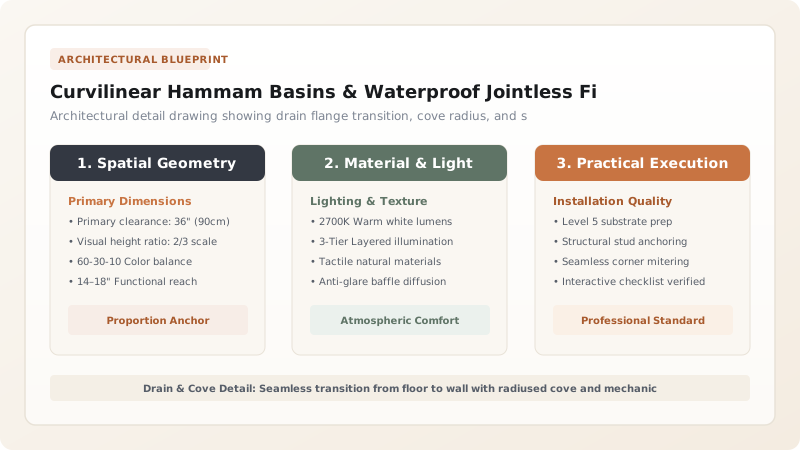
1. The Architectural Logic of Radiused Curves (No 90° Angles)
The cardinal rule of Tadelakt is never create sharp 90-degree corners. Internal coves must have a minimum 25mm to 50mm radius to allow burnishing stones to glide without gouging, while external bullnoses must be radiused to 15mm to 20mm to prevent edge chipping and distribute impact loads.
2. Substrate Construction for Sculpted Tadelakt Basins
Tubs and basins require complete dimensional stability under water weight (1,000 kg per cubic meter). Substrates are built of carved aerated autoclaved concrete (AAC) or high-density extruded polystyrene (XPS) foam reinforced with 160 g/m² fiberglass mesh and certified liquid tanking membranes before tadelakt application.
3. Drain & Fixture Transition Engineering
Differential thermal expansion between metals and lime necessitates two-stage clamping drain flanges. The drain body bonds to the substrate membrane, while tadelakt terminates at a clamping collar with a 3mm perimeter reveal filled with neutral-cure sanitary silicone concealed beneath the drain grate.
Tadelakt Detailing Guidelines for Wet Rooms & Hammams
Use this reference table to calculate exact physical dimensions, ratios, and specifications before purchasing:
| Detailing Location | Minimum Radius / Tolerance | Substrate Reinforcement | Waterproofing Requirement |
|---|---|---|---|
| Wall-to-Floor Junction | R = 30mm internal cove | Alkali-resistant mesh embedded in basecoat | Continuous tanking membrane under scratch coat |
| Bathtub Lip / Rim | R = 20mm external bullnose | High-density concrete masonry or XPS foam carcass | Full tanking wrapping over rim into tub interior |
| Shower Drain Transition | Flush clamp with 3mm sealant reveal | Stainless steel clamping ring assembly | Integrated weep holes and elastomeric flashing collar |
| Niche & Bench Corners | R = 25mm soft curve | Pre-molded foam or brick corbel structure | Tanking extending 150mm past niche perimeter |
Architectural & Maintenance Constraints
Every successful decoration project must account for physical and environmental constraints:
Substrate Rigidity
Floors must be engineered to < L/720 deflection under full tub water weight.
Maintenance Regimen
In residential showers, Tadelakt should be washed with dilute black soap every 1 to 2 months to nourish the calcium oleate layer.
Protocol for Building and Plastering a Tadelakt Shower Basin
Execute this professional sequence to achieve flawless results without backtracking:
Carcass Sculpting & Sloping
Construct shower base using masonry blocks with 35mm radiused coves and 2% slope to drain.
Substrate Tanking & Mesh Reinforcement
Apply two coats of flexible waterproof membrane; embed 160 g/m² fiberglass mesh across all corners and rims.
Hydraulic Basecoat Application
Trowel a 10mm NHL 3.5 lime basecoat; shape curves with radiused wooden templates.
Tadelakt Application & Molding
Apply two coats of authentic Marrakech Tadelakt seamlessly across floor, coves, and walls.
Stone Burnishing on Curved Profiles
Use rounded basalt stones to burnish internal coves and bullnoses.
Soap Saponification & Sealant Caulking
Burnish with olive black soap; seal fixture and drain expansion grooves with silicone.
Common Mistakes & Countermeasures
Avoid these costly errors that compromise aesthetics, ergonomics, and budget:
Creating sharp right-angle corners in shower floors
Plastering tightly against metal shower valve stems without expansion gaps
Project Execution Checklist
Track your physical progress. Checkboxes persist automatically on this device:
Frequently Asked Questions
Can a Tadelakt bathtub withstand boiling hot water?
Yes. Tadelakt has high thermal stability and does not degrade with heat. However, avoid thermal shock on freezing days by tempering with warm water before filling with scalding water.
How slippery is a Tadelakt shower floor?
Despite its silky, polished appearance, Tadelakt has a high coefficient of friction when wet, similar to honed natural limestone. In commercial installations, subtle stippling or stone mosaic inserts can enhance slip resistance.


