
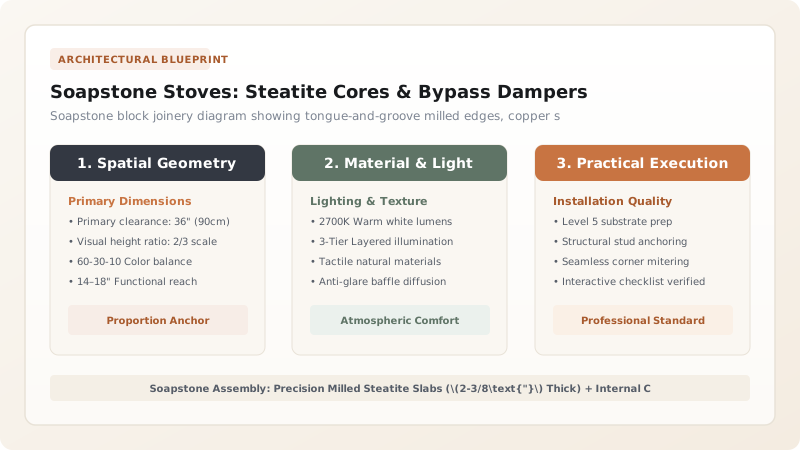
Fabricate soapstone masonry heater cores by assembling precision-milled slabs of high-purity architectural steatite (minimum 2-3/8" thickness) using tongue-and-groove joints locked with internal copper staples and high-temperature waterglass (sodium silicate) adhesive. Incorporate an airtight rotary bypass damper above the firebox to establish instant draft during cold starts.
At a Glance: Key Takeaways
- Talc-Magnesite Mineralogy: 50% talc (thermal shock elasticity) + 40% magnesite (extreme thermal density and heat retention).
- Double the Specific Heat of Granite: Absorbs 0.98 kJ/(kg·K), storing massive thermal energy without thermal cracking.
- Tongue-and-Groove Dry Assembly: Precision CNC-milled seams interlocked with sodium silicate mortar, ensuring a 100% gastight core.
- Solid Copper Staple Connectors: Heavy U-shaped copper staples embedded in pre-drilled holes, clamping slabs together under heat expansion.
- Zero Structural Creep: Unlike iron, soapstone never warps, oxidizes, or blisters even after decades of continuous 1,800°F firings.
1. Mineral Physics: Steatite Crystal Matrix & Specific Heat Capacity
While standard firebricks are porous and slowly degrade after repeated thermal cycles, Natural Architectural Soapstone (*Steatite*) is a dense metamorphic rock forged under millions of years of subterranean volcanic heat and pressure.
Its unique geological composition—roughly 50% Talc and 40% Magnesite—gives it thermodynamic superpowers. The magnesite provides Twice the Volumetric Heat Capacity of Standard Brick, while the surrounding talc matrix allows the stone to expand and contract freely without internal micro-fracturing. Explore how this fits into masonry heater architecture and study serpentine flue paths.

2. Damper Engineering: Rotary Linkages & Solving Cold-Chimney Air Plugs
A masonry heater core contains over 3,500 pounds of stone. When unlit in mid-winter, this stone is ice-cold, creating a dense, heavy column of cold air inside the flues.
Stove builders mount an airtight Cast Iron or 304 Stainless Steel Bypass Damper right at the crown of the soapstone firebox. Actuated by a solid brass front-facing rotary linkage rod, opening this damper diverts the initial kindling smoke straight into the chimney liner. After 10 minutes of roaring draft, the handle is rotated closed, sending the superheated gases through the soapstone channels. Master ceramic cladding in glazed Kachel tile cladding and see Rumford fireplaces.
Thermal Storage Core Materials Comparison
Use this reference table to calculate exact physical dimensions, ratios, and specifications before purchasing:
| Core Material | Specific Heat Capacity (kJ/kg·K) | Thermal Conductivity (W/m·K) | Thermal Shock Resistance | Lifespan |
|---|---|---|---|---|
| Finnish Soapstone (Steatite - Optimal) | 0.98 kJ/(kg·K) | 6.4 W/m·K (10× faster transfer than brick) | Exceptional (Zero internal cracking) | 100+ Years |
| High-Alumina Refractory Firebrick | 0.88 kJ/(kg·K) | 1.1 W/m·K (Slow heat migration) | High | 40 to 60 Years |
| Dense Chamotte Ceramic Blocks | 0.85 kJ/(kg·K) | 1.0 W/m·K | High | 35 to 50 Years |
| Solid Cast Iron Plates (Avoid for Core) | 0.46 kJ/(kg·K) (Poor storage) | 50.0 W/m·K (Too fast / Overheats room) | Low (Warps and cracks over time) | 15 to 25 Years |
Thermal Waterglass Mortar Rapid Desiccation
Every successful decoration project must account for physical and environmental constraints:
Sodium Silicate Waterglass Mortar Flash-Drying on Dusty Soapstone Causing Air Leaks
Fine soapstone talc dust acts as a bond-breaker; applying sodium silicate adhesive over dusty unwashed stone causes the joint to dry instantaneously into a brittle crust that shears off under thermal expansion; always wash soapstone mating edges with clean water and acetone, keeping the stone damp (*saturated surface dry*) when spreading sodium silicate mortar.
How to Assemble a Soapstone Masonry Core with Bypass Damper
Execute this professional sequence to achieve flawless results without backtracking:
Clean and Dry-Fit Milled Soapstone Slabs
Wipe 2-3/8" thick soapstone blocks with damp rags to remove all talc dust; dry-fit on level sub-hearth pad.
Bore Alignment Holes for Copper Structural Staples
Drill 1/4" holes 1" deep across adjoining slab top faces to receive heavy 6-gauge U-shaped copper clamping staples.
Spread Sodium Silicate Waterglass Stone Adhesive
Apply 1/16" film of high-temperature refractory sodium silicate adhesive along tongue-and-groove milled edges.
Tap Soapstone Slabs Together and Drive Copper Staples
Press slabs together; tap with rubber dead-blow mallet; hammer copper staples into pre-drilled holes to lock seams.
Mount Airtight Bypass Damper Frame over Firebox Apex
Bed cast iron bypass damper frame in ceramic gasket rope; fasten with 3/8" stainless bolts with expansion washers.
Install Front-Facing Rotary Linkage Control Rod
Thread solid brass rotary control rod through exterior stove face; connect universal joint linkage to damper axle.
Vacuum and Wipe Finished Soapstone with Mineral Oil
After 7 days of mortar curing, wipe exterior soapstone with food-grade mineral oil to bring out rich dark charcoal veining.
Common Mistakes & Countermeasures
Avoid these costly errors that compromise aesthetics, ergonomics, and budget:
Using Standard Steel Screws to Clamp Soapstone Blocks
Project Execution Checklist
Track your physical progress. Checkboxes persist automatically on this device:
Frequently Asked Questions
Can soapstone be cleaned if stained with soot or wood oil?
Yes! Because soapstone is completely non-porous and chemically inert, any surface soot or scratches can be removed instantly by lightly wet-sanding the stone with 220-grit sandpaper and applying a fresh coat of mineral oil.


