
Design and construct European masonry heaters (Kachelofen) by building an ultra-high-temperature refractory firebox that burns fuel wood rapidly at 1,800°F with 90%+ efficiency. Direct the exhaust gases through a labyrinth of multi-pass serpentine channels within a 3,000 to 5,000 lb soapstone or firebrick core, capturing the heat before the clean exhaust exits, and radiating gentle 120°F far-infrared warmth for up to 24 hours.
At a Glance: Key Takeaways
- 90%+ Thermal Efficiency: Burns wood at extreme temperatures (1,600°F–2,000°F), combusting all unburnt hydrocarbons and creosote into pure heat.
- 3,000 to 5,000 lb Thermal Battery: Massive refractory core stores thermal energy, releasing it slowly over 18 to 24 hours without temperature spikes.
- Serpentine Contraflow Flue Labyrinth: 20 to 30 feet of internal masonry exhaust channels extracting heat from smoke before exiting the chimney.
- Natural Soapstone (*Steatite*) Slabs: Possesses twice the specific heat capacity and 10× the thermal conductivity of standard brick.
- Hand-Glazed Ceramic *Kachel* Tiles: Traditional hollow ceramic tiles wired together with copper ties, expanding gracefully without cracking.
In-Depth Guides in this Directory
Explore specialized subtopic blueprints, technical dimensions, and execution checklists:
Serpentine Flues: Masonry Heater Thermal Channels
Engineering guide to masonry heater internal thermodynamics: multi-flue serpentine exhaust routing, contraflow draft physics, bypass dampers, and cleanout port locations.
Soapstone Stoves: Steatite Cores & Bypass Dampers
Master soapstone masonry heater engineering: natural steatite mineralogy, 2.5× specific heat capacity of granite, dry-stacked tongue-and-groove joints, and bypass damper linkages.
Kachel Tiles: Glazed Ceramic Stoves & Expansion Joints
Master Austrian and German Kachelofen cladding craft: hollow-back Kachel ceramic tiles, wire-tied copper assemblies, clay-chamotte packing, and expansion joints.
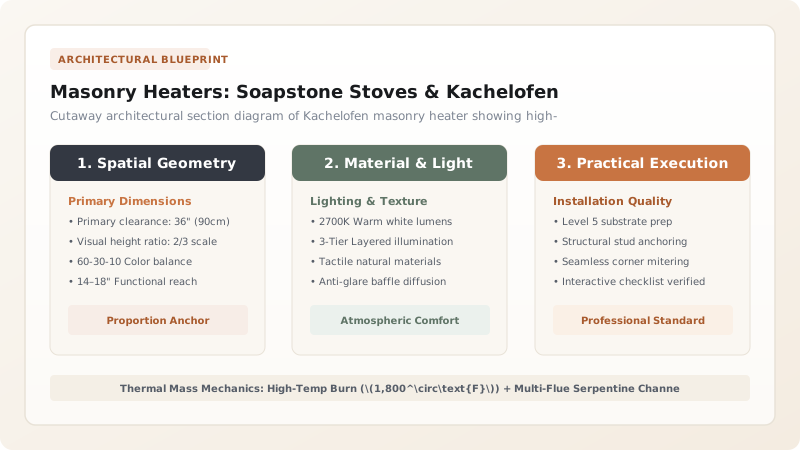
1. Thermal Physics: Contraflow Channels & 24-Hour Far-Infrared Storage
Standard cast iron woodstoves operate like thermal rollercoasters: they get scorchingly hot (burning room oxygen and baking dust), and then freeze 4 hours later once the fire dies down.
A Masonry Heater (Kachelofen or Finnish Contraflow Stove) operates on an entirely different thermodynamic principle. A small, intense fire is burned for just 2 Hours at 1,800°F (980°C). The scorching exhaust gases are forced through 25 to 35 Linear Feet of Serpentine Masonry Channels within a 4,000 lb Refractory Core. By the time the gases reach the chimney, their temperature has dropped from 1,800°F down to an astonishing 250°F—the remaining heat is trapped in the stone. Explore our detailed guide on serpentine exhaust channels and thermal storage.

2. Material Science: Natural Soapstone (*Steatite*) vs Hand-Glazed *Kachel* Tiles
The exterior finish determines how the stored heat radiates into the room.
Natural Soapstone (*Steatite*) is the world's finest thermal storage rock, featuring dense talc-magnesite minerals that absorb thermal shock without cracking and conduct heat smoothly. Alternatively, traditional Austrian and German heaters are clad in Handmade Glazed Ceramic *Kachel* Tiles. These hollow tiles are packed with clay and crushed firebrick, then wired together with Solid Copper Ties to create a flexible exterior skin that breathes as the stove expands. Discover soapstone engineering in soapstone fireboxes and bypass dampers and master ceramic cladding in hand-glazed ceramic Kachel tiles.
Heating Appliance Performance Comparison
Use this reference table to calculate exact physical dimensions, ratios, and specifications before purchasing:
| Heating System | Combustion Efficiency | Surface Operating Temp | Thermal Storage Duration | Particulate Emissions |
|---|---|---|---|---|
| Masonry Heater / Kachelofen (Optimal) | 88% to 94% (Near-perfect burn) | 120°F to 160°F (Safe, gentle, non-scorching) | 18 to 24 hours per burn | Ultra-Low (<1.0 g/hr / Smokeless) |
| EPA-Certified Cast Iron Wood Stove | 65% to 75% | 400°F to 700°F (Severe burn danger / Bakes dust) | 3 to 6 hours | Moderate (2.0 to 4.5 g/hr) |
| Traditional Open Fireplace | 10% to 15% (Loses 85% heat up flue) | Varies (Severe radiant hot spot) | 0 hours (Freezes when fire dies) | Very High (>30 g/hr / Smoky) |
| Pellet Stove with Electric Blower | 75% to 83% | 200°F to 300°F | 0 hours (Requires constant electricity) | Low (Requires electric auger) |
Massive Concentrated Floor Load Failure
Every successful decoration project must account for physical and environmental constraints:
Installing a 4,500 lb Masonry Heater Over Standard Residential Wooden Floor Joists
A masonry heater concentrates up to 5,000 lbs on a 4×5 foot footprint (over 250 lbs/sq ft); placing this on standard 2×10 wood floor joists causes structural floor failure and collapsed ceilings below; masonry heaters must sit on dedicated reinforced concrete footings poured directly from virgin sub-grade soil or heavily reinforced steel I-beam columns.
How to Build a European Kachelofen Masonry Heater
Execute this professional sequence to achieve flawless results without backtracking:
Pour Dedicated 8" Reinforced Concrete Footing Pad
Excavate to frost depth; pour 4,000-psi concrete footing with dual-layer #5 rebar grid to support 5,000 lb dead load.
Build High-Temperature Firebox with Alumina Refractory Brick
Lay ASTM C64 firebricks in refractory mortar, incorporating secondary pre-heated combustion air ports for 1,800°F burns.
Assemble Serpentine Contraflow Exhaust Channel Core
Erect downward and upward masonry exhaust channels; incorporate cleanout access ports at the base of every vertical run.
Install Heavy Cast Iron Bypass Damper for Cold Starts
Mount spring-loaded bypass damper allowing exhaust to vent straight to chimney during lighting before diverting into serpentine channels.
Wrap Refractory Core in Ceramic Fiber Expansion Blanket
Install 1/2" high-temp ceramic insulation blanket over the core to decouple core expansion from the outer decorative shell.
Wire and Set Glazed Ceramic Kachel Tiles with Copper Ties
Pack tile hollows with crushed chamotte and clay; loop 12-gauge copper tie wires between adjoining tile ribs; mortar with lime-clay blend.
Perform 14-Day Low-Temperature Curing Burns
Air-dry stove for 14 days; conduct small 5 lb kindling fires daily to evaporate all internal water vapor before full loading.
Common Mistakes & Countermeasures
Avoid these costly errors that compromise aesthetics, ergonomics, and budget:
Bonding the Decorative Outer Skin Directly to the Hot Core
Project Execution Checklist
Track your physical progress. Checkboxes persist automatically on this device:
Frequently Asked Questions
How often do you need to add wood to a masonry heater?
Only once or twice per 24-hour day! You load 30 to 40 lbs of dry cordwood, light it from the top, let it burn completely for 2 hours, and close the airtight damper. The stove radiates gentle warmth for the next 24 hours.


