
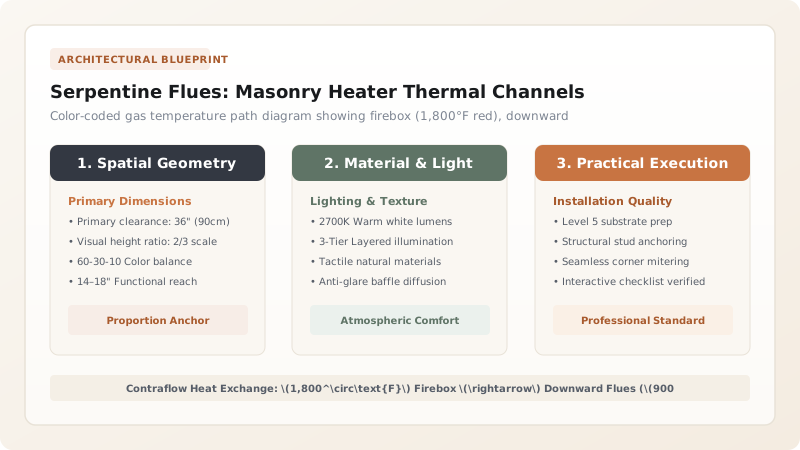
Engineer masonry heater serpentine flues using the Finnish contraflow or Austrian five-pass system. Exhaust gases rise from the 1,800°F firebox, divide into dual downward-flowing channels along the outer walls, converge at the stove base, and enter the exit chimney at roughly 250°F. Incorporate cleanout access thimbles at every turn and install an airtight bypass damper for easy cold-chimney startups.
At a Glance: Key Takeaways
- Contraflow Thermodynamic Balance: Exhaust flows down the outer walls, heating the bottom of the stove where human bodies sit.
- Bypass Damper Mechanism: Cast iron damper routed straight to chimney, bypassing channels for 10 minutes to establish cold-start draft.
- Uniform Cross-Sectional Area: Channel dimensions maintained at 8" × 8" (64 sq in) throughout the run to prevent gas constriction or stalling.
- Cast Iron Soot Cleanout Thimbles: 6-inch gasketed round access plugs at every bottom channel corner for annual fly-ash vacuuming.
- Chamotte Refractory Channel Liners: Heavy tongue-and-groove ceramic blocks resisting thermal gas friction and flue acid condensation.
1. Aerodynamic Thermodynamics: Contraflow Down-Drafting vs Multi-Pass Channels
In standard chimneys, hot air naturally wants to rise. How do masonry heaters force 1,200°F exhaust gases to travel Downwards Toward the Floor without stalling the draft?
The answer is Thermal Pressure Differentials. In a Finnish Contraflow System, the blazing firebox creates a towering column of ultra-hot, low-density gas. As this gas tops the crown, gravity and the suction of the tall, warm exterior chimney pull the cooling gases downward along the outer perimeter channels. Because the gas cools as it descends, it transfers its heat directly into the lower masonry base—ensuring the warmest part of the stove is right at seated human level. Study the complete system in our masonry heater hub.

2. Operational Controls: Direct-Draft Bypass Dampers & Cleanout Port Geometry
When lighting a cold masonry heater in mid-winter, 30 feet of cold brick flues will create a cold air plug that pushes smoke back into the room.
Stove builders incorporate a Precision Bypass Damper (Start-Up Damper). Pulling a polished brass control knob opens a direct path from the firebox ceiling straight into the chimney flue. Once a blazing fire is established and the chimney is drawing vigorously (typically 10 to 15 minutes), the operator closes the bypass damper, forcing the roaring exhaust into the serpentine thermal labyrinth. Read about soapstone cores in soapstone fireboxes and ceramic tiles in hand-glazed ceramic Kachel tiles.
Masonry Heater Flue Configuration Comparison
Use this reference table to calculate exact physical dimensions, ratios, and specifications before purchasing:
| Flue Channel Configuration | Draft Reliability | Thermal Heat Transfer | Footprint Required |
|---|---|---|---|
| Finnish Contraflow Dual-Drop (Optimal) | Exceptional (Symmetrical balanced flow) | Very High (Heats lower base uniformly) | Compact (4 ft × 3.5 ft footprint) |
| Austrian Five-Pass Serpentine (Kachelofen) | High (Requires established chimney draft) | Extreme (Longest flue path / Maximum capture) | Sprawling (Integrated heated benches & beds) |
| Russian Bell System (Kuznetsov) | High (Free gas movement in inverted bells) | High (Stratified gas separation) | Moderate to Large |
| Straight Upward Baffle System (Avoid) | High | Poor (Exhaust exits too hot / Wastes energy) | Small |
Low Exhaust Temperature Chimney Creosote Condensation
Every successful decoration project must account for physical and environmental constraints:
Extracting Too Much Heat Dropping Stack Temperature Below 200°F Causing Acid Condensation
If the serpentine flue run is made excessively long (>40 ft), exhaust gases exit into the chimney below the water vapor dew point (<180°F); water vapor condenses inside the masonry chimney, reacting with sulfur to create corrosive sulfuric acid that eats mortar; always calibrate channel length to maintain an exit stack temperature between 250°F and 320°F.
How to Layout and Build Serpentine Contraflow Flues
Execute this professional sequence to achieve flawless results without backtracking:
Layout Flue Channel Footprint on Refractory Base Slab
Snap chalk lines establishing 8" × 8" minimum cross-sectional area for all supply, downward drop, and collection flues.
Install Heavy Cast Iron Cleanout Thimbles at Base
Bed gasketed round or square cleanout access frames at the bottom of all vertical channels with refractory rope.
Lay Interlocking Chamotte Refractory Down-Drop Channels
Build outer vertical dividing walls with tongue-and-groove refractory blocks, checking channel smoothness with a damp sponge.
Install Cast Iron Bypass Damper Plate at Crown Junction
Mount precision machined bypass damper over upper direct-to-chimney port; connect extension linkage rod to front face.
Form Curved Aerodynamic Turning Baffles at Bottom Turns
Miter and round bottom turn bricks at 45° to guide downward-flowing gas smoothly into the collection trunk without eddy drag.
Seal Flue Core Exterior with Refractory Parging
Apply 3/8" coat of hydraulic refractory mortar over all exterior brick joints to guarantee 100% gastight performance.
Perform Negative Pressure Smoke Test Before Enclosing
Burn smoke flare in base; close bypass damper; verify zero smoke leakage through channel joints with digital pressure gauge.
Common Mistakes & Countermeasures
Avoid these costly errors that compromise aesthetics, ergonomics, and budget:
Omitting Cleanout Ports at Channel Inversion Bends
Project Execution Checklist
Track your physical progress. Checkboxes persist automatically on this device:
Frequently Asked Questions
What is 'fly ash' in a masonry heater?
Because wood burns at 1,800°F in a masonry heater, virtually zero black creosote is formed. The only byproduct that settles in the flues is an ultra-fine, sterile, fluffy white powder called fly ash, easily vacuumed every few years.


