
Laminate complex marquetry wood floor medallions by placing the assembly inside a heavy-duty polyurethane vacuum press bag connected to a rotary vane vacuum pump. Draw a deep 29" Hg vacuum (exerting 14.7 PSI / 1,800 lbs/sq.ft of uniform pressure), bonding 6mm hardwood wear layers to Baltic birch cores with structural epoxy.
At a Glance: Key Takeaways
- 29" Hg Atmospheric Pressure: Delivers 14.7 PSI (\(1,800\text{ lbs/sq.ft}\)) of perfectly uniform, clamp-free clamping force.
- 100% Solids Structural Epoxy (Zero Water): Prevents wood veneers from swelling and warping during lamination.
- Balanced Backer Veneer Mandate: Applying an equal thickness veneer to the panel underside eliminates warping tension.
- Multi-Ply Baltic Birch Core (15mm): Void-free cross-laminated birch core resists multi-directional wood movement.
- Rigid Aluminum Platen Cauls: Keeps complex multi-piece geometric medallions dead-flat during vacuum curing.
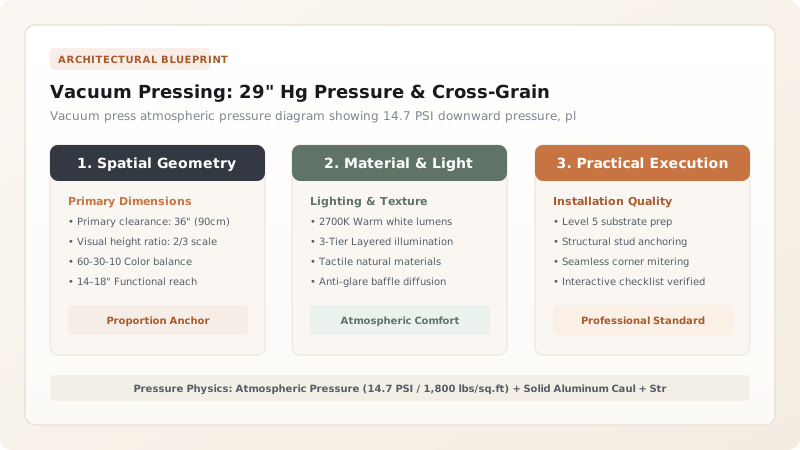
1. Atmospheric Physics: The 1,800-Lb/Sq.Ft Clamping Principle
Mechanical screw clamps apply intense pressure directly beneath the clamp jaw but leave wide dead zones in between, causing delicate marquetry veneer puzzle pieces to buckle and blister.
In a Vacuum Press System, evacuating air to 29 inches of Mercury (\(29\text{" Hg}\)) allows Earth's atmosphere to exert \(14.7\text{ PSI} (1,800\text{ lbs per square foot})\) of completely uniform downward pressure across every square millimeter of the medallion. For puzzle layout math, review laser kerf medallion assembly.

2. Structural Epoxy Adhesives & Balanced Substrate Architecture
Using water-based PVA glues for marquetry is disastrous: the wood absorbs water solvents, expands rapidly inside the press, and then shrinks and splits open when dry.
Master floorwrights use 100% Solids Structural Epoxy (such as West System 105/206). Epoxy contains 0% water solvents and does not swell wood. Applying an equal thickness Backer Veneer to the underside ensures the panel remains dead-flat forever. Explore modern tambour panels in fluted tambour wood wall surfacing.
Adhesives for Marquetry Floor Lamination
Use this reference table to calculate exact physical dimensions, ratios, and specifications before purchasing:
| Adhesive Formulation | Solvent Carrier | Veneer Moisture Swelling | Structural Durability |
|---|---|---|---|
| 100% Solids Structural Epoxy (Optimal) | None (100% Reactive resin) | 0% Swelling (Zero movement) | Maximum (Immune to humidity) |
| Urea-Formaldehyde Resin (Unibond) | Water mixed powder | Low (Rigid thermoset line) | High-End Architectural |
| Standard PVA Yellow Wood Glue (Avoid) | 50% Water Solvent | EXTREME: Swells and blisters | FAILS: Causes joint gaps upon drying |
| Contact Cement (FORBIDDEN) | Solvent rubber | Creeps under walking loads | DANGEROUS: Veneers peel loose |
Unbalanced Panel Cupping Tension Constraints
Every successful decoration project must account for physical and environmental constraints:
Marquetry Medallion Cupping into a Convex Dome After Removal from Press
Laminating a 6mm hardwood wear layer to only one side of plywood creates unbalanced moisture tension, warping the panel into a bowl; ALWAYS laminate a matching 6mm balancing veneer (plain maple or birch) to the underside of the panel during the same vacuum pressing cycle.
How to Vacuum-Press a Marquetry Floor Medallion
Execute this professional sequence to achieve flawless results without backtracking:
Prep 15mm Baltic Birch Substrate
Cut void-free Baltic birch plywood core to size; scuff with 80-grit abrasive for mechanical key.
Mix 100% Solids Structural Epoxy
Mix West System epoxy resin and slow hardener; spread over substrate with 1/16" notched trowel.
Position Marquetry Assembly & Underside Balancing Layer
Place top marquetry assembly and underside balancing veneer onto the glued substrate.
Sandwich Assembly Between Melamine Platens
Place breather mesh and flat 3/4" melamine cauls on top and bottom to distribute pressure dead-flat.
Slide into Polyurethane Vacuum Bag and Evacuate
Seal bag clamp; start rotary vane pump and pull vacuum to 29" Hg gauge pressure.
Maintain Vacuum for 6 Hours
Allow epoxy to cure completely under continuous atmospheric pressure before opening bag.
Common Mistakes & Countermeasures
Avoid these costly errors that compromise aesthetics, ergonomics, and budget:
Using Water-Based Glue in a Vacuum Press
Project Execution Checklist
Track your physical progress. Checkboxes persist automatically on this device:
Frequently Asked Questions
How thick should the vacuum press bag be?
Specify heavy-duty 20-mil to 30-mil Seamless Polyurethane Vacuum Bags. Polyurethane is puncture-resistant, highly elastic, and withstands thousands of hours of high-vacuum clamping cycles.


