
Assemble laser-cut marquetry floor medallions by applying a 0.0025-inch outward vector offset in CAD to compensate for the 0.005-inch laser beam kerf width. Cut 6mm sawn hardwood veneers, hand-fit the segments on a flat assembly board, and bind all top surface seams with gummed paper veneer tape before pressing.
At a Glance: Key Takeaways
- Laser Kerf Math (\(K = 0.005"\)): Accounting for laser beam vaporized wood width ensures hairline, seamless puzzle joints.
- 6mm Thick Sawn Hardwood (*Not Sliced*): Sawn veneer preserves authentic wood fiber density and allows deep floor refinishing.
- Water-Activated Gummed Veneer Tape: Shrinks slightly as it dries, pulling adjacent wood puzzle pieces into tight contact.
- Contrasting Grain Orientation: Alternating radial grain directions causes petals to shimmer dynamically under walking sightlines.
- Backer Balancing Veneer: Applying an equal thickness veneer to the underside of the panel prevents warping cupping tension.
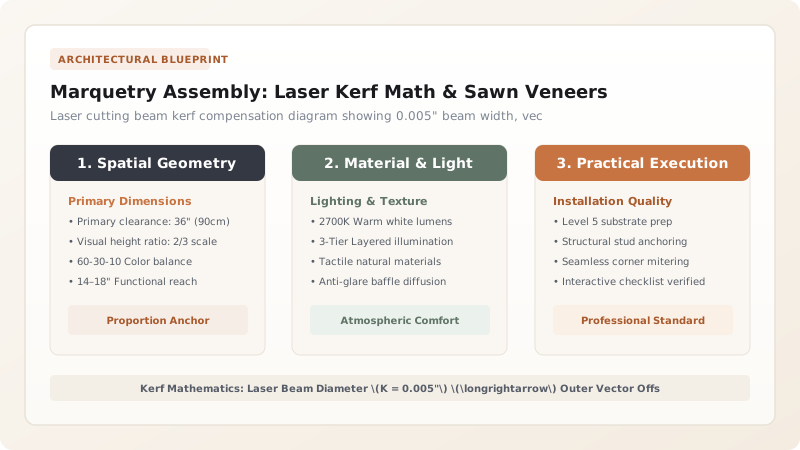
1. Laser Physics: The 0.005" Beam Kerf Compensation Formula
When a CO2 laser cuts wood, the focused laser beam vaporizes a narrow strip of material known as the Kerf (\(K \approx 0.005\text{ inches} / 0.13\text{mm}\)). If you cut two mating pieces from identical vector lines, the resulting joint will have an unsightly 0.010-inch loose gap.
Master CNC operators apply Dual Toolpath Offsetting in CAD:
$$\text{Offset}_{\text{pocket}} = -\frac{K}{2} = -0.0025" \qquad \text{Offset}_{\text{inlay}} = +\frac{K}{2} = +0.0025"$$
This mathematical compensation ensures that when pieces are pressed together, they fit with zero perceptible seam clearance (airtight friction fit). Review brass borders in solid brass metal floor inlays.

2. Veneer Tape Shrink Tension & Sawn Veneer Selection
Never use plastic masking tape to assemble marquetry: plastic stretches under vacuum press heat, allowing pieces to drift apart. Joiners use Water-Activated Gummed Paper Veneer Tape.
As the paper tape dries, it naturally contracts, pulling the hardwood puzzle pieces into unbreakable mechanical contact. Use 6mm Sawn Hardwood Veneers rather than paper-thin sliced veneers. Learn vacuum pressing in vacuum-press cross-grain stabilization.
Laser Cutting Parameters for Marquetry Flooring
Use this reference table to calculate exact physical dimensions, ratios, and specifications before purchasing:
| Wood Species | Veneer Thickness | Laser Power / Speed Spec | Kerf Width (K) |
|---|---|---|---|
| French Walnut (Medium Density) | 6mm Sawn Billet | 150W Laser @ 18 mm/sec | 0.005" (0.13mm) Kerf |
| Figured Birdseye Maple (Dense) | 6mm Sawn Billet | 150W Laser @ 14 mm/sec | 0.0045" (0.11mm) Kerf |
| African Wenge / Ebony (Very Dense) | 6mm Sawn Billet | 150W Laser @ 10 mm/sec | 0.004" (0.10mm) Kerf |
| Standard Sliced Veneer (Thin) | 0.6mm Paper Veneer | 50W Laser @ 80 mm/sec | 0.003" (Too thin for floors!) |
Laser Charring Edge Discoloration Constraints
Every successful decoration project must account for physical and environmental constraints:
Laser Burning Black Char on White Maple Veneer Edges Showing Dark Seam Lines
High laser heat leaves a carbonized black edge on light maple wood; inject high-pressure Nitrogen (N2) assist gas at 40 PSI into the laser cutting nozzle to blow away heat and eliminate edge scorching, leaving pristine white wood cut faces.
How to Laser-Cut and Assemble a Marquetry Medallion
Execute this professional sequence to achieve flawless results without backtracking:
Program CAD Offsets with 0.0025" Kerf
Offset male and female vector paths in AutoCAD/Rhino by half the laser beam width (±0.0025").
Level and Vacuum-Clamp Sawn Veneer Billets
Secure 6mm quartersawn hardwood sheets on laser honeycomb bed with vacuum hold-down.
Laser-Cut Pieces with Nitrogen Assist
Run 150W CO2 laser using 40 PSI nitrogen gas assist to prevent edge charring.
Hand-Fit Segments on Full-Scale Paper Blueprint
Lay laser-cut segments over full-scale printed layout, checking seamless grain flow.
Apply Wet Gummed Paper Tape Across Seams
Dampen perforated paper veneer tape with sponge and roll firmly across all top face joints.
Let Tape Dry and Inspect Friction Joints
Allow paper tape to dry 2 hours; verify all joints are closed tight with zero gaps.
Common Mistakes & Countermeasures
Avoid these costly errors that compromise aesthetics, ergonomics, and budget:
Placing Veneer Tape on the Underside (Glue Face) of the Wood
Project Execution Checklist
Track your physical progress. Checkboxes persist automatically on this device:
Frequently Asked Questions
How do you remove the paper veneer tape after pressing?
Lightly mist the dried paper tape with warm water, let it soften for 60 seconds, and scrape it off cleanly with a sharp hand scraper before final orbital sanding.


