
Create architectural marquetry and wood inlay flooring by laser-cutting contrasting exotic hardwood wear layers (such as French walnut, figured maple, and ebony) into geometric or floral medallions. Laminate the veneer assembly to a multi-ply Baltic birch substrate inside a 29" Hg vacuum press with rigid structural epoxy, framing with solid brass stringer inlays.
At a Glance: Key Takeaways
- Laser-Cut Hardwood Precision: 0.005" laser kerf tolerances ensure tight, seamless joints between contrasting wood species.
- 6mm Thick Wear Layer Standard: Allows the floor to be sanded and refinished 4 to 5 times over a century of domestic use.
- Solid Brass & Zinc Stringer Inlays: 1/8" to 1/4" solid metal ribbons separate wood species and add Art Deco luxury contrast.
- Vacuum-Press Cross-Grain Stabilization: 29" Hg vacuum pressure bonds multi-directional grain layers without buckling.
- Ceramic-Reinforced Polyurethane Finishes: Ultra-matte UV-cured urethane protects delicate wood inlays from foot abrasion.
In-Depth Guides in this Directory
Explore specialized subtopic blueprints, technical dimensions, and execution checklists:
Marquetry Assembly: Laser Kerf Math & Sawn Veneers
Master laser-cut wood floor medallion craftsmanship: calculating 0.005" laser kerf offset math, 6mm sawn hardwood veneer selection, veneer tape assembly, and puzzle joint tolerances.
Metal Floor Inlays: Solid Brass & Zinc Inlay Channels
Master luxury wood flooring metal inlays: solid architectural brass and zinc divider strips (1/8" to 1/4"), diamond knurling, flexible polyurethane bonding, and flush sanding.
Vacuum Pressing: 29" Hg Pressure & Cross-Grain Stability
Master marquetry floor veneer lamination: 29" Hg vacuum press atmospheric pressure (1,800 lbs/sq.ft), structural epoxy resin bonding, cross-grain balancing veneers, and eliminating cupping.
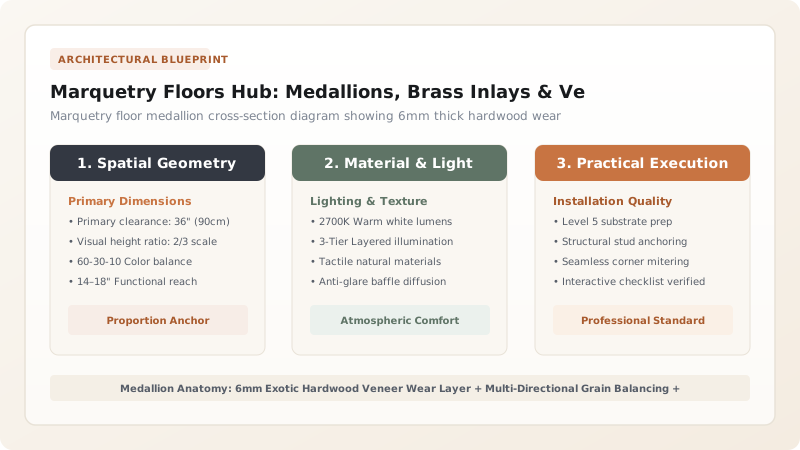
1. Fine Artistry: Laser-Cut Exotic Hardwood Medallions
Dating back to 17th-century French royal palaces (Versailles and the Louvre under André-Charles Boulle), Marquetry Wood Inlay (*Marqueterie*) is the fine art of assembling thin pieces of contrasting woods into intricate floor medallions, compass roses, and border crests.
While historic artisans cut veneers with manual fretsaws, modern architectural master floors utilize High-Precision CO2 Laser Cutters (with 0.005" kerf compensation). This guarantees flawless, gap-free fit between contrasting species (such as dark Wenge, golden Figured Sycamore, and rich French Walnut). Master medallion layout in laser-cut marquetry medallion assembly.

2. Solid Brass Inlays & Vacuum-Press Substrate Stabilization
Assembling multiple wood species with different grain directions creates severe risks of Cross-Grain Tearing as ambient humidity changes throughout the year.
Craftsmen stabilize marquetry by laminating the 6mm thick hardwood wear layer onto a 15mm Baltic Birch Plywood Core inside a 29" Hg Vacuum Press using rigid structural epoxy resin. Border fields are accented with solid brass and zinc metal stringer inlays. Learn vacuum pressing in vacuum-press cross-grain stabilization.
Wood Species Combinations for Marquetry Flooring
Use this reference table to calculate exact physical dimensions, ratios, and specifications before purchasing:
| Hardwood Species | Color & Texture | Janka Hardness | Design Role in Medallions |
|---|---|---|---|
| French Walnut (*Juglans regia*) | Rich smoky cocoa brown | 1,010 Janka | Primary background field / borders |
| Birdseye / Curly Maple | Shimmering creamy gold | 1,450 Janka | High-contrast floral petals / compass points |
| African Wenge / Ebony | Deep midnight black | 1,930 Janka | Crisp outline ribbons & geometric stars |
| Padauk / Bloodwood | Vibrant crimson ruby | 1,725 Janka | Warm botanical accents & heraldic crests |
Thermal Differential Metal Expansion Constraints
Every successful decoration project must account for physical and environmental constraints:
Solid Brass Floor Inlays Popping Out of Wood Grooves in Summer
Brass expands faster than wood under summer heat; smooth brass strips slide loose; knurl or notch the bottom edge of solid brass inlays with a diamond file, bed in flexible structural polyurethane adhesive (Bostik Best), and anchor every 12 inches with countersunk brass brads.
How to Fabricate and Install a Marquetry Floor Medallion
Execute this professional sequence to achieve flawless results without backtracking:
Generate CAD Vector Cut Files with Kerf Offset
Design CAD medallion geometry; apply 0.005" laser kerf compensation to all mating male/female pieces.
Laser-Cut 6mm Sawn Hardwood Veneers
Cut contrasting walnut, maple, and wenge pieces using a 150W CO2 laser with nitrogen assist.
Assemble Puzzle Pieces with Veneer Tape
Fit wood pieces together face-down; apply perforated paper veneer tape across all top face joints.
Vacuum-Press to 15mm Baltic Birch Substrate
Roll structural epoxy over substrate, place veneer assembly, and clamp in 29" Hg vacuum bag for 6 hours.
Rout Floor Cavity and Glue Medallion Flush
Rout exact matching circle in parquet floor with plunge router; glue medallion with elastomeric floor adhesive.
Install Solid Brass Inlay Border Ribbon
Rout 1/8" perimeter channel, bed solid brass strip in epoxy, and flush-sand with 220-grit rotary sander.
Common Mistakes & Countermeasures
Avoid these costly errors that compromise aesthetics, ergonomics, and budget:
Using Thin 0.6mm Paper Veneer for High-Traffic Floor Medallions
Project Execution Checklist
Track your physical progress. Checkboxes persist automatically on this device:
Frequently Asked Questions
Can a marquetry floor medallion be installed over underfloor radiant heating?
Yes! When built on a multi-ply Baltic birch engineered core with flexible epoxy adhesive, marquetry medallions easily tolerate radiant heating floor temperatures up to 82°F (28°C) without cracking.


