
Traditional Japanese Kumiko Wood Lattice Screens represent the ultimate mastery of subtractive precision joinery in architectural woodwork. Originating in the Asuka period (6th century) and reaching aesthetic perfection during the Edo era, Kumiko screens assemble thousands of micro-grooved wood slats (typically slow-grown Hinoki cypress or Akita cedar) without a single nail, screw, or dab of glue. Fitted together purely through friction into an outer structural frame (tsukeko), Kumiko screens diffuse harsh daylight, provide natural ventilation, and imbue interiors with auspicious sacred geometries like the hemp leaf (Asanoha) and tortoise shell (Kikkou).
At a Glance: Key Takeaways
- Nail-Free Friction Joinery: Thousands of miniature wooden pieces grooved with sub-millimeter tolerances locked by friction alone.
- Auspicious Sacred Geometries: Over 200 traditional patterns including Asanoha (hemp leaf for vitality) and Kikkou (tortoise shell for longevity).
- Porous Light & Shadow Diffusion: Softens direct 80,000-lux sunlight into a gentle, non-glare 350-lux ambient glow.
- Aromatic Hinoki & Sugi Timbers: Fine-grained, slow-grown Japanese cypress and cedar seasoned to < 10% equilibrium moisture content.
- Acoustic Sound Scattering: Three-dimensional faceted wood surfaces scattering high-frequency flutter echoes in tea houses and salons.
In-Depth Guides in this Directory
Explore specialized subtopic blueprints, technical dimensions, and execution checklists:
Asanoha & Kikkou Geometric Kumiko Latticework: Sacred Mathematics & Infill Geometry
Technical guide to Asanoha (hemp leaf) and Kikkou (tortoise shell) Kumiko patterns: 60-degree triangular grids, micro-bevel angles, and sacred geometric drafting.
Hand-Planed Kana Joinery Without Nails or Glue: Tooling, Jigs & Sub-Millimeter Tolerances
Comprehensive tooling manual for Japanese Kumiko woodworking: Japanese hand planes (kanna), chisel sharpening, wooden guide blocks (kezuri-dai), and sub-millimeter tolerances.
Diffused Light Transmission & Acoustic Dampening: Environmental Physics of Kumiko Screens
Physics and architectural science of Japanese Kumiko screens: Lambertian daylight diffusion, solar heat attenuation, acoustic sound scattering, and Washi paper backing.
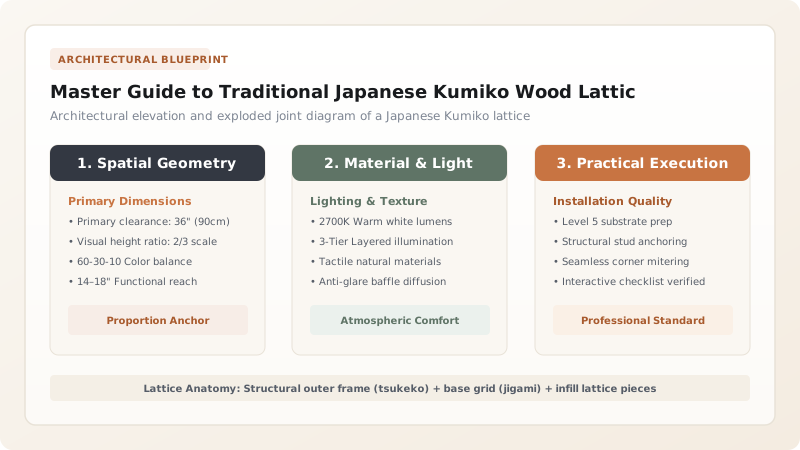
1. History & Philosophy of Japanese Kumiko Artistry
Developed alongside Buddhist temple architecture in the Asuka period (538–710 AD) and later integrated into residential shoin-zukuri and sukiya-zukuri tea house interiors, Kumiko (組子, literally "interlocking pieces") is a decorative and environmental technique that arranges micro-dimensioned wooden slats into intricate geometric webs.
Unlike Western latticework that relies on overlapping cross-halved battens nailed together, Kumiko relies on two-way and three-way half-lap notches cut with microscopic precision into thin wooden laths measuring only 1.2mm to 2.5mm thick. When slotted together, the surfaces sit flush in a single planar diaphragm, transforming partition walls (ranma transoms and shoji doors) into living tapestries of natural wood.
2. The Two Structural Layers: Jigami and Tsumiko
A complete Kumiko panel is organized into two distinct structural hierarchies:
- The Primary Grid (Jigami): The rigid structural framework formed from continuous vertical and horizontal (or 60° diagonal) wooden laths notched at regular intervals. The jigami establishes equilateral triangles, squares, or diamonds that act as the structural skeleton.
- The Decorative Infill (Tsumiko): The miniature patterned elements inserted into each cell of the jigami. Each tiny piece is mitered, notched, and beveled at its ends to fit inside the grid cavity purely through frictional interference fit, with zero adhesives.
3. Material Sourcing: Yoshino Hinoki & Akita Sugi
The survival and aesthetic brilliance of Kumiko depend strictly on wood anatomy. Master artisans (tategu-shi) reject fast-grown plantation softwoods, selecting exclusively ancient, slow-grown timbers:
Yoshino Hinoki (Chamaecyparis obtusa) from Nara prefecture and Akita Sugi (Cryptomeria japonica) from northern Honshu are prized for their ultra-tight, straight medullary rays (over 20 to 30 annual growth rings per centimeter). This grain density ensures that thin 1.5mm slats do not warp, twist, or buckle across decades of seasonal humidity fluctuations.
Traditional Kumiko Pattern Geometry & Symbolism Matrix
Use this reference table to calculate exact physical dimensions, ratios, and specifications before purchasing:
| Geometric Pattern | Japanese Name | Underlying Grid (Jigami) | Auspicious Symbolism | Focal Interior Placement |
|---|---|---|---|---|
| Hemp Leaf | Asanoha (麻の葉) | Triangular 60° Grid | Rapid healthy growth, vitality, protection from evil | Shoji doors, centerpiece wall panels |
| Tortoise Shell | Kikkou (亀甲) | Hexagonal Honeycomb | Longevity, endurance (10,000 years of life) | Ranma transom screens, scholar alcoves |
| Cherry Blossom | Sakura (桜) | Diamond / Triangular | Renewal, ephemeral beauty, spring prosperity | Decorative room dividers, tea ceremony niches |
| Square Check | Kaku-kumiko (角組子) | Orthogonal 90° Grid | Balance, order, structural calm | Window shoji screens, perimeter sliding panels |
Craftsmanship & Environmental Constraints
Every successful decoration project must account for physical and environmental constraints:
Extreme Tooling Tolerance
An error of just 0.1mm in notch spacing compounds across a 50-cell grid into a 5mm misalignment, preventing assembly.
Relative Humidity Sensitivity
Kumiko panels installed in dry air-conditioned rooms will shrink slightly; frames must allow subtle perimeter expansion.
Protocol for Sizing and Assembling an Asanoha Kumiko Panel
Execute this professional sequence to achieve flawless results without backtracking:
Precision Timber Resawing & Seasoning
Rip quartersawn Hinoki cants into 2.0mm thin slats; equilibrate in climate-controlled workshop for 21 days to achieve 9% EMC.
Kana Hand-Planing to Gauge
Plane wooden laths using a specialized Kumiko hand plane (kana) fitted with calibrated steel depth stops, holding ±0.05mm thickness tolerance.
Notch Gang-Cutting with Pull-Saw
Clamp bundled jigami slats in precision indexing guide jigs; cut 60° half-lap relief notches using fine Japanese dozuki saws.
Jigami Base Grid Assembly
Interlock notched jigami laths into equilateral triangular matrix; tap joints flush using a soft wooden block and horn hammer.
Tsumiko Infill Beveling & Slicing
Bevel ends of miniature infill pieces on specialized angular cutting jigs (kumiko-kezuri-dai) at exact 30°, 60°, and 120° angles.
Friction-Fit Locking & Frame Mounting
Insert three-way infill leaves into triangular cells, locking joints under gentle thumb pressure; mount assembly into grooved tsukeko outer frame.
Common Mistakes & Countermeasures
Avoid these costly errors that compromise aesthetics, ergonomics, and budget:
Using PVA or cyanoacrylate glue to bond Kumiko infill pieces
Planing Kumiko slats with grain running in opposing directions
Project Execution Checklist
Track your physical progress. Checkboxes persist automatically on this device:
Frequently Asked Questions
How long do traditional Kumiko screens last without glue?
When crafted from high-grade quartersawn Hinoki cypress and kept indoors away from direct rain, authentic friction-fit Kumiko screens easily endure for over 150 to 300 years, tightening naturally as timber ages under atmospheric carbonation.
Can Kumiko screens improve room acoustics?
Yes. The thousands of three-dimensional angled wooden facets act as a mathematical acoustic diffuser, scattering high-frequency sound waves across multiple angles and eliminating harsh flutter echoes in rooms with hard floors or glass.


