
Diffused Light Transmission and Acoustic Dampening represent the sophisticated environmental physics embedded within Kumiko screens. Functioning as architectural light filters and sound diffusers, Kumiko lattices transform harsh, high-contrast exterior sunlight into soft, uniform ambient daylighting through multi-angle optical scattering. When paired with translucent mulberry Washi paper, screens eliminate visual glare while the thousands of three-dimensional wooden facets scatter acoustic reflections, eliminating flutter echoes and enhancing conversational intimacy.
At a Glance: Key Takeaways
- Lambertian Light Scattering: Three-dimensional slat depth scattering direct solar rays into omni-directional soft illumination.
- Daylight Glare Mitigation: Reduces 80,000-lux exterior solar glare to an optimal 300 to 450 lux interior reading environment.
- Acoustic Reflection Diffusion: Faceted slat edges breaking specular flutter echoes in minimalist tea house architecture.
- Kozo Washi Paper Synergy: Handmade mulberry paper backing providing thermal vapor buffering and shadow gradation.
- Passive Microclimate Ventilation: Unbacked Kumiko transoms (ranma) permitting continuous convective room air exchange.
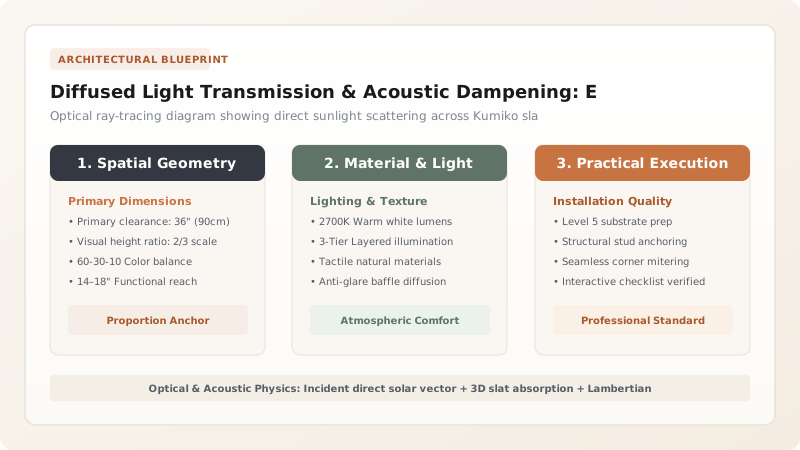
1. Optical Physics: Slat Depth-to-Spacing Ratios & Glare Control
Unlike flat window glass which transmits harsh, directional light beams, a Kumiko screen functions as an array of miniature three-dimensional optical louvers. The ratio between the depth of the wooden slats (typically 10mm to 15mm) and the open aperture spacing (15mm to 30mm) establishes a precise solar cutoff angle.
Direct sunlight striking the screen at angles greater than 45° cannot penetrate directly into the room. Instead, the incident rays strike the silky, hand-planed faces of the pale Hinoki cypress. The light is reflected multiple times within each geometric cell, converting harsh, blinding glare (often surpassing 70,000 lux outdoors) into a gentle, non-directional illumination of 300 to 500 lux, perfectly tuned to human visual comfort.
2. Synergy with Mulberry Washi Paper
In exterior-facing shoji doors, the Kumiko lattice is backed with traditional Washi paper hand-made from the inner bark fibers of the paper mulberry tree (Broussonetia papyrifera / Kozo).
Under microscopic analysis, Kozo washi consists of long, intertwined cellulose fibers with thousands of microscopic air pockets. When light passes through the paper, it undergoes Lambertian diffuse scattering—transmitting over 50% of visible light while rendering the source completely diffuse. Furthermore, the porous washi paper breathes naturally, absorbing excess humidity during humid summer rains and releasing it during dry winter days.
3. Acoustic Wave Scattering & Flutter Echo Elimination
In traditional Japanese interiors dominated by smooth wood ceilings and tatami mats, hard perpendicular surfaces can generate irritating flutter echoes (repetitive high-frequency sound reflections between parallel walls).
An open-work Kumiko screen acts as a quadratic-residue acoustic diffuser. When high-frequency sound waves (1,000 Hz to 8,000 Hz, corresponding to the human voice and musical instruments like the koto) strike the lattice, the alternating depths and angled facets scatter the sound energy across multiple directions and phase angles. This eliminates harsh slap-back reflections, creating an intimate, tranquil acoustic environment prized for tea ceremonies and meditation.
Kumiko Environmental Performance Specifications
Use this reference table to calculate exact physical dimensions, ratios, and specifications before purchasing:
| Screen Configuration | Visual Light Transmittance (VLT) | Acoustic Diffusion Coeff. (2 kHz) | Thermal Shading (SHGC) | Primary Application |
|---|---|---|---|---|
| Open Kumiko Transom (Ranma) | 45% - 65% Open | 0.72 (High High-Freq Scatter) | 0.38 (Direct Sun Cutoff) | Interior ventilation & acoustic softening |
| Washi-Backed Shoji Screen | 35% - 48% Diffuse | 0.55 (Moderate Absorption) | 0.26 (Superior Heat Shading) | Perimeter exterior sliding windows |
| Double-Glazed Inset Kumiko | 40% - 52% Clear | 0.35 (Standard Glass Profile) | 0.22 (Low-E Modern Assembly) | Contemporary luxury facade glazing |
| Acoustic Wall Feature Panel | 20% - 35% Deep Lattice | 0.85 (Optimized Diffusion) | N/A (Interior Wall Element) | Recording studios, boardrooms, concert halls |
Maintenance & Environmental Constraints
Every successful decoration project must account for physical and environmental constraints:
Washi Paper Lifespan
Authentic washi paper on sliding doors should be re-papered every 2 to 4 years to maintain pristine white translucency.
Direct Rain Exposure
Unprotected Kumiko lattices must never be installed on exterior facades without an outer layer of protective architectural glass.
Protocol for Mounting and Backing Kumiko Screens with Washi Paper
Execute this professional sequence to achieve flawless results without backtracking:
Lattice Dusting & Degreasing
Wipe completed Kumiko lattice with dry microfiber cloths to remove all wood dust; ensure surface is completely dry.
Wheat Starch Paste Preparation
Cook pure refined wheat starch (shofu-nori) with distilled water into a translucent, reversible, neutral-pH paste.
Washi Paper Sizing & Rolling
Select handmade Kozo washi paper; unroll sheets with smooth side facing outward; allow paper to relax in room humidity for 2 hours.
Paste Application along Jigami Rails
Dab diluted wheat paste along the back perimeter rails of the Kumiko frame using a soft goat-hair pasting brush.
Washi Stretching & Adhesion
Lay washi paper smoothly across the pasted frame; smooth outward from center with a dry horsehair smoothing brush.
Tension Water Misting
Lightly mist the dried paper with fine atomized water; as the washi dries, it shrinks taut as a drumhead with zero wrinkles.
Common Mistakes & Countermeasures
Avoid these costly errors that compromise aesthetics, ergonomics, and budget:
Using modern synthetic wallpaper paste or vinyl glues to adhere Washi paper to Kumiko
Applying water misting before the perimeter paste has fully dried
Project Execution Checklist
Track your physical progress. Checkboxes persist automatically on this device:
Frequently Asked Questions
How do you clean dust out of an intricate Kumiko screen?
In Japan, artisans use a traditional soft feather duster (hataki) or a gentle canned-air blower to dislodge dust from the tiny geometric crevices. A vacuum cleaner brush must never be pressed directly against the delicate wood slats.
Can modern low-E double glazing incorporate authentic Kumiko panels?
Yes. Leading contemporary architects encapsulate authentic hand-crafted Kumiko panels inside the sealed cavity of double-glazed insulated glass units (IGUs), protecting the delicate woodwork from dust and moisture while delivering modern thermal U-values.


