
Hand-Planed Kana Joinery Without Nails or Glue is the technical craft engine behind Kumiko screens. Eliminating modern mechanical fasteners and chemical adhesives, master joiners (tategu-shi) utilize traditional Japanese pull-planes (kanna) with forged laminated steel blades (shirogami/aogami) tuned to take shavings under 15 microns thick. Operating specialized wooden shooting boards and angle-guide jigs (kezuri-dai), craftsmen shape thousands of micro-notches and compound miters to tolerances under ±0.05mm, relying on timber's natural cellular elasticity to lock joints forever.
At a Glance: Key Takeaways
- Laminated Japanese Kanna Blades: Blue paper steel (Aogami) forged with soft iron backing taking razor 10-micron shavings.
- Angle-Guide Jigs (Kezuri-Dai): Hardwood shooting blocks with precision 30°, 45°, and 60° ramps guiding plane passes.
- Sub-Millimeter Tolerancing (±0.05mm): Essential to prevent cumulative dimensional skew across repeating multi-cell grids.
- Natural Cellular Friction: Wood cell tracheids compressing during insertion and expanding to form irreversible friction locks.
- Zero-Glue Longevity: Reversible, breathable assembly that flexes with seasonal humidity without brittle glue-line failure.
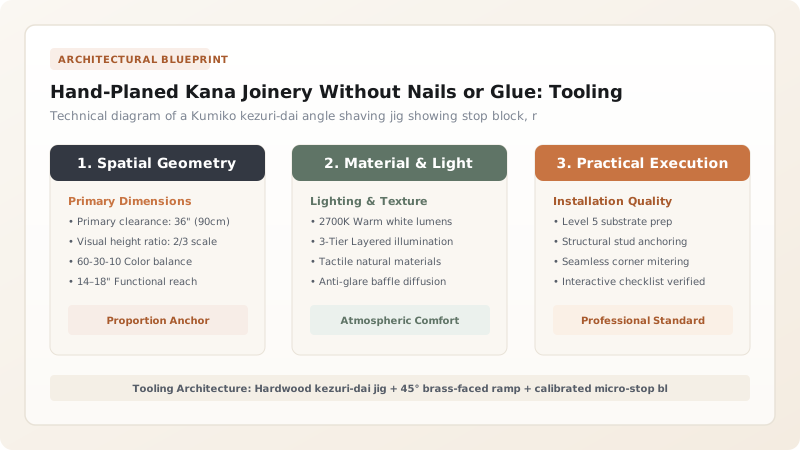
1. The Japanese Hand Plane (Kanna): Steel Metallurgy & Tuning
At the center of Kumiko woodworking is the Kanna. Unlike Western planes pushed forward, the Japanese kanna is pulled toward the craftsman's torso, utilizing the large muscles of the back and legs to achieve absolute control and linear stability.
The cutting blade (kanna-shin) is forged by traditional blacksmiths using laminated carbon steel: a paper-thin layer of ultra-hard high-carbon steel (Hitachi White Paper Steel #1 / Shirogami or Blue Paper Steel #1 / Aogami, hardness HRC 64–66) forge-welded to a body of ductile, shock-absorbing wrought iron. Sharpened on natural Japanese waterstones (tennen toishi) up to 10,000 grit, the blade slices wood cells cleanly rather than tearing them, leaving a water-repellent, mirror-smooth burnished surface that requires zero sandpaper.
2. Precision Guide Jigs (Kezuri-Dai)
Human hands cannot reliably hold a 15mm wooden slat at an exact 60° angle across thousands of repetitions. Master joiners fabricate specialized shooting boards termed kezuri-dai.
Crafted from stable, dense hardwoods like Japanese oak (kashi) or pearwood, the kezuri-dai incorporates ramped slots milled at exact angles (30°, 45°, 60°, and 67.5°) equipped with adjustable brass micro-stop blocks. The artisan lays the thin Kumiko slat into the slot, and passes the kanna over it. The plane cuts until its wooden sole touches the reference surface of the jig, automatically cutting the wood to the exact angle and length within ±0.05mm.
3. The Physics of Glue-Free Friction Locking
The structural cohesion of a Kumiko screen relies on elastic cell deformation and friction. When a slat is pressed into a half-lap notch that is machined 0.05mm narrower than the slat thickness, the microscopic tubular wood cells (tracheids) compress elastically.
Once seated, the natural hygroscopic elasticity of the wood causes the compressed cells to exert outward normal force (\(F_n\)) against the notch walls. According to Amontons' Law of Friction, the frictional holding force \(F_f = \mu \cdot F_n\) is distributed across hundreds of contact nodes, creating a unified structural diaphragm that can withstand substantial seismic vibration and physical handling without shifting.
Essential Kumiko Specialty Tooling Specifications
Use this reference table to calculate exact physical dimensions, ratios, and specifications before purchasing:
| Tool Name | Japanese Name | Steel / Material Specification | Primary Workshop Function |
|---|---|---|---|
| Finishing Pull-Plane | Hira-Kanna (平鉋) | Aogami #1 Blue Paper Steel + Oak Dai | Planing slats to calibrated uniform thickness |
| Angle Shaving Block | Kezuri-Dai (削り台) | Quarter-sawn Japanese White Oak | Guides plane to cut precise 30°/45°/60° miters |
| Fine Kerf Pull-Saw | Dozuki-Nomi (胴付鋸) | 0.2mm High-Carbon Spring Steel | Cuts crisp, non-tearout half-lap relief notches |
| Paring Chisel | Tsuki-Nomi (突鑿) | Shirogami #1 White Paper Steel | Pares notch bottoms flat to uniform depth |
| Natural Waterstone | Awasedo (合砥) | Siliceous sedimentary stone (8000–12000 grit) | Final razor polish on plane blades |
Tooling & Workshop Constraints
Every successful decoration project must account for physical and environmental constraints:
Hand Tool Learning Curve
Mastering the tuning of a Japanese kanna sole and laminated blade requires months of dedicated apprenticeship.
Temperature-Humidity Workshop Stability
Variations in workshop humidity exceeding 15% will alter wood slat dimensions during a production run.
Protocol for Tuning a Kanna Plane for Micro-Thin Kumiko Shavings
Execute this professional sequence to achieve flawless results without backtracking:
Kanna Sole Trueing (Dai-Naoshi)
Scrape the wooden plane sole with a sole-scraper (dai-naoshi-kanna) to establish the traditional two-point or three-point contact plane.
Waterstone Blade Sharpening
Hone the blade sequentially on 1000, 3000, and 8000 grit waterstones until a flawless mirror bevel is achieved with zero burr.
Blade Projection Adjustment
Insert blade into wooden block; tap the blade crown with a soft iron hammer until the cutting edge projects less than 0.02mm.
Chipbreaker Setting
Set the secondary chipbreaker blade (osae-gane) within 0.3mm of the primary cutting edge to eliminate grain tear-out.
Test Shaving Verification
Pull plane across scrap Hinoki; verify that shavings emerge as a continuous, gossamer, translucent ribbon under 15 microns thick.
Production Slat Thicknessing
Plane bundled Kumiko slats using side-stop shooting boards, periodically checking thickness with digital micrometer calipers.
Common Mistakes & Countermeasures
Avoid these costly errors that compromise aesthetics, ergonomics, and budget:
Using a blunt plane blade that compresses wood fibers rather than slicing them
Neglecting seasonal swelling of the wooden plane body (dai)
Project Execution Checklist
Track your physical progress. Checkboxes persist automatically on this device:
Frequently Asked Questions
Why do Japanese carpenters pull planes toward themselves instead of pushing?
Pulling a tool utilizes the body's powerful back, latissimus, and core muscles while lowering the center of gravity, allowing smoother, steadier linear strokes with less chatter and blade deflection than pushing.
Can Kumiko pieces be cut accurately using modern CNC laser cutters?
Laser cutters burn and char the wood edges, sealing cell pores with melted lignin and leaving unsightly dark brown seams. Traditional Kumiko requires razor knife-cut surfaces where open, unburned wood tracheids can compress and interlock naturally.


