
Heavy-duty overhead ball-bearing trolleys and soft-close dampers are the critical rolling kinetic hardware that allow heavy solid-core pocket doors (up to 160 kg / 350 lbs) to glide effortlessly with fingertip force. Utilizing four-wheel articulated trucks fitted with sealed radial ball bearings (ABEC-5 rating) running inside extruded aluminum box tracks, paired with bi-directional hydraulic dampers that catch the door and decelerate it over its final 100mm of travel, they eliminate slamming, bouncing, and mechanical derailment.
At a Glance: Key Takeaways
- Four-Wheel Articulated Hangers: Pivoting center axle equalizing wheel load distribution across all four wheels on uneven track surfaces.
- Precision Sealed Bearings: ABEC-5 rated radial ball bearings packed with synthetic grease for 100,000+ maintenance-free cycles.
- Self-Centering Box Track: Heavy extruded aluminum track with curved wheel contact shoulders preventing wheel climb and derailment.
- Bi-Directional Soft Damping: Separate hydraulic pistons for both opening and closing cycles, preventing harsh slam impacts.
- Tool-Free Height Adjustment: Hanger bolt with cam-lock adjustment mechanism permitting ±6mm vertical door tuning without disassembling the jamb.
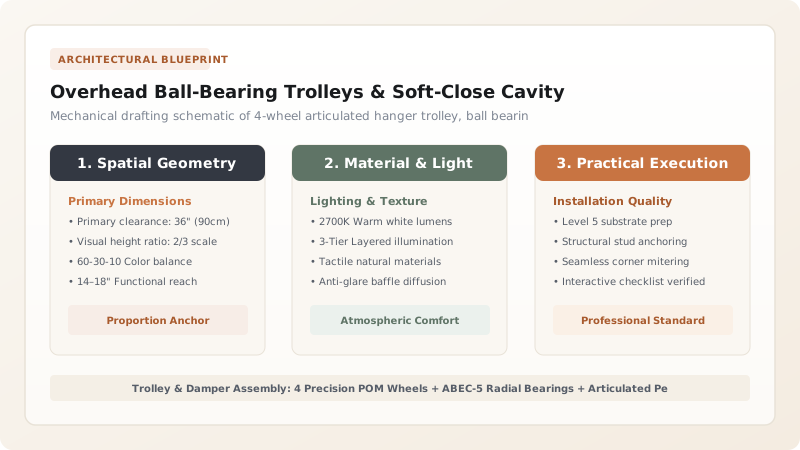
1. Tribology & Kinematics: Rolling Resistance & Ball Bearings
The effortless glide of a 120 kg solid oak pocket door depends on minimizing the total mechanical resistance force \(F_{\text{push}}\). This force consists of rolling resistance at the wheel-track interface plus internal rotational bearing friction:
Where \(W_{\text{door}}\) is door weight, \(R_{\text{wheel}}\) is wheel radius, \(r_{\text{bearing}}\) is bearing journal radius, \(\mu_r\) is rolling resistance coefficient (\(\approx 0.001\text{ m}\)), and \(\mu_b\) is internal ball bearing friction (\(\approx 0.0015\)).
In high-performance trolleys:
- ABEC-5 Deep-Groove Radial Bearings: Hardened chrome steel balls riding in precision-ground raceways, packed with low-viscosity synthetic grease and sealed with rubber contact seals (2RS) to lock out airborne drywall dust.
- High-Modulus POM Wheel Tires: The outer tire is CNC-machined from Polyoxymethylene (Delrin/Acetal) rather than cheap stamped steel or soft rubber. POM offers high tensile modulus (\(E \approx 3,100\text{ MPa}\)), preventing the formation of permanent 'flat spots' when a heavy door rests in one position for weeks. The required manual push force is barely \(6\text{ to } 9\text{ Newtons}\) (1.5 to 2.0 lbs)! Review framing in split-stud cage framing.

2. Damper Physics: Kinetic Energy Dissipation & Hydraulic Orifices
When a user forcefully pushes a 100 kg door toward the pocket, the door possesses substantial kinetic energy \(E_k = \frac{1}{2} m v^2\). Slamming into the back of the wall frame would shake the drywall, chip paint, and eventually crack plaster joints.
Modern cavity sliders solve this with Two-Way Hydraulic Soft-Close Dampers:
- Engagement Trigger: An actuator pin mounted on top of the door engages the spring-loaded carriage of the damper \(100\text{ mm}\) before full travel.
- Variable-Orifice Hydraulic Cylinder: The carriage drives a piston through a sealed silicone fluid chamber. As the piston advances, bypass orifices progressively narrow, exerting a resistance force proportional to velocity (\(F_d = -c \cdot v\)), absorbing kinetic energy smoothly regardless of whether the door was pushed gently or slammed violently.
- Final Tension Pull: An internal helical tension spring completes the final 20mm of stroke, pulling the door gently and silently into its fully closed (or fully recessed) position. Connect to trimless jambs in trimless plaster-in jamb profiles.
3. Track Engineering: Enclosed Box Profiles & In-Situ Serviceability
Older I-beam or J-track sliding systems allowed wheels to jump off the rail if bumped upward. High-end systems utilize Enclosed C-Channel Box Tracks:
- Anti-Jump Retention: The trolley wheels ride inside a fully enclosed hollow box extrusion. The bottom throat of the track is narrower than the wheel carriage, making physical derailment impossible even during seismic shaking or aggressive door lifting.
- Removable Track Section: A critical engineering innovation is the In-Situ Removable Track Throat. If a damper needs replacement after 15 years, a small access stop in the head jamb unbolts, allowing the trolley and damper to drop out into the doorway without cutting open finished drywall. Review master systems in our pocket door systems hub.
Sliding Door Trolley Technology Comparison
Use this reference table to calculate exact physical dimensions, ratios, and specifications before purchasing:
| Trolley System | Standard 2-Wheel Stamped Nylon | Heavy-Duty 4-Wheel Articulated Ball-Bearing | Magnetic Levitation (Maglev) Drive |
|---|---|---|---|
| Rated Capacity | 35 - 50 kg (75 - 110 lbs) | 120 - 160 kg (265 - 350 lbs) | 80 - 120 kg (175 - 265 lbs) |
| Wheel Bearing Type | Plain brass eyelet (unsealed) | Sealed radial ball bearings (ABEC-5) | Zero contact (permanent magnetic levitation) |
| Acoustic Noise Level | 48 - 55 dBA (rattling noise) | < 28 dBA (whisper-quiet glide) | < 15 dBA (absolute silence) |
| Push Effort Required | 15 - 25 Newtons (heavy drag) | 6 - 9 Newtons (fingertip glide) | 2 - 4 Newtons (frictionless) |
| Cost & Complexity | Low ($25 - $45) | Medium-High ($180 - $350) | Extreme ($2,500 - $5,000) |
Mechanical & Installation Constraints
Every successful decoration project must account for physical and environmental constraints:
Minimum Door Width for Two-Way Soft Close
Because both the opening damper and closing damper require linear track length (approx. 300mm each), installing two-way soft close requires a minimum door slab width of 750mm (30 inches). Narrower doors (e.g., 600mm) can only accommodate a single soft-close mechanism on the closing stroke.
Drywall Dust Infiltration into Track
During construction, airborne gypsum sanding dust settles into the aluminum track, contaminating wheel bearings and creating gritty rolling friction. The track throat must be sealed with protective foam tape until all painting and floor sanding is finished.
Misalignment of Damper Catch Pin
If the door height is adjusted up or down by 5mm, the top catch trigger pin can disengage from the damper jaws, causing the soft-close mechanism to fail to catch. The pin height must be recalibrated after final door leveling.
Overhead Trolley & Soft-Close Commissioning Protocol
Execute this professional sequence to achieve flawless results without backtracking:
Track Cleaning & Air Blast
Clean interior of aluminum box track with solvent wipe; blow out all dust and metal shavings with compressed air.
Damper & Trolley Insertion
Slide rear trolley, soft-stop damper, front trolley, and closing damper into track in sequential order; verify orientation of damper catch jaws.
Hanger Bolt Mounting & Door Suspension
Screw mounting plates into top edge of door slab at quarter-points; hoist door and engage hanger pendulum bolts into trolley receivers.
Plumb & Floor Clearance Tuning
Adjust vertical hanger bolts with spanner wrench until door is dead plumb and bottom floor clearance is uniform 6mm across the entire span.
Soft-Close Trigger Pin Alignment
Position track trigger pins so that damper activates exactly 100mm before door reaches the jamb stop; tighten pin set screws.
Cycle Testing & Speed Check
Cycle door 20 times at varying push speeds to confirm smooth hydraulic deceleration, zero bounce, and perfect latch engagement.
Common Mistakes & Countermeasures
Avoid these costly errors that compromise aesthetics, ergonomics, and budget:
Spraying Petroleum Lubricant (WD-40) into Track
Using Under-Rated Trolleys for Solid Timber Doors
Forgetting to Tighten Hanger Jam Nuts
Project Execution Checklist
Track your physical progress. Checkboxes persist automatically on this device:
Frequently Asked Questions
Can soft-close dampers be added to an existing old pocket door?
Usually no, unless the existing frame has a modern C-channel aluminum track that allows retrofitting. Traditional vintage pocket frames use convex I-beam rails or stamped sheet metal tracks that cannot accept modern damper cartridges without replacing the entire overhead track assembly.
How long do hydraulic soft-close dampers last?
Commercial-grade pocket door dampers are cycle-tested to EN 1527 standards for 100,000 continuous open/close cycles. In typical residential use (10 to 15 cycles per day), a quality hydraulic damper operates reliably for 15 to 20 years before the internal seals require replacement.
Why does my pocket door bounce back when closed forcefully?
Bounce-back occurs when the system lacks a hydraulic damper or when the rubber bumper in the jamb is too hard and elastic. Without damping, the kinetic energy of the door rebounds off the stop like a billiard ball. Installing a proper soft-close damper absorbs the kinetic energy and locks the door in place.


