
Secret bookcase doors and false-wall entrances utilize concealed mechanical and electronic access control systems to provide hidden, impenetrable panic room portals. Anchored by heavy-duty needle-thrust floor pivot bearings carrying up to 1,500 kg, the door is secured by fail-secure 24V electromagnetic shear locks delivering 15 kN (3,300 lbs) of shear holding force. Triggered by concealed biometric capacitive fingerprint readers, RFID proximity coils hidden behind veneer, or secret tilt books, they unlock silently in under 0.2 seconds.
At a Glance: Key Takeaways
- Concealed Floor Pivot Geometry: Oil-bath needle thrust bearings positioned at the center of mass to eliminate sagging and allow effortless swing.
- Magnetic Shear Lock Mechanics: Steel shear pins interlocking into magnetic armature plate resisting 15 kN of lateral forced-entry leverage.
- Covert Sensor Triggers: Capacitive touch sensors sensing hand presence through 20mm of solid wood paneling with zero visible hardware.
- Fail-Secure Deadbolt Redundancy: Motorized hardened stainless steel shoot-bolts extending automatically into steel frame receivers upon closing.
- Duress Code Automation: Secondary fingerprint scan or code that silently unlocks the door while simultaneously transmitting an emergency silent alarm to private security.
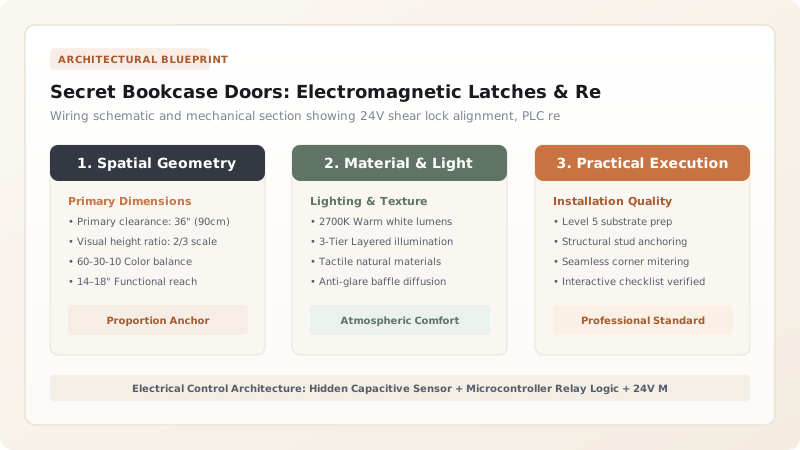
1. Door Kinematics: Floor Pivot Geometry & Centroid Alignment
A secret bookcase door loaded with books and steel armor weighs between \(500\text{ kg}\) and \(1,200\text{ kg}\). Standard side-mounted butt hinges fail rapidly under this load because the cantilevered moment arm \(M = W \cdot (w/2)\) tears screws from wall jambs.
Secret doors solve this using Heavy-Duty Architectural Center-Pivot or Offset-Pivot Bearings:
- Floor-Mounted Needle Thrust Bearing: The entire vertical dead weight is supported by a precision ground hardened steel thrust bearing grouted directly into the structural floor slab. Friction coefficient \(\mu < 0.005\), allowing a 1,000 kg door to be pushed open with less than \(15\text{ N}\) (3.3 lbs) of manual force.
- Kinematic Swing Clearances: To ensure the bookcase swings open without rubbing against adjacent wall shelving, the pivot axis is placed with a compound offset. The perimeter reveal gap is held to a tight \(2.5\text{ mm} \pm 0.5\text{ mm}\), masked by overlapping architectural shadow reveals or fluted pilasters. Review safe room enclosures in our secret safe rooms hub.

2. High-Security Locking: Magnetic Shear Locks vs Standard Maglocks
Standard architectural electromagnetic locks (maglocks) rely on direct tensile magnetic attraction. While rated at 1,200 lbs, an intruder with a 5-foot crowbar can generate over 2,500 lbs of leverage at the door edge, peeling standard maglocks open with ease.
Secret safe rooms require Magnetic Shear Locks:
- Mechanical Shear Pins: When energized, high-strength magnetic pull draws the armature plate into contact with the electromagnet, engaging hardened alloy steel shear studs into precision CNC-machined recesses.
- Shear Resistance: Any forced entry attempt must physically shear the steel alloy pins in half. Certified shear locks provide \(15,000\text{ N}\) (3,300 lbs) to \(22,000\text{ N}\) (5,000 lbs) of holding force.
- Motorized Stainless Deadbolts: Supplemented by two independent 24V motorized deadbolts with 25mm diameter case-hardened steel pins that extend 35mm into reinforced jamb strikes. Learn armor plate specs in ballistic steel cavity walls.
3. Access Control & Covert Relays: Capacitive Sensors & Duress Logic
The electronic access trigger must be totally invisible to intruders yet instantly accessible to homeowners during a violent home invasion:
- Sub-Veneer Capacitive Proximity Sensors: A copper foil antenna is laminated beneath the wood veneer of a specific book, decorative molding, or wood panel. Placing a palm against the surface changes the dielectric capacitance, triggering an optocoupled relay input.
- Biometric Fingerprint Scanner with Duress Algorithm: A covert capacitive fingerprint reader is hidden behind a hinged dummy book spine or inside a slide-out drawer. Enrolling the right index finger opens the door normally; enrolling the left pinky triggers a Silent Duress Signal that opens the door while silently transmitting an emergency panic alert to private security and police. Learn life support in CBRN filtration.
Secret Door Locking & Actuation System Comparison
Use this reference table to calculate exact physical dimensions, ratios, and specifications before purchasing:
| Locking Technology | Standard Face-Pull Maglock (1,200 lb) | Magnetic Shear Lock (3,300 lb) | Motorized Multi-Point Deadbolt System |
|---|---|---|---|
| Defeat Resistance (Pry Bar) | Poor (peels under crowbar leverage) | Exceptional (requires shearing steel pins) | Exceptional (multiple 25mm steel pins) |
| Aesthetic Concealment | Bulky box visible in door frame | 100% concealed inside top mortise | Concealed inside door edge and jamb |
| Locking Action Speed | Instantaneous (< 0.1 sec) | Instantaneous (< 0.2 sec) | 1.5 to 2.5 seconds (motor travel) |
| Power Failure Mode | Fail-Safe (drops lock on power cut) | Configurable (specify Fail-Secure) | Fail-Secure (remains locked mechanically) |
| Operating Noise | Silent magnetic hum | Silent magnetic click | Motor gear whirring sound (45 dBA) |
Electrical & Mechanical Secret Door Constraints
Every successful decoration project must account for physical and environmental constraints:
Door Warpage Causing Shear Pin Jamming
Natural seasonal wood movement (humidity changes) can shift door alignment by 2mm. If magnetic shear pins misalign with jamb strike holes, the lock cannot engage or release. Bookcase frames must be welded from steel tubing with wood facing only.
Flexible Power Transfer Wire Fatigue
Wires passing from wall to moving door fatigue and snap after thousands of open/close cycles. Use armored stainless steel flexible door loops or wireless inductive power transfer coils.
Power Grid Sabotage by Intruders
Attackers cut residential power mains upon entry. Lock controllers must run on a supervised 24V AGM/Lithium battery backup bank providing at least 72 hours of standby and 200 locking cycles.
Secret Bookcase Door & Lock Commissioning Sequence
Execute this professional sequence to achieve flawless results without backtracking:
Steel Subframe Fabrication & Wood Cladding
Weld rigid 50mm HSS steel tube door skeleton; dress with fine hardwood library shelves, maintaining true square within 1mm.
Needle-Bearing Floor Pivot Anchor Grouting
Core drill floor slab; seat bottom pivot base with high-strength non-shrink grout; verify pivot axis is strictly plumb with laser transit.
Magnetic Shear Lock Mortise & Wiring
Mill precision mortises in header steel tube and top door stile; install 24V shear lock and armature plate with spring-loaded anti-residual magnetism washers.
Covert Capacitive Sensor & Reader Installation
Adhere copper foil touch sensors behind veneer; mount biometric reader in hidden compartment; route shielded wiring through stainless pivot loop.
PLC Controller Programming & Power Supply
Wire 24V DC battery-backed power supply; program microcontroller logic for 5-second unlock dwell time, door-position monitoring, and duress relay.
Alignment, Gap Tuning & Camouflage Test
Hang door on pivot; tune top pivot adjustment screw until perimeter reveals are perfectly parallel (2.5mm); test silent operation and lock engagement.
Common Mistakes & Countermeasures
Avoid these costly errors that compromise aesthetics, ergonomics, and budget:
Using All-Wood Construction for Secret Bookcase Doors
Installing Fail-Safe Hardware Without Battery Backup
Creating Visible Door Reveal Shadows
Project Execution Checklist
Track your physical progress. Checkboxes persist automatically on this device:
Frequently Asked Questions
Can someone open the secret door if they find the hidden book trigger by accident?
High-security secret doors require two-factor authentication. For example, tilting the secret book closes a micro-switch that illuminates an invisible capacitive keypad or fingerprint sensor; only upon scanning an authorized fingerprint will the 15 kN shear lock release.
What happens if a battery dies while someone is locked inside?
Inside the safe room, all locks have direct, un-electrified mechanical egress overrides: turning a heavy internal thumbturn mechanically retracts the deadbolts and releases the door instantly, complying with fire escape life-safety codes.
How heavy can the books on the secret shelf be?
Because the door rotates on an industrial needle-bearing floor pivot rated for 1,500 kg (3,300 lbs), the shelves can be completely filled with hundreds of heavy hardcover encyclopedia volumes without causing the door to drag or bind.


