
A secret panic room is a fortified residential security sanctuary engineered to withstand forced entry, high-caliber ballistic assault, and biochemical threats while concealed behind architectural finishes such as moving bookcases or paneled walls. Built with UL 752 Level 8 ballistic steel or structural Kevlar composite wall envelopes, concealed heavy-duty needle-bearing floor pivot hinges carrying up to 1,000 kg, fail-secure electromagnetic shear locks (1,200+ lbs holding force), and autonomous positive-pressure NBC/CBRN air filtration, it guarantees occupant survival until emergency response arrives.
At a Glance: Key Takeaways
- Ballistic Enclosure Standards: UL 752 Level 8 / EN 1522 FB7 certified steel and woven aramid composite plates stopping multiple 7.62x51mm AP rifle rounds.
- Concealed Heavy-Duty Pivot Hinges: Precision oil-bath thrust needle-bearing hinges supporting 1,000 kg secret doors with zero floor deflection or drag.
- Dual-Stage Locking Mechanisms: 24V fail-secure electromagnetic shear locks (holding force > 15 kN) backed by motorized multi-point stainless deadbolts.
- Positive-Pressure CBRN Filtration: Autonomous HEPA + activated carbon gas scrubbers maintaining +50 Pa internal pressure against toxic chemical gas attacks.
- Emp-Hardened Satellite Comms: Faraday cage copper mesh shielding with dedicated subterranean fiber optic lines and satellite telephone uplink arrays.
In-Depth Guides in this Directory
Explore specialized subtopic blueprints, technical dimensions, and execution checklists:
Ballistic Steel Cavity Walls & Anti-Ram Foundation Anchors
Structural security engineering guide for panic room walls: Hardox 500 armor plate sizing, overlap joint spall guards, anti-ram floor anchors, and shear wall bracing.
Secret Bookcase Doors: Electromagnetic Latches & Relays
Architectural access control guide for secret doors: 15 kN magnetic shear locks, concealed floor pivot hinges, biometric capacitive sensors, and silent motorized deadbolts.
Autonomous NBC Air Filtration & Safe Room Oxygen Systems
Life support engineering guide for panic rooms: military-grade CBRN positive pressure scrubbers (+50 Pa), HEPA nuclear filtration, activated carbon, and closed-circuit oxygen resupply.
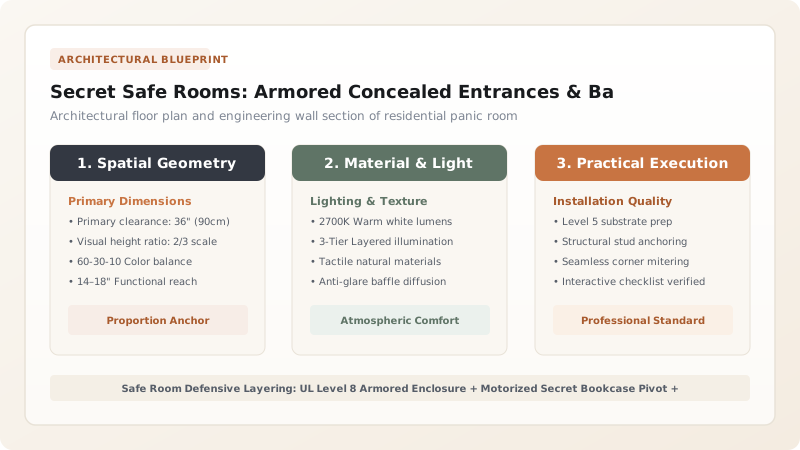
1. Ballistic Structural Mechanics: UL 752 Ratings & Kinetic Dissipation
Modern architectural panic rooms are classified according to stringent ballistic testing standards—primarily UL 752 (USA) and EN 1522 / EN 1063 (Europe). A residential safe room must be engineered to resist high-velocity military rifle calibers (e.g., 7.62x51mm NATO / .308 Winchester and 5.56x45mm NATO):
Ballistic impact creates extreme localized kinetic energy \(E_k = \frac{1}{2} m v^2\). For a 7.62mm NATO ball projectile (mass \(m = 9.7\text{ grams}\), velocity \(v = 840\text{ m/s}\)), the impact delivers over \(3,400\text{ Joules}\) of kinetic energy concentrated across a 7.8mm diameter impact zone within microseconds.
Walls are fortified using Cross-Laminated Structural Ballistic Panels combining:
- Hardened High-Hard Armor Steel (Hardox 500 / Armox 500T): 8mm to 10mm quenched steel plates with Brinell hardness of 500 HBW that shatter the hardened tungsten or steel bullet core upon impact.
- Woven E-Glass / Kevlar Aramid Composite Backers: Multi-ply woven roving panels bonded with thermoset polyester resin that catch spall fragments and dissipate residual shockwaves through tensile fiber delamination. Learn wall framing in our guide to ballistic steel cavity walls.

2. Architectural Camouflage: Secret Pivot Doors & Magnetic Shear Locks
The most effective defense is invisibility. If attackers cannot locate the door, they cannot attack it. However, disguising an 800 kg armored vault door behind a moving library bookcase creates formidable mechanical challenges:
- Heavy-Duty Oil-Bath Pivot Hinges: Cantilevered butt hinges will sag instantly under hundreds of kilograms of books and armor plate. Concealed doors utilize floor-mounted needle-thrust pivot bearings rated for \(1,200\text{ to } 2,000\text{ kg}\), transferring the entire vertical load directly into the building's concrete floor slab.
- Fail-Secure Electromagnetic Shear Locks: Standard maglocks pull apart under direct tensile leverage. Secret doors employ Magnetic Shear Locks where interlocking alloy pins engage in shear, delivering holding forces exceeding \(15,000\text{ N}\) (3,300 lbs) while operating completely silently.
- Concealed Biometric & Radio Triggers: Doors are opened via covert actions: tilting a specific false book spine, tapping an RFID fob concealed behind wall paneling, or scanning an optical sub-dermal fingerprint reader. Learn trigger circuits in bookcase latch and trigger relays.
3. Autonomous Life Support: CBRN Positive Pressure & EMP Hardening
If intruders discover the safe room and cannot breach the door, they may attempt to smoke occupants out or wait outside for days. A safe room must function as an independent life-support capsule:
- CBRN / NBC Air Scrubbing: A military-grade positive-pressure air filtration system equipped with nuclear-grade HEPA filters (99.995% retention at 0.3 microns) and ASZM-TEDA impregnated activated carbon filters. The blower pressurizes the room to \(+50\text{ Pascals}\) relative to the house, ensuring toxic smoke, tear gas, or nerve agents cannot enter through microscopic door gaps.
- Emergency Bottled Oxygen Resupply: For scenarios where exterior air intakes are sealed by fire or rubble, high-pressure medical oxygen cylinders (200 bar) combined with potassium hydroxide or soda-lime CO2 scrubbing canisters sustain occupants for up to 72 hours. Detailed HVAC schematics in our guide to CBRN filtration and oxygen resupply.
Panic Room Defensive Threat Level Matrix
Use this reference table to calculate exact physical dimensions, ratios, and specifications before purchasing:
| Defensive Tier | Tier 1: Forced Entry (Burglary) | Tier 2: High-Caliber Ballistic (UL Level 4-8) | Tier 3: Extreme Tactical & CBRN Nuclear |
|---|---|---|---|
| Threat Addressed | Pry bars, sledgehammers, handguns | Assault rifles (5.56 NATO, 7.62 NATO) | Armor-piercing rounds, smoke, nerve gas, EMP |
| Wall Construction | 12mm ballistic fiberglass + steel mesh | 8mm Hardox steel plate + Kevlar composite | 12mm Hardox + 200mm reinforced concrete + lead liner |
| Door Format | Reinforced solid timber + multi-point lock | Armored steel pivot door behind bookcase | Double-airlock motorized blast door |
| Air Filtration | Standard HVAC with manual damper shutoff | Independent HEPA smoke scrubber | Military-grade positive-pressure (+50 Pa) CBRN system |
| Holding Time Capability | 30 to 60 minutes | 4 to 12 hours | 72+ hours fully self-sustained |
| Approximate System Cost | $25,000 - $45,000 | $60,000 - $120,000 | $150,000 - $350,000+ |
Structural Engineering & Tactical Constraints
Every successful decoration project must account for physical and environmental constraints:
Floor Slab Load Capacity Under Armor Weight
Armoring a 3m x 3m safe room with steel and Kevlar adds 2,500 to 4,500 kg (5,500 to 10,000 lbs) of dead load. If installed on an upper residential floor, joists will fail without structural steel columns or carbon-fiber under-slab laminate reinforcement.
Cellular Signal Attenuation (Faraday Effect)
Ballistic steel plates and reinforced concrete completely block radio frequency (RF) and cellular telephone signals. Occupants cannot dial 911 unless hardwired coaxial antenna feeds, subterranean fiber cables, or hidden satellite antennas are pre-installed.
Door Jamming from Explosion Debris
An outward-swinging secret bookcase door can be trapped shut if heavy debris or collapsed drywall falls in front of the door swing. Safe rooms must incorporate an inward-opening secondary emergency escape hatch.
Secret Armored Panic Room Construction Sequence
Execute this professional sequence to achieve flawless results without backtracking:
Foundation Load Verification & Anchoring
Inspect concrete floor slab; core drill 16mm holes and chemical epoxy anchor heavy structural steel perimeter base channel tracks.
Ballistic Steel Wall Envelope Erection
Erect HSS structural steel tube wall frames; fasten overlapping Hardox 500 ballistic steel plates with Grade 8 hardened carriage bolts and ballistic fiberglass panels.
Concealed Pivot Hinge & Vault Door Hanging
Grout bottom needle-bearing pivot base plate into concrete slab; mount armored steel door slab; balance counterweights for single-finger swinging effort.
Electromagnetic Shear Lock & Deadbolt Wiring
Install concealed 15 kN magnetic shear lock in top header jamb; wire 24V fail-secure power supply with 72-hour lithium-iron battery backup enclosure.
Autonomous CBRN Air Scrubber & Vent Coring
Core drill blast-resistant intake and exhaust ducts through exterior masonry; install positive-pressure CBRN filtration unit with overpressure barometric damper.
Secret Bookcase Millwork Overlay & Camouflage
Build functional mahogany library bookcase facade directly onto the armored door face; calibrate soft-closing alignment and test covert trigger sensors.
Common Mistakes & Countermeasures
Avoid these costly errors that compromise aesthetics, ergonomics, and budget:
Using Fail-Safe Instead of Fail-Secure Maglocks
Leaving Exposed Hinges on Outward-Swinging Doors
Forgetting Emergency Hardwired Communications
Project Execution Checklist
Track your physical progress. Checkboxes persist automatically on this device:
Frequently Asked Questions
What is the difference between a safe room and a panic room?
The terms are used interchangeably, but in architectural security, a 'panic room' emphasizes immediate short-term survival (30 minutes to 2 hours) against home invasion until police arrive. A 'safe room' or 'survival sanctuary' is designed for extended multi-day habitation, incorporating CBRN air filtration, water storage, sanitation facilities, and emergency power.
Can someone detect the secret door by tapping on the walls?
High-end secret doors are acoustically dampened with high-density rockwool and constrained-layer damping sheets inside the door core. When tapped, the disguised bookcase or wood-paneled wall sounds solid, identical to surrounding non-moving architectural millwork.
How much does a fully loaded secret bookcase door weigh?
A standard 1.0m wide by 2.4m tall door comprising a heavy steel frame, 8mm ballistic armor plate, solid hardwood shelving, and 300 hardcover books weighs between 450 kg and 800 kg (1,000 to 1,750 lbs). Because it rotates on a precision oil-bath needle thrust bearing pivot, it can be swung open and shut smoothly with a single hand.


