
Motorized hopper vents in glazed cupolas utilize bottom-hinged sashes fabricated from thermally broken aluminum or bronze profiles with 34mm polyamide insulation struts to eliminate thermal bridging. Driven by concealed 24V DC synchronized electric chain actuators providing 300mm to 500mm of stroke, the sashes open inward to exhaust buoyant thermal air plumes driven by natural stack-effect thermodynamics, controlled automatically via environmental sensors.
At a Glance: Key Takeaways
- Thermal Barrier Insulation: 34mm glass-fiber reinforced polyamide (PA66 GF25) thermal struts separating interior and exterior metal sash extrusions.
- Chain Actuator Power: 24V DC low-voltage micro-processor controlled actuators delivering 300N to 600N of push/pull force with electronic limit stops.
- Chain Stroke Displacement: 300mm to 500mm linear travel providing an aerodynamic free opening area of at least 45% of total glazed aperture.
- Acoustic Silent Drive: Operating sound level below 32 dB(A), ensuring quiet operation in luxury residential and historic library environments.
- Weather Safety Overrides: Hardwired integration with exterior optical precipitation sensors and cupola-mounted cup anemometers for emergency auto-closure.
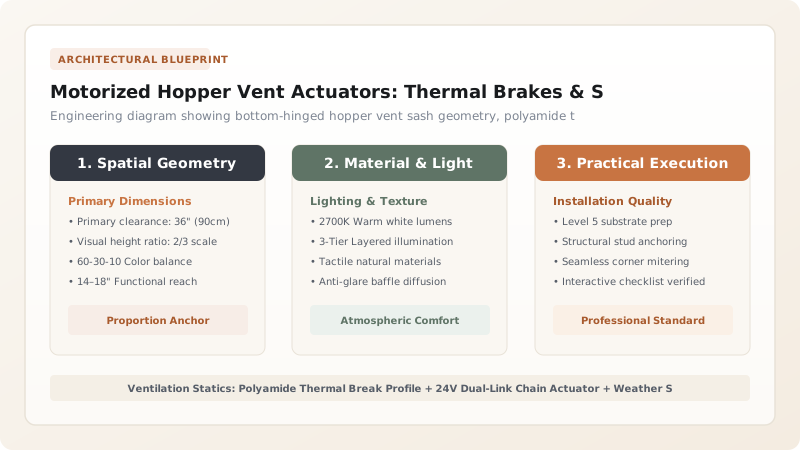
1. Thermal Barrier Metallurgy: Polyamide Struts & Condensation Resistance
Cupolas create extreme interior micro-climates. In winter, warm, highly humid air rises to the roof peak, where it meets exterior temperatures down to \(-20^\circ\text{C}\). Standard solid aluminum or bronze sash frames would suffer from severe thermal bridging, sweating gallons of condensation that would drip onto ceiling finishes below.
To eliminate thermal bridging, cupola hopper sashes are engineered with Polyamide Thermal Breaks (PA66 GF25):
- 34mm Multi-Chamber Struts: Interior and exterior architectural extrusions are mechanically separated by two continuous 34mm polyamide bars reinforced with 25% glass fiber, matching the thermal expansion coefficient of aluminum.
- Condensation Resistance Factor (CRF): The thermal break assembly achieves a minimum CRF rating of \(>72\) and an overall frame U-value of \(U_f \le 1.3\,\text{W/m}^2\text{K}\).
- Triple EPDM Gasket Envelopes: Dual perimeter compression gaskets and a continuous central acoustic fin gasket ensure an airtight seal (Class 4 airtightness under EN 12207) when sashes are locked under actuator tension.
2. Electric Chain Actuators: Push Force, Stroke Length & Concealment
Because cupola sashes are mounted 6 to 15 meters above the floor, manual cord or pole operation is impractical. Sashes are operated via precision 24V DC Electric Chain Actuators:
- Dual-Link Stainless Steel Chain: A rigid-backed stainless steel link chain emerges from a low-profile aluminum drive housing mounted to the curb sill. The chain resists buckling under high compressive push loads (up to \(600\text{ N}\) / 135 lbs).
- Stroke Kinematics: Actuators provide \(300\text{ mm} \text{ to } 500\text{ mm}\) of adjustable stroke length, tilting the bottom-hinged hopper inward to an angle of \(25^\circ \text{ to } 35^\circ\). This geometry directs incoming drafts upward toward the ceiling, avoiding direct cold downdrafts onto occupants.
- Concealed Sash Mounting: Slimline actuator housings (measuring only \(35\text{ mm} \times 45\text{ mm}\)) are recessed directly into the timber or aluminum mullion profile, leaving only the polished stainless chain visible when extended.
3. Natural Buoyancy Physics: Aerodynamic Sizing & Sensor Logic
The rate of air exchange through the open cupola hoppers is governed by the natural buoyancy of heated air. The Neutral Pressure Plane (NPP) of the building sits at roughly mid-height. Above the NPP, positive internal pressure pushes warm air outward through the cupola:
Where \(\Delta P_{\text{stack}}\) is the driving pressure differential (Pa), \(\rho_o\) is outdoor air density, and \(h\) is height above the neutral plane. To regulate this system automatically:
- BMS Micro-Climate Controllers: Actuators receive 0–10V modulating signals, opening sashes in 10% increments according to indoor \(\text{CO}_2\) levels (>800 ppm) and ambient temperature (>23°C).
- Weather Station Overrides: Optical rain sensors trigger an emergency high-speed close command (closing all 8 sashes in <12 seconds) upon detecting rain, while ultrasonic wind sensors close windward sashes during storms (>40 km/h) to prevent rain drive-in while keeping leeward sashes open for negative-pressure suction. Learn finial and flashing integration in our guide to copper-clad finials and flashing envelopes.
Actuator Sizing & Operational Specification Matrix
Use this reference table to calculate exact physical dimensions, ratios, and specifications before purchasing:
| Sash Height / Area | Required Push Force | Recommended Stroke Length | Actuator Model Spec |
|---|---|---|---|
| 500mm - 750mm (<0.6 m²) | 200N - 300N (45 - 65 lbs) | 250mm - 300mm Stroke | Single Compact Chain Drive (24V DC) |
| 750mm - 1200mm (0.6 - 1.2 m²) | 350N - 500N (80 - 112 lbs) | 350mm - 450mm Stroke | Medium-Duty Silent Drive (24V DC) |
| 1200mm - 1800mm (1.2 - 2.0 m²) | 600N - 800N (135 - 180 lbs) | 500mm - 600mm Stroke | Tandem Synchronized Dual-Chain Drive |
| Heavy Bronze Sashes (>100 kg) | 1000N+ (225 lbs+) | Hydraulic / Rack & Pinion | Heavy Industrial Linear Spindle Drive |
Electrical & Mechanical Operating Limits
Every successful decoration project must account for physical and environmental constraints:
Line-Drop Voltage Losses on 24V Circuits
Because cupolas sit 15-20 meters from electrical utility closets, 24V DC circuits suffer severe voltage drop over long wire runs. Size power conductors to minimum 2.5mm² (14 AWG) copper to ensure actuators receive full 24V.
Pinch Hazard Obstruction Detection
High-torque actuators can crush hands during closing cycles. Specify intelligent actuators with electronic current-sensing obstruction detection that reverses travel upon meeting a 100N resistance.
Condensation Freeze-Locking
In sub-zero winter climates, condensation dripping into sill gaskets can freeze sashes shut. Specify heated perimeter gasket profiles or current-limiting motor drivers to prevent motor burnout.
Motorized Hopper Vent Installation Sequence
Execute this professional sequence to achieve flawless results without backtracking:
Rough Opening Verification & Conduit Routing
Verify rough mullion openings are plumb within 1mm. Pull 4-core shielded 24V DC power and sensor bus wiring through pre-drilled internal timber mullion channels.
Thermally Broken Sash Sub-Frame Mounting
Fasten thermally broken aluminum or bronze sash frames into the octagonal timber posts using stainless Torx fasteners with EPDM isolating washers.
Bottom Hinge Pivot Alignment
Install heavy-duty stainless steel friction-stay bottom hinges. Verify sash swings freely without binding and compresses perimeter EPDM gaskets evenly by 3mm.
Chain Actuator Mounting & Bracket Attachment
Mount low-profile actuator body to curb sill with vibration-dampening neoprene pads. Fasten chain connector bracket to the top rail of the hopper sash.
Stroke Calibration & Limit Switch Programming
Connect programming pendant to actuator controller. Calibrate open stroke limit to 350mm and close limit to full gasket compression without motor stalling.
Weather Sensor Integration & Storm Testing
Mount optical rain sensor and wind anemometer on cupola spire. Simulate rain with spray bottle and high wind with blower, verifying 100% auto-closure in <12 seconds.
Common Mistakes & Countermeasures
Avoid these costly errors that compromise aesthetics, ergonomics, and budget:
Using Top-Hinged Awning Sashes in Cupolas
Daisy-Chaining Actuators Without Sync Modules
Omitting Secondary Manual Power Override
Project Execution Checklist
Track your physical progress. Checkboxes persist automatically on this device:
Frequently Asked Questions
Can cupola hopper actuators be integrated into a smart home system like KNX, Crestron, or Lutron?
Yes. Modern 24V DC actuators connect directly to home automation networks via relay modules, 0–10V analog interfaces, or native KNX/Modbus digital bus gateways, allowing automated opening schedules, temperature triggers, and mobile app monitoring.
How much energy does natural stack ventilation save compared to air conditioning?
In temperate spring and autumn seasons, utilizing stack ventilation through an automated cupola can reduce mechanical cooling loads by 40% to 75%, allowing commercial atriums and luxury residences to operate in complete passive cooling mode for weeks at a time.
Do hopper vents let in bugs when open at night?
No. Architectural cupolas are fitted with removable, fine-mesh stainless steel or bronze insect screens (minimum 18x14 mesh size) mounted flush with the exterior sash face, allowing unrestricted air exhaust while barring all insect entry.


