
Select fireplace stone by comparing material properties: ASTM C1364 dry-tamped cast stone delivers 6,500 to 8,500 PSI compressive strength with less than 6% water absorption and zero natural fissure lines. Natural quarried limestone (135–145 lbs/cu.ft / 4,000–6,000 PSI) offers authentic geological fossils and veining.
At a Glance: Key Takeaways
- ASTM C1364 Cast Stone Standards: Mandates minimum 6,500 PSI compressive strength and <6% cold water absorption.
- Elimination of Geological Fissures: Engineered cast stone eliminates hidden clay seams that crack under firebox heat.
- Density Comparison (135 to 145 lbs/cu.ft): Both materials share identical architectural mass and acoustic heft.
- Color Uniformity & Custom Sizing: Cast stone enables monolithic 7-foot lintel spans cast in precision CNC rubber molds.
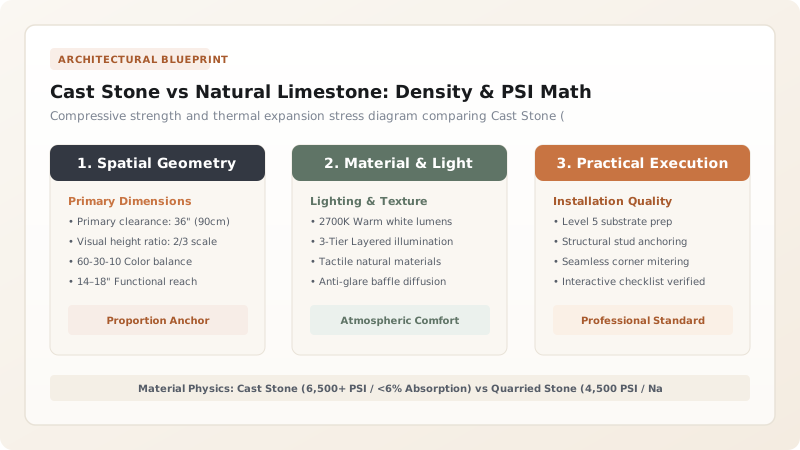
1. Material Science: Pneumatic Dry-Tamping vs Sedimentary Bedding
Natural limestone is formed over millions of years through sedimentary calcification of marine organisms. While beautiful, quarried limestone contains unpredictable bedding planes, clay seams, and quartz veins.
When exposed to intense \(400^{\circ}\text{F}\) radiant heat from an open firebox, moisture trapped in natural sedimentary veins expands, inducing spalling and thermal shock fractures. In contrast, ASTM C1364 Dry-Tamped Cast Stone is compacted uniformly in heavy molds using pneumatic rammers, yielding an isotropic, zero-fault mineral matrix. Learn structural framing in heavy stone mantel steel reinforcement.

2. Water Absorption (<6%) & Non-Combustible Fire Ratings
ASTM C1364 mandates that architectural cast stone maintain a water absorption rate under 6.0% (tested via 48-hour cold immersion). Low porosity prevents soot, wine, and cleaning chemicals from soaking deep into the stone.
Both cast stone and natural limestone achieve a Class A1 Non-Combustible Fire Rating (0 Flame Spread / 0 Smoke Developed), allowing them to be installed directly abutting firebox openings per NFPA 211 non-combustible clearance standards. For antique aesthetics, explore French Provencal stone mantels.
Cast Stone vs Natural Limestone Technical Data
Use this reference table to calculate exact physical dimensions, ratios, and specifications before purchasing:
| Physical Property | ASTM C1364 Cast Stone | Natural French Limestone | Architectural Impact |
|---|---|---|---|
| Compressive Strength | 6,500 - 8,500 PSI | 4,000 - 6,000 PSI | Cast stone has higher structural capacity |
| Density | 135 - 142 lbs/cu.ft | 138 - 148 lbs/cu.ft | Virtually identical substantial mass |
| Water Absorption | < 6.0% (Low porosity) | 4.0% - 9.0% (Variable) | Cast stone resists soot & wine staining |
| Thermal Shock Resistance | Excellent (No fissure planes) | Moderate (Can crack on vein lines) | Cast stone is ideal for high-BTU gas fires |
| Lead Time & Moldability | 4 - 6 Weeks (Cast from molds) | 12 - 16 Weeks (Milled in France) | Cast stone allows complex custom fluting |
Acid Cleaner Etching Constraints
Every successful decoration project must account for physical and environmental constraints:
Masons Using Muriatic Acid to Clean Mortar Smears Etching Stone Surface
Muriatic acid dissolves calcium carbonate, destroying the smooth honed finish of limestone and cast stone instantly; strictly prohibit hydrochloric/muriatic acid; use only pH-neutral stone cleaners or non-acidic efflorescence removers with nylon scrub brushes.
How to Specify and Inspect Architectural Cast Stone
Execute this professional sequence to achieve flawless results without backtracking:
Verify ASTM C1364 Lab Certification
Require supplier to provide certified lab test reports verifying ≥6,500 PSI compressive strength.
Specify Aggregate and Cement Proportions
Mandate crushed limestone aggregate mixed with White Portland Cement (ASTM C150 Type I/White).
Check CNC Rubber Mold Precision
Verify that fluted leg columns and dentil moldings are cast in seamless polyurethane rubber molds.
Inspect Curing Chamber Humidity Logs
Confirm stones were steam-cured at 95%+ relative humidity for 48 hours to reach full cure hardness.
Apply Penetrating Silane-Siloxane Sealer
Coat finished stone with breathable, penetrating water-repellent sealer (such as Prosoco Stand Off).
Common Mistakes & Countermeasures
Avoid these costly errors that compromise aesthetics, ergonomics, and budget:
Confusing Wet-Cast Precast Concrete with Architectural Dry-Tamped Cast Stone
Project Execution Checklist
Track your physical progress. Checkboxes persist automatically on this device:
Frequently Asked Questions
Does cast stone look like real natural stone?
Yes! High-grade ASTM C1364 cast stone is made of 85% crushed natural limestone aggregate. Once cured and acid-washed or honed, it is virtually indistinguishable from fine French or Indiana limestone to the naked eye.


