
Design authentic French Provencal fireplace mantels by sourcing hand-chiseled French Bourgogne limestone featuring a subtle segmental arched lintel (Campagnarde arch) supported by S-scroll console corbels. Back the firebox with a heavy 150-lb antique cast iron fireback plate (plaque de cheminée) to reflect radiant heat.
At a Glance: Key Takeaways
- 18th-Century Campagnarde Segmental Arch: A gentle 3-to-4-inch curved lintel rise creates relaxed, rustic French farmhouse warmth.
- Reclaimed French Pierre de Bourgogne: Hand-quarried limestone weathered over two centuries with fossil shells and soft aged patinas.
- S-Scroll Console Jamb Corbels: Curvilinear hand-carved bracket profiles transition heavy lintel weight gracefully into jamb plinths.
- Radiant Cast Iron Fireback Plates: 150-lb decorative iron plaques reflect 50% more heat back into the room while protecting masonry.
- Distressed Potash & Walnut Glaze Patinas: Aging newly carved limestone with mineral lye washes and walnut husk pigment.
In-Depth Guides in this Directory
Explore specialized subtopic blueprints, technical dimensions, and execution checklists:
Campagnarde Mantels: Arched Lintel & Corbel Proportions
Master French Provencal Campagnarde fireplace architectural proportions: calculating segmental arch rise ratios (1:12 arch slope), S-scroll corbel projection math, and carved cartouches.
Limestone Aging: French Bourgogne Patinas & Lye Washes
Master natural limestone distressing and aging craftsmanship: replicating 200-year-old French Pierre de Bourgogne patinas, potash lye washes, walnut husk stains, and soft wax finishes.
Fireback Plates: Cast Iron Metallurgy & Radiant Heat Physics
Master antique cast iron fireback engineering: Plaque de cheminée thermal emissivity physics, radiant heat reflection (+50% warmth), protecting firebrick masonry, and bracket mounting.
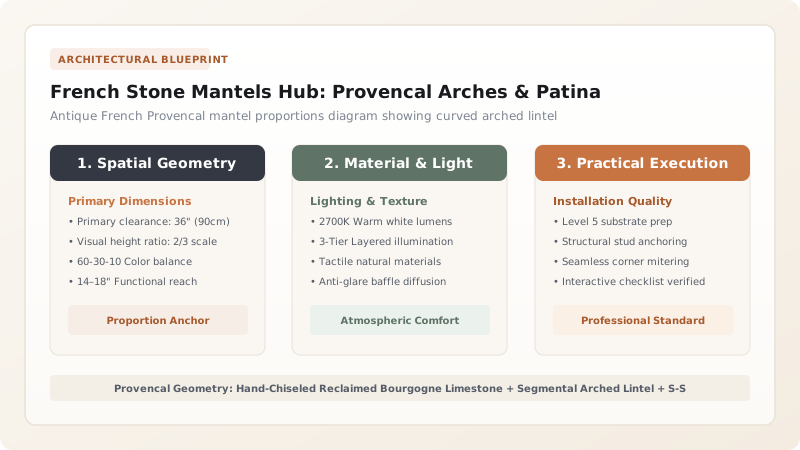
1. Classical Proportions: The Campagnarde Segmental Arched Lintel
Unlike rigid rectangular English Tudor fireplaces or grandiose Parisian Louis XIV mantels, the French Provencal Campagnarde Mantel is defined by its gentle, organic curves and pastoral proportions.
The central lintel features a shallow Segmental Arch (rising 3 to 4 inches at the apex), carved with a delicate raised central cartouche or olive branch motif. The lintel rests on Sculpted S-Scroll Console Corbels that flow into tapered side jambs. Learn how to calculate arch ratios in Campagnarde arched stone lintel proportions and coordinate with Nordic Gustavian palettes.

2. Reclaimed Pierre de Bourgogne & Radiant Fireback Metallurgy
True French mantels are carved from Pierre de Bourgogne—a dense, cream-colored limestone extracted from quarries in Burgundy, France. The stone contains natural calcified fossils and centuries-old hand-tool marks.
In the rear of the firebox, installing an authentic Cast Iron Fireback (*Plaque de Cheminée*) prevents roaring wood fires from cracking the back firebrick while increasing radiant heat reflection by over 50%. Master aging glazes in reclaimed limestone aging techniques and explore heat physics in cast iron fireback radiant physics.
French Architectural Fireplace Styles Comparison
Use this reference table to calculate exact physical dimensions, ratios, and specifications before purchasing:
| French Mantel Style | Historical Era | Lintel Geometry & Carvings | Aesthetic Character |
|---|---|---|---|
| Provencal Campagnarde (Optimal) | 18th Century Provence | Segmental curved arch + S-scroll corbels | Rustic country manor warmth |
| Louis XV Rococo (Parisian) | Mid-18th Century | Asymmetrical serpentine acanthus shell | Opulent formal Parisian salon |
| Louis XVI Neoclassical | Late 18th Century | Rectangular straight lintel + fluted jambs | Restrained aristocratic symmetry |
| Château Gothic / Renaissance | 16th - 17th Century | Monumental straight lintel + massive plinths | Imposing castle monumentality |
Antique Stone Structural Micro-Fracture Constraints
Every successful decoration project must account for physical and environmental constraints:
Reclaimed 200-Year-Old French Lintel Cracking During Crane Lift
Historic stone possesses internal centuries-old micro-fissures; lifting with center chains creates point tension that snaps the lintel; rig lifting with dual wide canvas cradle slings padded with rubber, lifting the stone smoothly without point stress.
How to Install an Antique Provencal Stone Mantel
Execute this professional sequence to achieve flawless results without backtracking:
Inspect Reclaimed Stone for Soundness
Tap stone lightly with wooden mallet; a clear ring indicates solid stone (dull thud indicates hidden fractures).
Lay Solid Bourgogne Limestone Hearth
Set 3" thick antique stone hearth slab on 1" mortar bed, leveling with cedar shims.
Anchor Console Corbels and Jamb Legs
Drill 1/2" holes and set stainless threaded rods in structural epoxy anchoring legs to masonry firebox.
Cradle Lift and Seat Arched Lintel
Use padded canvas slings to hoist arched lintel onto corbel shoulders, bedding in non-staining lime mortar.
Anchor Firebox Wall Ties
Fasten concealed stainless steel seismic strap ties from lintel back to chimney masonry.
Install Cast Iron Fireback Plate
Set 150-lb antique cast iron fireback on hearth bed against rear firebrick wall, securing with masonry brackets.
Common Mistakes & Countermeasures
Avoid these costly errors that compromise aesthetics, ergonomics, and budget:
Using High-Pressure Water Wash on Antique Hand-Chiseled Limestone
Project Execution Checklist
Track your physical progress. Checkboxes persist automatically on this device:
Frequently Asked Questions
How can you tell if a French limestone mantel is truly antique?
Look for hand-hewn chisel grooves (*boucharde* marks), soft rounded wear on bottom plinth corners where brooms rubbed, natural iron-oxide mineral patinas in recesses, and authentic 18th-century French quarry stone stamps.


