
Design authentic 18th-century Swedish Gustavian interiors by capturing Nordic winter light: finish architectural woodwork in chalky, ultra-matte egg tempera paints (pale Stockholm greys, chalk whites, and soft celadons). Detail with hand-carved fluted ribbon moldings and rosettes, paired with scrubbed pine floors treated with potash lye and white soap.
At a Glance: Key Takeaways
- Maximizing Nordic Winter Light: Pale chalky finishes bounce scarce Scandinavian winter daylight deep into interior rooms.
- Egg Tempera & Distemper Chalk Paints: Micro-porous, ultra-matte chalk finishes create a soft, luminous powdery glow.
- Neoclassical Carved Ribbons & Rosettes: Symmetrical fluting, laurel leaf garlands, and square corner rosette blocks.
- Potash Lye & White Soap Pine Floors: Lye leaches out yellow tannins; natural white soap buffing leaves silky blonde wood.
- Gilt Accents & Swedish Mora Clocks: Hand-carved curved wooden grandfather clocks and gold leaf looking-glass mirrors.
In-Depth Guides in this Directory
Explore specialized subtopic blueprints, technical dimensions, and execution checklists:
Gustavian Paint: Chalky Egg Tempera Recipes & Greys
Master authentic 18th-century Gustavian paint recipes: egg yolk tempera emulsion chemistry, champagne chalk (calcium carbonate), raw umber pigments, and Stockholm grey color formulation.
Gustavian Trim: Fluted Ribbons & Carved Rosette Blocks
Master 18th-century Gustavian architectural millwork: continuous fluted ribbon casings, hand-carved floral rosette corner blocks, dentil friezes, and pin-less corner joinery.
Scrubbed Lye Floors: Potash Lye & White Soap Chemistry
Master traditional Scandinavian scrubbed pine floor treatments: potash lye (potassium hydroxide) tannin bleaching, white-pigmented wood floor soap, and non-yellowing blonde patinas.
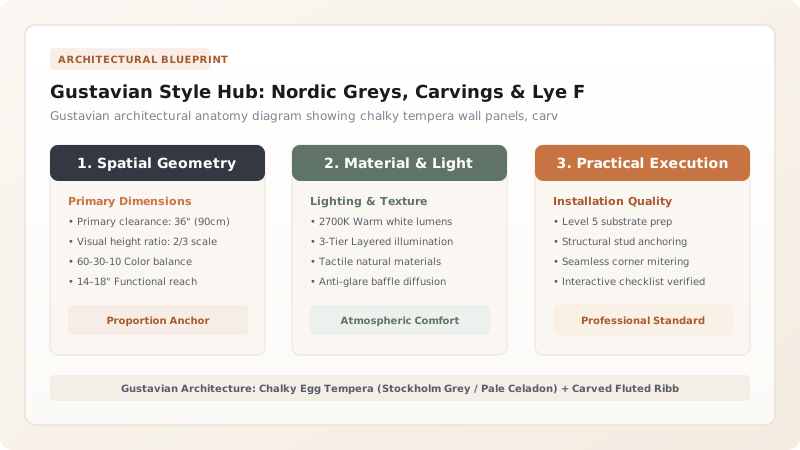
1. Royal Heritage: King Gustav III & The Swedish Neoclassical Adaptation
Inspired by his 1771 visit to the Palace of Versailles, King Gustav III brought French Louis XVI Neoclassicism to Sweden, transforming gilded royal grandeur into a restrained, luminous Scandinavian aesthetic.
Because Sweden faced long, dark sub-arctic winters and lacked marble quarries, royal craftsmen adapted grand French designs using local Scots pine painted in luminous chalky greys, soft blues, and whites. Master paint mixing in pale grey and egg tempera paint recipes and explore Scandinavian minimalist design.

2. Fluted Ribbon Trim & Traditional Potash Lye Scrubbed Floors
Gustavian carpentry is defined by clean Neoclassical architectural trim: fluted pilasters, carved laurel garlands, and square floral rosettes.
Floors are constructed from wide-plank Scots pine or spruce treated with traditional potash lye and white soap scrub treatments. Learn trim profiling in fluted ribbon carved trim and rosette corner blocks.
Gustavian vs French Louis XVI Architecture
Use this reference table to calculate exact physical dimensions, ratios, and specifications before purchasing:
| Design Element | French Louis XVI (Versailles) | Swedish Gustavian (Nordic) | Atmospheric Quality |
|---|---|---|---|
| Wood Materials | Exotic mahogany & heavy gilt bronze | Native Scots pine & birch | Restrained, airy provincial warmth |
| Paint Finishes | Gloss lacquer & heavy gold leaf | Ultra-matte chalk egg tempera | Soft, light-diffusing powdery glow |
| Primary Color Palette | Saturated royal gold, crimson & navy | Stockholm grey, pearl white & celadon | Maximizes scarce winter sunlight |
| Floor Treatment | Intricate high-gloss parquet de Versailles | Scrubbed lye and white soap pine planks | Silky, bare-foot Nordic naturalness |
Chalk Paint Moisture Rub-Off Constraints
Every successful decoration project must account for physical and environmental constraints:
Traditional Chalk Egg Tempera Rubbing Off on Clothing and Washing Away in Moisture
Pure distemper paint is water-soluble; in high-traffic hallways and bathrooms, seal chalk tempera finishes with two coats of dead-flat clear matte furniture wax or waterborne matte acrylic poly (Dead Flat <2% sheen) to protect against stains while preserving the powdery chalk look.
How to Design and Execute a Gustavian Interior
Execute this professional sequence to achieve flawless results without backtracking:
Install Neoclassical Fluted Door Casing
Frame openings with 3.5" wide fluted wood trim and 4" square carved floral rosette corner blocks.
Erect Beaded Wainscoting or Picture Rail
Install 36" tall tongue-and-groove beaded wainscoting capped with a classic Gustavian chair rail.
Mix Traditional Stockholm Grey Chalk Paint
Blend champagne chalk, titanium white, raw umber, and egg yolk emulsion to create authentic Nordic grey.
Apply Paint with Long-Bristle Brush Strokes
Brush two coats of tempera, leaving subtle visible horizontal brush texture to catch ambient light.
Treat Pine Floors with Potash Lye
Mop sodium/potassium lye solution over raw pine floors to bleach tannins and prevent yellowing.
Scrub Floors with White Wood Floor Soap
Mop floors weekly with white-pigmented vegetable oil soap to build a silky, dirt-resistant chalk-blonde patina.
Common Mistakes & Countermeasures
Avoid these costly errors that compromise aesthetics, ergonomics, and budget:
Applying Modern High-Gloss Polyurethane Over Gustavian Pine Floors
Project Execution Checklist
Track your physical progress. Checkboxes persist automatically on this device:
Frequently Asked Questions
What is Stockholm Grey in Gustavian decor?
Stockholm Grey (*Stockholmsvitt / Stockholmsgra*) is an 18th-century heritage paint color formulated with chalk white, a touch of lamp black, and raw umber. It changes tone throughout the day, appearing warm pearl in morning light and cool silver at twilight.


