
Install a heavy cast iron fireback plate (plaque de cheminée) against the rear firebox wall to protect firebrick masonry from thermal cracking and increase radiant heat output by 30% to 50%. Cast iron absorbs flame heat and acts as a thermal mass battery (emissivity \(\epsilon = 0.85\)), radiating gentle infrared heat into the room long after flames die down.
At a Glance: Key Takeaways
- Plaque de Cheminée Heritage: 16th to 18th-century French innovation originally cast in foundries across Alsace and Lorraine.
- High Thermal Emissivity (\(\epsilon = 0.85\)): Cast iron radiates stored thermal energy outward into the room with extreme efficiency.
- Protects Firebrick Masonry: Shields porous refractory firebrick from thermal shock spalling and corrosive wood ash acids.
- 100 to 200-Lb Solid Gray Iron Mass: High thermal storage capacity acts as a continuous radiant room heater for 4+ hours.
- Slotted Expansion Mounting Brackets: Heavy cast iron brackets allow the plate to expand thermally without buckling masonry.
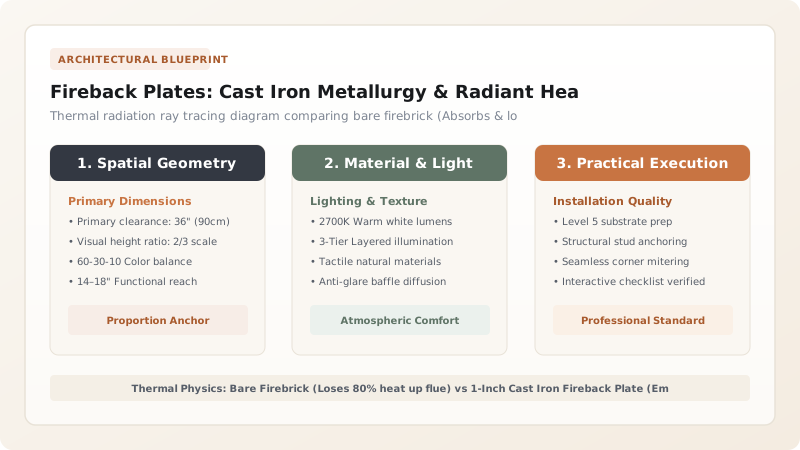
1. Thermodynamic Physics: The Stefan-Boltzmann Radiation Law
In an open masonry fireplace, up to 85% of heat escapes directly up the chimney flue, while the rear refractory firebrick absorbs heat and bleeds it slowly into the exterior chimney stack.
Installing a 1-inch thick Cast Iron Fireback (*Plaque de Cheminée*) fundamentally alters firebox thermodynamics according to the Stefan-Boltzmann Radiant Heat Law (\(q = \epsilon \cdot \sigma \cdot T^4\)). The dense gray cast iron reaches \(600^{\circ}\text{F}\), operating with a high Thermal Emissivity of \(\epsilon = 0.85\), casting a massive wall of Infrared Radiant Heat directly forward across the living room floor. Explore Provencal mantels in antique French stone mantels.

2. Metallurgy & Thermal Expansion Mounting Cleats
Cast iron expands significantly when heated to \(600^{\circ}\text{F}\). If a fireback is mortared rigidly into firebrick walls, thermal expansion will shatter the surrounding brickwork within days.
Installers set the fireback on Cast Iron Support Feet (*Chenets*) or fasten it using Slotted Stainless Steel L-Brackets anchored into mortar joints with a 1/2-inch air expansion gap behind the plate. Explore outdoor masonry cooking in outdoor masonry pizza oven complexes.
Fireback Plate Sizing Guide by Firebox Dimensions
Use this reference table to calculate exact physical dimensions, ratios, and specifications before purchasing:
| Firebox Back Wall Width | Optimal Fireback Dimensions | Plate Weight (Gray Iron) | Thermal Heat Increase |
|---|---|---|---|
| 24 Inches (610mm) | 20" Wide × 20" High | 65 - 85 lbs | +30% Radiant warmth |
| 30 Inches (760mm) | 24" Wide × 26" High | 95 - 125 lbs | +40% Radiant warmth |
| 36 Inches (915mm) Standard | 28" Wide × 30" High | 135 - 165 lbs | +50% Radiant warmth (Optimal) |
| 42 - 48 Inches Grand | 34" Wide × 36" High | 190 - 240 lbs | +55% Monumental heat battery |
Thermal Shock Water Splashing Constraints
Every successful decoration project must account for physical and environmental constraints:
Throwing Water on Roaring Fire Cracking Red-Hot Cast Iron Fireback
Throwing water onto a 600°F cast iron fireback causes violent thermal shock that cracks the iron plate in half instantly; never use water to extinguish wood fires; use a fireplace poker to scatter embers or suffocate flames with a firebox spark screen.
How to Size and Mount a Cast Iron Fireback
Execute this professional sequence to achieve flawless results without backtracking:
Measure Rear Firebox Wall Dimensions
Measure rear brick width and height; select fireback leaving at least 3 inches of brick exposed on all sides.
Position Cast Iron Fireback Support Feet
Set heavy cast iron support feet on the firebrick hearth 2 inches forward from the rear wall.
Place Fireback Plate into Support Grooves
Lower 150-lb cast iron fireback into the support foot slots, leaning plate back at slight 5° angle.
Install Top Slotted Safety Wall Cleats
Fasten two stainless steel slotted brackets into upper rear mortar joints to prevent forward tipping.
Maintain 1/2" Air Gap Behind Plate
Ensure 1/2-inch clear air space behind plate to allow unrestricted thermal expansion.
Season Iron with Stove Black Polish
Buff graphite stove black polish (such as Rutland Cast Iron Polish) over plate to prevent corrosion.
Common Mistakes & Countermeasures
Avoid these costly errors that compromise aesthetics, ergonomics, and budget:
Mortaring the Fireback Solidly into the Rear Masonry Wall
Project Execution Checklist
Track your physical progress. Checkboxes persist automatically on this device:
Frequently Asked Questions
Can you use a cast iron fireback in a gas fireplace?
Yes! A cast iron fireback can be installed behind gas logs to add historic elegance and reflect radiant heat forward into the room, creating an authentic European hearth appearance.


