
Gold leaf smalti tesserae are specialized architectural mosaic glass elements made by fusing 24-karat gold leaf between a base glass slab and a protective micro-thin vitreous glass layer (cartellina). Cleaved by hand using a traditional mosaicist's hammer (martellina) over a steel hardy anvil to produce faceted, light-refracting conchoidal edges, they are set in hydraulic pozzolanic lime mortar with microscopic angle tilts (5°–10°) to catch and refract ambient light.
At a Glance: Key Takeaways
- The Three-Layer Gold Sandwich: Heavy base glass (8mm) + beaten 24k gold leaf + 0.5mm protective transparent glass wafer (cartellina).
- Martellina Hammer & Hardy Cleaving: High-carbon steel hammer with chisel edges striking against a stationary steel wedge hardy anvil.
- Conchoidal Fracture Optics: Controlled natural glass cleaving producing angled faceted faces that refract light with brilliant fire.
- 5-to-10 Degree Setting Tilt: Hand-pressing tesserae into mortar with deliberate micro-angles to catch candlelight and natural daylight.
- Hydraulic Pozzolana Setting Bed: Lime putty blended with volcanic earth curing without thermal expansion, locking smalti glass permanently.
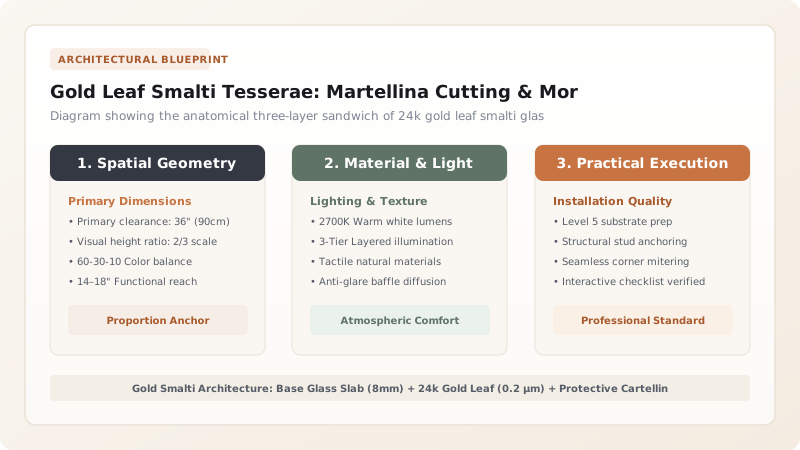
1. Vitreous Metallurgy: The 24-Karat Gold Leaf Glass Sandwich
Ordinary gilded glass (verre églomisé) has gold leaf applied with animal glue to the back of glass, which degrades rapidly under moisture. Authentic Venetian Gold Leaf Smalti (Smalti d'Oro) is a fused glass composite developed on the island of Murano:
- The Base Glass Slab: A slab of molten glass (typically dark red, amber, or opaque black soda-lime glass, 8mm thick) is cast onto a steel marver. The dark base color enriches the optical warmth of the gold.
- 24-Karat Pure Gold Leaf: Sheets of beaten pure gold leaf (purity \(> 99.99\%\), thickness barely \(0.1\text{ to } 0.2\, \mu\text{m}\)) are applied across the molten glass surface while hot.
- The Cartellina (Protective Wafer): A gather of crystal-clear blown glass is blown paper-thin into a bubble, burst, and pressed over the gold leaf while at \(800^\circ\text{C}\). The protective glass layer (the cartellina, thickness \(0.3\text{ to } 0.5\text{ mm}\)) fuses permanently to the base slab, hermetically sealing the gold leaf inside an impervious vitreous capsule. The gold leaf can never tarnish, oxidize, or peel. Review whole floor layout in our Cosmatesque mosaics hub.

2. Cleaving Mechanics: The Martellina Hammer & Hardy Anvil
Modern diamond tile saws produce smooth, polished, parallel edges that reflect light like dull bathroom mirrors. Authentic mosaic tesserae must be cleaved by hand using the ancient Martellina and Hardy (Tagliolo):
- The Tooling Geometry: The Hardy is a chisel-shaped steel wedge mounted vertically in a heavy wooden stump. The Martellina is a balanced hammer (mass 450g to 750g) with twin curved carbide or hardened steel chisel blades.
- Conchoidal Fracture Mechanics: The mosaicist balances the gold smalti slab on the sharp edge of the hardy, aligning the hammer blade directly above it. A swift, sharp tap delivers concentrated compressive shear stress directly through the glass. Glass fractures along natural Conchoidal Cleavage Planes:
The resulting tessera faces are not flat; they are subtly convex or concave facets. When installed, these millions of micro-facets scatter light in all directions, making the gold mosaic shimmer and dance with living light. Learn geometric design in porphyry and serpentinite guilloche geometry.
3. The Setting Craft: Angular Tilts & Pozzolanic Mortar Bedding
How the tesserae are pressed into the mortar bed dictates whether the mosaic looks alive or dead:
- The 5°–10° Intentional Angular Tilt: In classical Cosmatesque floors and Byzantine walls, tesserae are deliberately set with small micro-tilts (\(5^\circ\text{ to } 10^\circ\) off dead-flat). As a bather or worshipper walks across the room, the shifting viewing angle catches reflections from different gold cubes in sequence, creating an undulating, luminous sparkle.
- Pozzolanic Lime Mortar: The bedding mortar consists of aged slaked lime putty (CL 90-S) and fine volcanic pozzolana earth mixed with fine washed silica sand (1:1.5:1.5 ratio). The mortar remains workable for hours, allowing the artisan to carefully adjust each individual tessera height and angle before the lime sets. Discover roundel borders in our guide to polished marble roundels.
Mosaic Tesserae Cutting Method Comparison
Use this reference table to calculate exact physical dimensions, ratios, and specifications before purchasing:
| Cutting Method | Traditional Martellina & Hardy | Rotary Diamond Tile Saw | Compound Wheeled Mosaic Nippers |
|---|---|---|---|
| Cut Edge Texture | Conchoidal faceted cleavage (high sparkle) | Dead flat, smooth polished edge (dull reflection) | Slightly crushed, irregular edge |
| Cartellina Delamination Risk | Zero (clean shear through glass) | High (blade vibration chips gold wafer) | Moderate (can crush cartellina corners) |
| Production Speed | Fast (skilled rhythm: 60 cuts/min) | Slow (requires individual water feeds) | Moderate (causes hand fatigue) |
| Tessera Dimension Control | Sub-millimeter by tactile eye | Exact straight lines | Variable / irregular |
| Historical Authenticity | 100% Authentic Roman & Byzantine | Modern industrial (lacks soul) | Modern amateur / hobbyist standard |
Gold Smalti Handling & Installation Hazards
Every successful decoration project must account for physical and environmental constraints:
Cartellina Spalling from Grout Rubbing
Rubbing coarse sanded cement grout across freshly set gold smalti can scratch the micro-thin 0.5mm cartellina glass wafer or catch sharp edges, flaking off the protective glass and exposing the delicate gold leaf. Grout must be wiped with soft sponge floats using non-sanded superfine marble dust lime grout.
Mortar Bleed-Through Clouding Gold Faces
Pressing smalti too deeply into wet mortar forces lime slurry up between joints and over the face of the gold glass. If allowed to dry, caustic lime etches the glass surface permanently. Smalti faces must be wiped clean with damp sponges immediately during setting.
High Cost & Material Scarcity
Genuine 24k gold leaf smalti manufactured in Murano costs $1,200 to $2,500 per square meter. Cutting errors or shattered wafers cause substantial monetary waste. Artisans must practice cutting techniques on ordinary colored smalti before cleaving gold.
Gold Smalti Cleaving & Setting Execution Sequence
Execute this professional sequence to achieve flawless results without backtracking:
Hardy Anvil Seating & Hammer Weight Selection
Firmly wedge high-carbon steel hardy into heavy tree stump; select 500g carbide-tipped martellina hammer matched to glass slab thickness.
Gold Smalti Slab Stripping
Balance 8mm thick Murano gold smalti slab across hardy edge; score and strike along straight line to cleave into 10mm wide strips (tagliatelle).
Tesserae Cube Cleaving
Feed strip over hardy; strike with rhythmic hammer taps to cleave into uniform 10mm x 10mm cubes with natural conchoidal fractured edges.
Pozzolanic Lime Mortar Preparation
Mix aged slaked lime putty (CL 90) with fine red pozzolana earth and marble flour; trowel 15mm bedding layer over screed; comb with 6mm notched trowel.
Tesserae Setting & Angular Calibration
Using tweezers, press individual gold smalti cubes into mortar following architectural cartoon; introduce 5-degree subtle tilt angles toward the light source.
Face Cleaning & Damp Sponge Curing
Clean glass faces with damp cellulose sponge; mist with water fog; wet-cure under damp burlap cloths for 14 days to achieve maximum lime carbonation.
Common Mistakes & Countermeasures
Avoid these costly errors that compromise aesthetics, ergonomics, and budget:
Using Diamond Tile Saws on Gold Smalti
Setting Gold Smalti Completely Dead-Flat
Using Acidic Cleaners to Remove Mortar Haze
Project Execution Checklist
Track your physical progress. Checkboxes persist automatically on this device:
Frequently Asked Questions
Can you use gold leaf smalti on high-traffic floors?
Yes! Because the 24k gold leaf is hermetically protected beneath the fused 0.5mm cartellina glass wafer, foot traffic contacts only the durable, high-hardness glass surface. In historic Roman basilicas and Westminster Abbey, gold smalti in floor pavements has survived centuries of walking without wearing through to the gold layer.
What is the difference between 'yellow gold' and 'white gold' smalti?
Traditional gold smalti uses pure 24-karat yellow gold leaf (oro giallo) over amber glass. However, Murano glassmakers also produce 'white gold' (oro bianco, made with pure white gold or silver leaf under transparent glass) and 'lemon gold' (22k gold alloyed with a hint of silver) to create subtle tonal shading across intricate mosaic designs.
Why is the hammer called a 'Martellina'?
The word 'Martellina' is the Italian diminutive for hammer (martello). Its distinctive curved shape and razor-sharp chisel edges were specifically developed by Roman and Venetian mosaicists over 1,500 years ago to concentrate maximum cutting force on a microscopic glass contact point with minimal hand effort.


