
Dry-packed stone dust grouting involves sweeping fine, well-graded crushed stone flour (0-2mm particle size) into the 2-5mm joints between compacted Calçada cubes, followed by light mist hydration to induce micro-consolidation. This unbonded mineral joint system achieves high shear resistance through aggregate particle interlocking while providing exceptional stormwater permeability (infiltration rates of 50-150 mm/hr) without cement cracking.
At a Glance: Key Takeaways
- Mineral Aggregate Grading: Finely crushed limestone or basalt stone flour (0-2mm with 10-15% sub-0.063mm mineral fines).
- High Stormwater Infiltration: Water permeability coefficient \(k = 3.0 \times 10^{-5}\text{ to } 7.5 \times 10^{-5}\text{ m/s}\), actively preventing puddle formation.
- Aggregate Interlocking Shear: Micro-angular crushed particles wedge tightly under pedestrian traffic, resisting vacuum uplift from street sweepers.
- Multi-Pass Water Misting: Light, atomized water spray applied in 3 distinct passes to settle infill without washing stone dust out of joints.
- Thermal Self-Healing: Free from rigid portland cement, joints self-adjust during 40°C summer expansions and sub-zero winter contractions.
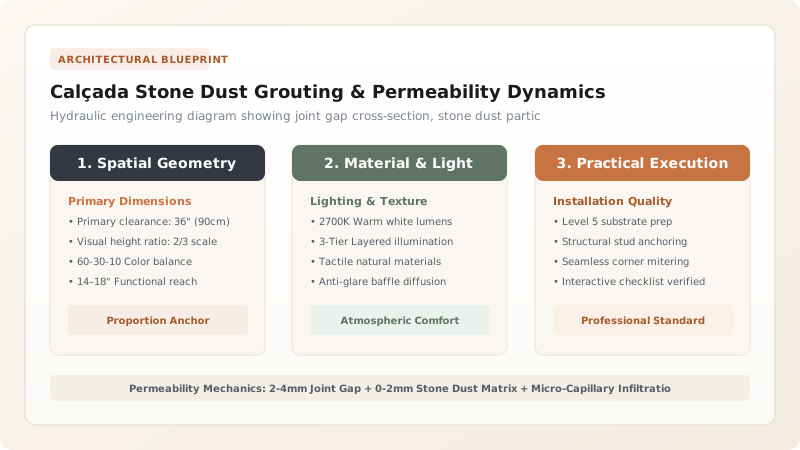
1. Mineral Grout Grading: The Physics of Aggregate Interlock
Unlike modern polymeric sands or rigid cementitious mortars, traditional Calçada Portuguesa relies on Pó de Pedra (Crushed Stone Flour) for joint stabilization:
The Terzaghi filter criteria govern joint particle stability against bedding sand loss:
- Grain Distribution: The ideal joint mineral mix spans 0 to 2 mm. Crucially, it must contain 10% to 15% sub-0.063mm mineral filler (fines). These microscopic fines act as a natural cementing matrix when exposed to rainwater and ambient carbon dioxide.
- Mechanical Angularity: Sawn or natural rounded wind-blown sand must never be used. The stone dust must be mechanically crushed, producing sharp, angular facets that achieve high internal friction angles (\(\phi > 42^\circ\)).
- Color Matching: For pure white limestone fields, white limestone dust (calcário moído) is specified to maintain pristine visual brightness. For black basalt motifs, basalt dust or dark granite flour preserves graphic contrast. Learn mosaic layout in wave pattern templating.

2. Urban Hydrology: Infiltration Dynamics & SUDS Performance
In modern sustainable drainage systems (SUDS), Calçada Portuguesa acts as a naturally Permeable Pavement Matrix:
- Darcy's Law for Pavement Infiltration:
$$Q = k \cdot A \cdot \frac{\Delta h}{L}$$Where \(Q\) is discharge rate, \(k\) is hydraulic conductivity (\(k \approx 5 \times 10^{-5}\text{ m/s}\)), \(A\) is surface joint area (typically 12-18% of total paved surface), and \(\Delta h / L\) is hydraulic gradient across the joint depth.
- Urban Heat Island Mitigation: Rainwater stored within the microporous sand-lime bedding and stone dust joints evaporates slowly during sunny afternoons. This latent heat of vaporization reduces surface ambient temperatures by 2°C to 4°C compared to asphalt or solid concrete slabs.
- Filtration of Particulates: The dense mineral dust captures airborne hydrocarbons, heavy metal dust, and tire wear particles, filtering runoff before it reaches groundwater aquifers. Explore core paving specifications in our Calçada Portuguesa hub.
3. Sweeping Protocols, Misting Cycles & Erosion Control
Achieving a durable joint infill requires disciplined application techniques:
- Diagonal Sweeping: Stone dust is distributed across the pavement using soft-to-medium bristle brooms, sweeping strictly at a 45° angle to the primary joint orientation. Sweeping parallel to joints scoops out material and leaves depressions.
- Three-Pass Misting Cycle: Water must be applied using atomized fogger nozzles. A heavy direct hose stream will scour the unbonded dust immediately out of the joints. Misting is applied in three cycles spaced 30 minutes apart to allow capillary water to penetrate the full 50mm joint depth.
- Replenishment Cycles: In civic urban plazas, high-velocity wind, vacuum street sweeping machines, and stormwater runoff remove 3-5mm of joint dust annually. Municipal maintenance schedules mandate a biennial top-dressing sweep of 0-2mm stone dust to keep joints packed flush with stone crowns.
Calçada Joint Infill Material Performance Matrix
Use this reference table to calculate exact physical dimensions, ratios, and specifications before purchasing:
| Infill Material | Grain Size | Hydraulic Conductivity (k) | Vacuum Erosion Resistance | Permeability Status | Maintenance Cycle |
|---|---|---|---|---|---|
| Traditional Calcário Stone Dust | 0 - 2 mm | 4.5 x 10⁻⁵ m/s | Moderate (Requires periodic sweep) | High (50-100 mm/hr) | Every 2 - 3 Years |
| Crushed Basalt Flour (Dark) | 0 - 1.5 mm | 3.8 x 10⁻⁵ m/s | High (Dense interlocking) | High (40-80 mm/hr) | Every 3 Years |
| Polymer-Modified Permeable Sand | 0.2 - 2 mm | 1.2 x 10⁻⁵ m/s | Very High (Polymer-bound) | Moderate (25-50 mm/hr) | Every 5 - 7 Years |
| Rigid Lime-Sand Slurry Grout | 0 - 1 mm + NHL 5 | < 1.0 x 10⁻⁷ m/s | Maximum (Non-erodible) | Impermeable (< 5 mm/hr) | Every 10 Years (Spall repairs) |
Joint Grouting & Permeability Constraints
Every successful decoration project must account for physical and environmental constraints:
Premature Vehicular Traffic
Permitting vehicle transit before the stone dust has settled and misted causes stones to pinch together, shearing sharp edges and creating ruts.
High-Pressure Street Washers
Municipal pressure washers operating at > 80 bar will completely excavate dry-packed dust from joints within seconds.
Subgrade Clogging from Silt Runoff
Adjacent garden beds without raised curbs can wash fine organic topsoil across the Calçada, clogging joint micropores and reducing permeability.
Weed Emergence in Humid Climates
Unbonded mineral joints with rising moisture can support opportunistic moss or weed seeds; periodic application of biodegradable vinegar spray or thermal flame weeding is required.
Professional Calçada Joint Infill & Hydration Protocol
Execute this professional sequence to achieve flawless results without backtracking:
Pavement Surface Cleaning
After completing rammer compaction, blow or sweep away all loose wood chips, construction debris, and large loose pebbles from the paving surface.
Dry Stone Dust Spreading
Deposit small mounds of dry, clean 0-2mm crushed stone flour (matching stone field color) across the pavement area at a rate of 8-10 kg/m².
Diagonal Sweeping
Sweep the stone dust repeatedly back and forth at a 45-degree angle across the joints using a stiff bristle broom until all gaps are filled flush with stone tops.
Atomized Water Misting
Fit a garden hose with an ultra-fine fogger nozzle. Spray the entire paved area with light mist until the surface is damp without pooling or runoff.
Second Compaction / Settlement Pass
Allow 45 minutes for water to draw dust downward into lower cavities. Re-sweep additional stone dust over areas showing joint settlement.
Final Clean Misting & Curing
Perform a final gentle misting pass to lock surface grains. Sweep excess dust off stone faces with a soft horsehair broom and cordon off the area for 48 hours.
Common Mistakes & Countermeasures
Avoid these costly errors that compromise aesthetics, ergonomics, and budget:
Hosing down the pavement with an open-bore water hose or pressure nozzle
Using rounded beach sand or play sand as joint infill
Sweeping joint dust parallel to the joint lines
Project Execution Checklist
Track your physical progress. Checkboxes persist automatically on this device:
Frequently Asked Questions
Can Calçada Portuguesa be pressure washed for routine maintenance?
No. Pressure washing will blast the stone dust out of the joints, destabilizing the entire pavement structure. Civic maintenance relies on soft rotary sweeping machines with light water mist or low-pressure (< 3 bar) washdowns.
How do you prevent weeds from growing in stone dust joints?
The use of Natural Hydraulic Lime (NHL 2) blended into the bedding creates an alkaline environment (pH > 11 initially) that suppresses seed germination. For long-term control, periodic application of organic eco-friendly acetic acid sprays or localized thermal weed burners keeps joints pristine.
What happens to the stone dust during heavy torrential downpours?
Once settled and hydrated, the angular particles of the stone dust interlock tightly under surface tension. Water percolates vertically through the porous matrix into the crushed aggregate base rather than washing material laterally across the surface.


