
Calçada Portuguesa (Portuguese mosaic cobblestone) is an ancient, hand-crafted paving system utilizing split cubic stones (calcário limestone and volcanic basalt) roughly 40-70mm in dimension, hand-set into an unbonded sharp sand and weak hydraulic lime bedding layer. Driven by master artisans (calceteiros) using wooden templates and specialized double-headed hammers (martelo de calceteiro), it yields high structural flexibility, natural stormwater permeability, and intricate monochromatic geometric mosaics.
At a Glance: Key Takeaways
- Hand-Dressed Tesserae: 40-70mm irregular cubic tesserae split from high-density calcário microcrystalline limestone and volcanic black basalt.
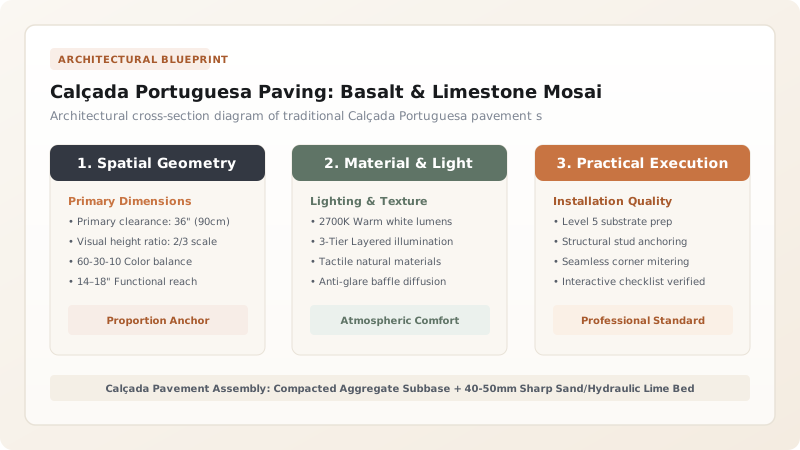
- Flexible Semi-Dry Bedding: Bedded over a 40-50mm sharp sand layer blended with NHL 2 or NHL 3.5 lime, allowing micro-flexure without mortar cracking.
- Geometric Nautical Motifs: Wooden radiating stencils guiding complex Mar Largo waves, compass roses (rosa dos ventos), and classical Greek frets.
- Permeable Stone Dust Joints: 2-5mm joints tightly packed with finely graded crushed stone flour (0-2mm), offering 15-25% surface water infiltration.
- Manual Rammer Compaction: Surface leveled and interlocked using 15-20kg weighted wooden rammers (maço) followed by light roller consolidation.
In-Depth Guides in this Directory
Explore specialized subtopic blueprints, technical dimensions, and execution checklists:
Calçada Cube Sizing: Basalt & Calcário Limestone Petrography
Technical guide to sourcing, quarrying, petrography, and hand-chiseling cubic stone tesserae for Portuguese pavement: basalt density, calcário grading, and cleavage angles.
Calçada Pattern Templating: Sand Bedding & Wave Layout
Engineering guide to layout, plywood stenciling, sand-lime bedding, and manual ramming for traditional Portuguese Calçada Portuguesa wave and geometric patterns.
Calçada Stone Dust Grouting & Permeability Dynamics
Technical guide to dry-packed stone dust joint infill, hydration misting, stormwater permeability, and erosion resistance in Portuguese Calçada Portuguesa paving.
1. Heritage & Urban Pedestrian Geometry: The Art of the Calceteiro
Born from the reconstruction of Lisbon following the catastrophic 1755 earthquake and popularized under Governor Eusebio Furtado in the 1840s, Calçada Portuguesa represents one of the world's most enduring and visually striking pedestrian hardscape traditions.
Unlike standard modular concrete pavers or large sawn stone flags, Portuguese pavement is executed entirely by Manual Tactile Masonry performed by specialized master pavers known as calceteiros:
- The Dichromatic Palette: The pavement relies exclusively on geological contrast between creamy white-to-ivory Calcário Branco (Microcrystalline Hard Limestone) and dense charcoal-to-jet-black Basalto Vulcânico (Volcanic Basalt). Learn precise stone properties in our guide to basalt and limestone cube sizing.
- The Mar Largo (Broad Sea) Undulation: The signature sinuous wave motif—first laid in the Rossio Square (Praça de D. Pedro IV) in 1848—creates an optical illusion of oceanic swells beneath pedestrians' feet, symbolizing Portugal's Maritime Age of Discovery.
- Structural Elasticity: Because the stones are set without rigid cementitious mortar joints, the pavement matrix absorbs thermal expansion, subterranean tree root shifts, and vehicular micro-deflections without catastrophic brittle cracking.

2. Subbase Engineering, Compaction & Load Bearing Ratios
The longevity of a Calçada Portuguesa pavement depends not on the stones themselves, but on the Graded Compaction of the Multi-Tier Foundation:
Where \(E_v\) is the strain modulus (deformation modulus, \(\text{MN/m}^2\)), \(p\) is contact pressure, \(r\) is plate radius, and \(s\) is settlement. For pedestrian and light maintenance vehicle traffic, subgrade preparation must satisfy rigorous compaction standards:
- Subgrade Sub-base: A 150-200mm layer of dense graded crushed aggregate (Type 1 sub-base, 0-31.5mm) compacted to 98% Modified Proctor Density.
- Setting Matrix (Leito de Areia): A 40-50mm bedding layer composed of coarse, sharp-grained silica sand (0-4mm grain size) blended dry with Natural Hydraulic Lime (NHL 2 or NHL 3.5) at a \(1:8\) volume ratio. The lime draws ambient moisture from the soil and humidity to slowly carbonate, consolidating into a firm, flexible bed that prevents stones from sinking under point loads. Study compaction methods in sand bed interlocking and templating.
- Stone Setting Technique: Stones are tapped into the bed with a pointed martelo de calceteiro (1.2-1.5kg), ensuring the stone's wider base sits downward with slightly tapered pyramidal flanks, creating mechanical wedging against adjacent stones.
3. Joint Infill, Surface Water Permeability & Slip-Resistance Tuning
Traditional Calçada surfaces balance pedestrian traction with hydrological sustainability:
- Dry-Packed Stone Dust Grouting (Pó de Pedra): Once all stones are set, the surface is swept clean and infilled with fine limestone or basalt flour (0-2mm). The infill is dry-swept into joints, thoroughly saturated with fine water mist to settle particles, and re-swept until joints are packed flush. Full joint chemistry is explored in stone dust grouting and permeability.
- Permeability Coefficient: An unbonded Calçada surface demonstrates an infiltration coefficient \(k = 2.5 \times 10^{-5}\text{ to } 8.0 \times 10^{-5}\text{ m/s}\), actively mitigating urban heat island effects and redirecting stormwater runoff directly into the subsoil.
- Slip Resistance Tuning: Over decades, pedestrian footfall polishes white limestone to a low Pendulum Test Value (PTV < 36 wet). Heritage architects restore friction through localized micro-bush-hammering (bujardagem) or light chemical etching, restoring PTV ratings above 45 without diminishing visual contrast.
Calçada Portuguesa Stone Grade & Paving Typology Matrix
Use this reference table to calculate exact physical dimensions, ratios, and specifications before purchasing:
| Application Type | Stone Size (mm) | Dominant Material | Bedding Depth | Joint Infill Material | Permissible Traffic Load |
|---|---|---|---|---|---|
| Pedestrian Wave Mosaic (Calçada Artística) | 40 - 60 mm (Small) | White Limestone + Black Basalt | 40 mm Sharp Sand + NHL 2 | Limestone Dust (0-1mm) | Strictly Pedestrian / Strollers |
| Urban Civic Promenade (Calçada Miúda) | 50 - 70 mm (Medium) | Cream Limestone (Moleanos) | 50 mm Coarse Sand + NHL 3.5 | Crushed Stone Flour (0-2mm) | Pedestrian + Light Cleaning Buggies |
| Historic Vehicular Street (Calçada Grossa) | 90 - 120 mm (Large) | Dense Grey Basalt / Granite | 70 mm Graded Sand-Gravel (0-6mm) | Basalt Grit & Hydraulic Mortar | Emergency Vehicles & Heavy Cars |
| Private Courtyard Border Accents | 50 - 60 mm (Uniform) | Black Basalt / Red Breccia | 40 mm Coarse River Sand | Polymeric Permeable Sand | Foot Traffic & Garden Furniture |
Calçada Portuguesa Engineering & Site Constraints
Every successful decoration project must account for physical and environmental constraints:
Labor Intensity
Laying artisanal Calçada requires roughly 1 to 1.5 worker-hours per square meter for plain field work, extending to 4-6 hours/m² for complex curvilinear mosaic patterns.
Material Sorting Waste
Quarry-supplied raw cubes exhibit variable geometries; up to 15-20% by weight must be re-split or rejected on site to maintain flush upper face tolerances.
Subgrade Settlement Vulnerability
Any localized piping or trench settlement in utility corridors beneath the aggregate bed will mirror directly on the pavement surface as depressions.
Polishing Under Foot Traffic
Microcrystalline calcário limestone experiences surface abrasion under heavy pedestrian traffic, requiring periodic non-acidic textured dressing to avoid slickness in rainy climates.
Master Step-by-Step Calçada Portuguesa Construction Protocol
Execute this professional sequence to achieve flawless results without backtracking:
Subgrade Excavation
Excavate native soil to a depth of 250-300mm below finished grade. Proof-roll the subgrade to achieve a California Bearing Ratio (CBR) > 5%.
Base Course Installation
Spread 150mm of well-graded crushed stone (0-31.5mm) and compact in two 75mm lifts using a 200kg vibratory plate compactor to 98% Standard Proctor density.
Setting Bed Preparation
Deposit a 40-50mm bed of washed sharp river sand (0-4mm) dry-blended with Natural Hydraulic Lime (NHL 2) at an 8:1 ratio. Screed the bed to rough gradient allowing 15mm surcharge for compaction.
Pattern Transfer & Alignment
Establish cardinal reference stringlines. Position 1:1 scale marine plywood templates or pin steel radius arm pivots for geometric wave curves or rosettes.
Artisanal Tesserae Setting
The calceteiro holds a stone cube in the left hand, chips awkward corners with the sharp pick of the martelo, and beds the stone firmly into the sand bed with the blunt hammer head.
Mechanical & Manual Ramming
Lay a heavy timber batten across the set stones and strike with a 15-20kg wooden maço rammer, driving cubes downward until tops form a planar, uniform plane.
Joint Filling & Curing
Sweep dry stone dust (0-2mm) across the pavement until all crevices are filled. Mist thoroughly with fine water droplets to set the lime and aggregate, repeat sweeping after 24 hours, and keep traffic off for 72 hours.
Common Mistakes & Countermeasures
Avoid these costly errors that compromise aesthetics, ergonomics, and budget:
Setting stones into rigid portland cement mortar beds
Inadequate stone tapering (setting inverted pyramid or cylindrical stones)
Water jet cleaning at high pressures (> 100 bar) on new pavement
Project Execution Checklist
Track your physical progress. Checkboxes persist automatically on this device:
Frequently Asked Questions
Why is Calçada Portuguesa slippery when wet, and how is it addressed?
Calcário limestone contains high calcium carbonate purity which polishes smooth under millions of shoe soles over decades. Modern specifications incorporate higher ratios of coarse basalt borders, apply non-acidic micro-abrasive rotary texturing, or use dolomitic limestone with higher quartz inclusions to sustain wet PTV ratings above 45.
Can Portuguese cobblestone pavement support automobile traffic?
Yes, but it requires the Calçada Grossa specification: larger hand-dressed granite or basalt cubes (90-120mm depth) placed over a 200-250mm reinforced crushed stone or lean roller-compacted concrete base with polymer-modified joint infill.
How do you repair a sunken or damaged patch of Calçada paving?
Repairs are exceptionally fast and zero-waste: the calceteiro picks out the loosened cubes, re-levels the sand-lime bedding with fresh material, re-inserts the original stones with the mallet, sweeps in fresh stone dust, and compacts. No unsightly patch lines or color mismatches occur.


