
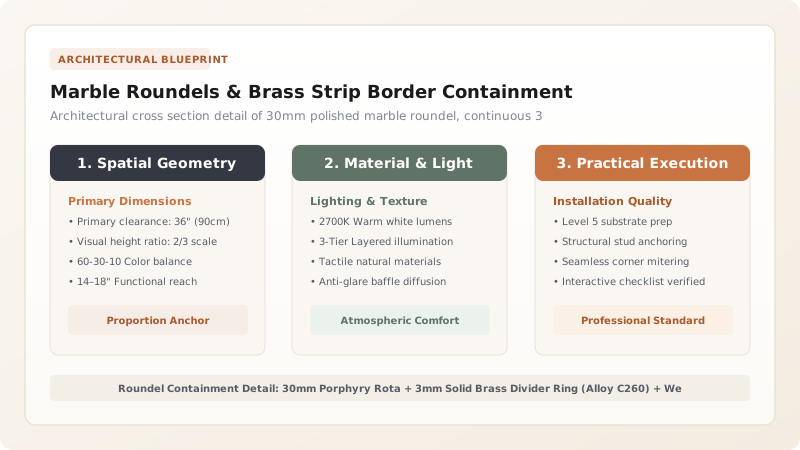
Polished marble roundels (rotae) and brass strip border containment are the structural perimeter assemblies used to frame and stabilize large monolithic stone discs within Cosmatesque mosaic floors. Cut from rare Imperial porphyry or serpentinite, these multi-ton circular roundels are bordered by continuous cold-rolled architectural brass divider strips (Alloy C260, 3mm x 30mm) fitted with mechanical anchoring tabs embedded in pozzolanic mortar, providing crisp aesthetic separation while absorbing differential thermal expansion.
At a Glance: Key Takeaways
- Monolithic Porphyry Rotae: Sliced circular discs measuring 600mm to 1,500mm diameter and 30mm thickness diamond-honed to 800-grit satin finish.
- Architectural Brass Divider Rings: 3mm thick solid cartridge brass (Alloy C260) cold-rolled to circular curvature to contain mosaic tesserae thrust.
- Welded Sub-Screed Anchoring Tabs: Split brass fishtail anchor tabs welded to the bottom edge of the strip, locking into the mortar bed every 200mm.
- Thermal Expansion Decoupling: Mitigating differential thermal expansion between large monolithic stone slabs and thousands of miniature tesserae.
- Continuous Wet Planetary Honing: Water-fed diamond resin pads polishing both brass dividers and stone roundels simultaneously to a flush plane.
1. Stone Fabrication: Monolithic Rotae Slicing & Diamond Honing
The monumental focal points of a Cosmatesque pavement are the Rotae (Wheels)—large circular stone roundels ranging from \(600\text{ mm}\) to over \(2,000\text{ mm}\) (2 to 6.5 feet) in diameter. Historically sliced from antique column shafts, modern fabricators use 5-axis CNC diamond wire saws and waterjet tables:
- Slab Thickness & Tolerances: Roundels are calibrated to a uniform \(30\text{ mm} \pm 0.5\text{ mm}\) thickness. The perimeter edge is sawn perfectly vertical (90 degrees) to fit tightly against the outer border ring.
- Progressive Diamond Honing: Porphyry is exceptionally hard (Mohs 7.0). Surface honing requires water-cooled planetary polishers using electroplated diamond abrasives (50, 100, 200 grit) followed by resin-bonded diamond discs (400, 800, 1500 grit). In heritage restorations, the stone is finished to an 800-grit honed satin patina rather than an artificial high-gloss plastic shine, preserving the historic tactile character of natural stone. Review master pavement architecture in our Cosmatesque mosaics hub.

2. Metal Metallurgy: Solid Brass Alloy C260 & Cold-Rolled Forming
Where a large monolithic slab meets thousands of tiny mosaic tesserae, the boundary is subject to high mechanical shear stress from foot traffic and thermal movement. Without a rigid metal boundary, the delicate triangular mosaic points bordering the roundel will crack and chip off:
- Architectural Cartridge Brass (Alloy C260 / CuZn30): Composed of 70% copper and 30% zinc, Alloy C260 offers optimal tensile strength (\(450\text{ MPa}\)), excellent cold-forming ductileness, and a rich, golden architectural luster that patinates naturally without rusting.
- Strip Sizing & Roll-Forming: Strips measuring \(3.0\text{ mm}\) thick by \(30\text{ mm}\) deep are cold-rolled through a 3-roll profile bender to the exact radius of the roundel, maintaining circular curvature with zero spring-back distortion.
- Split Fishtail Anchor Tabs: Laser-cut brass split tabs (50mm long) are silver-soldered to the bottom edge of the brass strip every 200mm. When pressed into the wet pozzolanic screed bed, these tabs lock the metal ring permanently into the concrete subfloor, preventing any lateral movement. Learn guilloche geometry in porphyry and serpentinite guilloche geometry.
3. Thermal Dynamics: Expansion Joints & Co-Planar Diamond Finishing
Large monolithic stone slabs have a higher thermal expansion mass than miniature mosaic tesserae:
- Differential Thermal Movement: A 1.5-meter red porphyry roundel expanding across a 15°C temperature swing will displace:
The 3mm brass containment strip, paired with an elastomeric silicone-modified pozzolanic joint seal, functions as an Integrated Expansion Gasket, absorbing thermal movement without allowing mosaic tesserae to compress or pop loose.
Once fully cured, the entire floor—stone roundel, brass divider, and mosaic tesserae—is ground simultaneously using a multi-head planetary wet floor machine. The diamond resin pads grind the brass and stone together at the exact same rate, creating a 100% Co-Planar, Flush Floor Surface with zero lippage or edge step-downs. Discover smalti glass craft in gold leaf smalti glass cutting.
Mosaic Border Containment System Comparison
Use this reference table to calculate exact physical dimensions, ratios, and specifications before purchasing:
| Containment Method | Solid Architectural Brass Strip (3mm) | Carved Marble Border Ring | Direct Mortar Butt Joint (No Divider) |
|---|---|---|---|
| Mechanical Edge Protection | Superior (brass absorbs impact; zero chipping) | Good (marble can chip on sharp corners) | Poor (mosaic points chip under foot traffic) |
| Thermal Expansion Absorption | High (ductile brass acts as expansion joint) | Low (rigid stone-on-stone contact) | Zero (leads to stress-popping of tesserae) |
| Aesthetic Visual Distinction | Crisp, golden jewel-like metallic outline | Soft, muted traditional stone outline | Messy, uneven grout line boundary |
| Co-Planar Grinding Ability | Polishes flush with stone under diamond pads | Polishes flush | Grout hollows out below stone level |
| Installation Complexity | High (requires rolling & anchoring tabs) | Very High (requires curved stereotomic cutting) | Low (simple tile setting) |
Border Containment Engineering Hazards
Every successful decoration project must account for physical and environmental constraints:
Brass Smearing Across White Marble During Grinding
Aggressive dry grinding can smear soft brass metal particles across the surface of porous white Carrara marble, creating stubborn grey-green metal stains. Grinding must be conducted with continuous flood water cooling and high-flow slurry vacuum extraction.
Galvanic Corrosion of Subfloor Fasteners
Fastening brass divider strips with standard zinc-plated steel screws into damp lime mortar causes rapid galvanic corrosion of the steel, rusting the anchor and lifting the brass strip. All anchor tabs, screws, and solder must be pure brass, bronze, or 316 stainless steel.
Roundel Rocking Due to Hollow Mortar Voids
Setting a heavy 1.2-meter porphyry roundel on a comb-troweled mortar bed leaves hollow air ridges. Under heavy foot traffic, the disc can rock and crack in half. Slabs must be back-buttered 100% and floated on a solid, void-free hydraulic mortar bed.
Marble Roundel & Brass Containment Installation Sequence
Execute this professional sequence to achieve flawless results without backtracking:
Substrate Recess Depth Verification
Verify concrete subfloor recess depth equals 30mm stone thickness plus 15mm mortar bed (45mm total); clean with high-pressure air blast.
Architectural Brass Strip Roll-Forming
Cold-roll 3mm x 30mm Alloy C260 brass strip through 3-roll bender to exact roundel radius; silver-solder split fishtail anchor tabs every 200mm.
Brass Ring Anchoring & Transit Leveling
Position brass containment ring on screed bed; anchor tabs into subfloor using non-shrink hydraulic mortar; level ring top edge to ±0.3mm with laser transit.
Full-Bed Pozzolanic Mortar Spreading
Trowel 15mm bed of non-shrink pozzolanic hydraulic lime mortar across the center of the ring; back-butter the porphyry roundel with 100% transfer coverage.
Roundel Hoisting & Vacuum Lifter Placement
Lower porphyry roundel into brass ring using overhead gantry and four-cup vacuum lifter; seat firmly with rubber dead-blow mallet until flush with brass top.
Co-Planar Diamond Wet Honing
After 28 days of mortar curing, run planetary floor machine with water-fed diamond resin pads (200, 400, 800-grit) across brass and stone until perfectly coplanar.
Common Mistakes & Countermeasures
Avoid these costly errors that compromise aesthetics, ergonomics, and budget:
Using Aluminum Divider Strips in Lime Mortar
Leaving the Brass Strip Standing Proud of the Stone
Omitting Mechanical Anchor Tabs on the Brass Strip
Project Execution Checklist
Track your physical progress. Checkboxes persist automatically on this device:
Frequently Asked Questions
Will the brass border strip tarnish or turn green over time?
In an interior floor environment, solid cartridge brass (Alloy C260) does not turn green (which requires acidic copper salts and outdoor rain exposure). Instead, through exposure to air and gentle foot traffic, the brass develops a warm, rich antique golden-bronze patina that beautifully complements historic marble and dark porphyry.
How heavy is a 1.5-meter red porphyry roundel?
A 1.5-meter (5-foot) diameter circular roundel sliced at 30mm thickness has a volume of approximately 0.053 cubic meters. At porphyry's dense specific gravity of 2,850 kg/m³, the monolithic disc weighs over 150 kg (330 lbs), requiring mechanical vacuum lifters and lifting cranes for safe installation.
Can damaged antique marble roundels be repaired in situ?
Yes. Cracked or chipped antique roundels can be surgically stabilized using vacuum-injected clear structural epoxy resins tinted with finely ground stone dust matching the natural plagioclase phenocrysts of the porphyry. Once cured, the repair is diamond-honed flush, making hairline fractures virtually invisible.


