
Cosmatesque geometric mosaic is a monumental 12th-to-14th-century architectural stone and glass inlay craft perfected by Roman marble-worker families (the Cosmati). Combining opus sectile (cut stone shapes) with opus vermiculatum (tesserae mosaics), it features large circular roundels (rotae) of rare Imperial Egyptian red porphyry and Spartan green serpentinite entwined within continuous interlacing guilloche bands filled with hand-chiseled marble triangles, squares, and 24-karat gold leaf Venetian smalti glass set in hydraulic pozzolanic lime mortar.
At a Glance: Key Takeaways
- Imperial Spolia Provenance: Salvaged Roman imperial red porphyry (Porfido Rosso Antico) and green serpentinite (Porfido Verde Antico) from antique monuments.
- Sacred Quincunx Geometry: Five interlocking circular roundels representing celestial harmony, flanked by infinity-loop guilloche braided bands.
- Opus Sectile Precision Cutting: Diamond-sawn and hand-chiseled polygons (triangles, lozenges, stars) fitted with 0.5mm hairline dry joints.
- 24-Karat Gold Leaf Smalti: Hand-pulled Murano/Venetian glass sandwiches enclosing pure gold leaf beneath protective vitreous glass wafers.
- Pozzolanic Hydraulic Mortar: Slaked non-hydraulic lime (CL 90) blended with Italian volcanic pozzolana earth, providing flexible, crack-free bedding.
In-Depth Guides in this Directory
Explore specialized subtopic blueprints, technical dimensions, and execution checklists:
Guilloche Interlacing Geometry: Porphyry & Serpentinite
Geometric design guide for Cosmatesque floors: golden ratio quincunx proportioning, Euclidean guilloche ribbon drafting, opus sectile angle calculations, and spandrel tesserae layout.
Gold Leaf Smalti Tesserae: Martellina Cutting & Mortars
Craft and chemistry guide for gold leaf smalti mosaics: 24k gold leaf glass wafer manufacturing, martellina hammer and hardy cutting mechanics, and pozzolanic lime mortar setting.
Marble Roundels & Brass Strip Border Containment
Masonry engineering guide for Cosmatesque floors: cutting monolithic porphyry roundels (rotae), cold-formed architectural brass border containment strips, expansion jointing, and wet diamond honing.
1. Materiality of Empire: Red Porphyry & Green Serpentinite Spolia
In medieval Rome, the Cosmati masters did not quarry new stone; they harvested architectural spolia from ruined Roman imperial palaces, baths, and basilicas. The two most sacred stones in the Cosmatesque hierarchy are:
- Imperial Red Porphyry (Porfido Rosso Antico): Quarried exclusively at Mons Porphyrites in the remote Eastern Desert of Egypt under Roman emperors. It is an extremely hard volcanic andesite (Mohs hardness 7.0, density \(\rho \approx 2,850\text{ kg/m}^3\)) containing white plagioclase feldspar phenocrysts suspended in a deep imperial purple-red matrix. In Roman imperial canon, porphyry symbolized supreme divine and imperial majesty.
- Spartan Green Serpentinite (Porfido Verde Antico / Lapis Lacedaemonius): Quarried in the Peloponnese near Sparta, this vivid grass-green metamorphic stone contains dark pyroxene crystals that contrast sharply with red porphyry.
- Circular Monolithic Rotae: Large circular discs (measuring 0.5m to 2.0m in diameter) were sliced horizontally from ancient Roman monolithic column shafts using iron saws fed with abrasive silica sand, forming the focal centers of the pavement. Learn roundel framing in our guide to polished marble roundels.

2. Sacred Geometry: The Quincunx & Interlacing Guilloche Ribbons
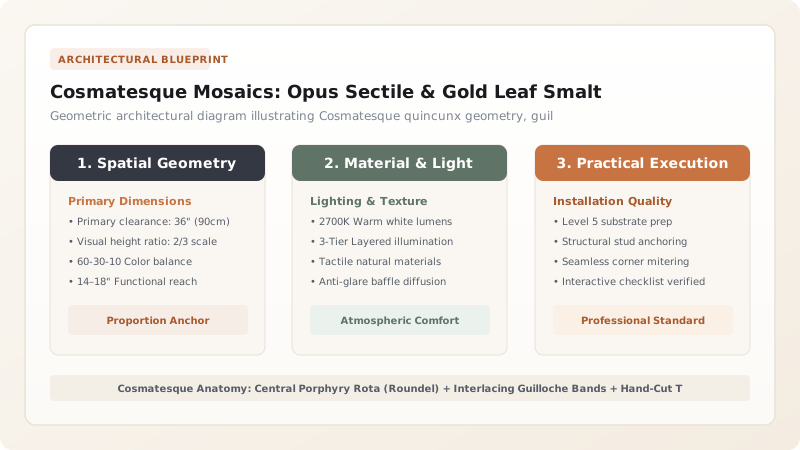
Cosmatesque pavements are organized around cosmological geometric canons. The preeminent compositional matrix is the Quincunx (The Five-Circle Cross):
- Four Outer Circles Flanking a Center: Four circular roundels placed at the cardinal points around a larger central fifth roundel, symbolizing the four Evangelists surrounding Christ or the four earthly elements revolving around the divine ether.
- Continuous Guilloche Braid: White Carrara marble bands weave over and under each other in an infinite serpentine figure-eight loop (guilloche), circumscribing the roundels without beginning or end.
- Opus Sectile Infill Geometry: The triangular and curved spandrel voids created between the intertwined ribbons are filled with thousands of tiny hand-cut geometric tesserae—equilateral triangles, rhombuses, and hexagrams forming starbursts (cosmati-stars). The internal angles adhere to Euclidean \(30^\circ - 60^\circ - 90^\circ\) or \(45^\circ - 45^\circ - 90^\circ\) symmetries. Master the geometry in our deep dive on porphyry and serpentinite guilloche geometry.
3. Craftsmanship: 24k Gold Smalti & Volcanic Pozzolana Mortar
To infuse dark marble floors with celestial luminosity, Cosmati artisans interspersed stone tesserae with 24-Karat Gold Leaf Smalti Glass:
- The Gold Smalti Sandwich: A thin wafer of hand-beaten 24-karat gold leaf is laid over a molten glass slab (pizza), covered by an ultra-thin layer of molten transparent soda-lime glass (the cartellina), and annealed. Cut into 8mm x 8mm cubes with a traditional mosaicist's hammer (martellina) on a steel hardy chisel, the broken glass edges refract light at irregular angles, creating an iridescent golden sparkle. Detailed smalti cutting in gold leaf smalti glass cutting.
- Pozzolanic Bedding Mortar: Rigid modern Portland cement destroys historic marble mosaics by causing high curing shrinkage and efflorescence. Cosmatesque floors are bedded in Traditional Roman Pozzolanic Mortar: 1 part slaked non-hydraulic fat lime putty (CL 90-S) mixed with 2.5 parts finely ground Italian volcanic pozzolana earth (from the Alban Hills near Rome). Pozzolanic silica reacts with calcium hydroxide:
This forms a resilient, flexible stone-like matrix that autogenously heals micro-cracks over centuries. Compare with Portuguese stone mosaics in Calçada Portuguesa paving.
Mosaic Architectural Typology Comparison
Use this reference table to calculate exact physical dimensions, ratios, and specifications before purchasing:
| Mosaic Tradition | Cosmatesque (Roman Opus Sectile) | Byzantine Glass Wall Mosaic | Classical Roman Pebble / Tesserae |
|---|---|---|---|
| Surface Application | Horizontal monumental church floors | Vertical curved domes and apses | Domestic atrium floors and courtyards |
| Primary Material | Imperial Porphyry, Serpentinite, Carrara | Opaque colored glass smalti + gold leaf | Natural rounded river pebbles / limestone cubes |
| Cutting Method | Opus Sectile geometric polygons + cubes | Opus Vermiculatum irregular cubes (5-10mm) | Naturally tumbled stone or rough cube splitting |
| Joint Tightness | Hairline joints (< 1.0mm micro-joints) | Wide open grout joints (2-3mm) | Sand-packed or lime-slurried joints |
| Visual Aesthetic | Architectural sacred geometry & symmetry | Figurative religious icons and saints | Monochrome figurative scenes and geometric mazes |
Conservation & Structural Setting Constraints
Every successful decoration project must account for physical and environmental constraints:
Subfloor Structural Deflection & Tesserae Popping
Cosmatesque floors contain tens of thousands of miniature hand-cut stone triangles. Any structural deflection of the supporting floor slab greater than L/1000 will compress joints, popping brittle porphyry tesserae off their bedding. Subfloors must be heavily reinforced monolithic concrete or solid masonry arches.
Moisture Attack on Gold Smalti Cartellina
If groundwater or cleaning moisture penetrates beneath poorly bedded gold smalti, hydraulic pressure and freeze-thaw cycles can cause the thin glass cover wafer (cartellina) to delaminate, flaking away the 24k gold leaf. Smalti must be back-buttered with pure epoxy or hydraulic pozzolana mortar.
Differential Hardness Wear Across Stone Species
Red porphyry has a Mohs hardness of 7.0, while surrounding Carrara white marble has a hardness of only 3.0. Over centuries of foot traffic, the softer white marble wears down faster, leaving the hard porphyry roundels standing proud by several millimeters. Polishing must be done with diamond pads using resin shims to avoid dishing softer stones.
Cosmatesque Geometric Pavement Execution Sequence
Execute this professional sequence to achieve flawless results without backtracking:
Substrate Leveling & Hydraulic Lime Screed
Clean structural floor slab; cast 40mm thick pozzolanic lime screed (1 part lime putty, 2.5 parts Italian red pozzolana); score surface with diagonal scratch lines.
Full-Scale Cartone (Cartoon) Grid Transfer
Draft full-scale geometry onto heavy paper cartoon; snap chalk lines transferring cardinal quincunx centers and guilloche arcs onto green lime screed.
Central Porphyry Rota (Roundel) Setting
Bed 30mm thick diamond-sawn Imperial red porphyry and green serpentinite discs in hydraulic mortar; check dead-level alignment with optical laser transit.
White Carrara Guilloche Ribbon Framing
Fit hand-curved white Carrara marble framing ribbons around roundels, keeping bed joints hairline tight (under 0.8mm) with matching lime butter.
Opus Sectile Tesserae Infill & Gold Smalti
Hand-cut triangular and diamond tesserae from yellow Siena, black marquinia, and 24k gold smalti; press individually into wet lime bed following geometric star templates.
Slurry Grouting & Diamond Pad Honing
Pack joints with superfine marble-dust pozzolanic lime grout; allow 28 days for carbonation; hone surface progressively with 200 to 800-grit diamond resin pads lubricated with water.
Common Mistakes & Countermeasures
Avoid these costly errors that compromise aesthetics, ergonomics, and budget:
Using Modern Portland Cement for Bedding
Polishing with Rotary Carborundum Stones
Cutting Gold Smalti with Diamond Tile Saws
Project Execution Checklist
Track your physical progress. Checkboxes persist automatically on this device:
Frequently Asked Questions
Who were the Cosmati, and where did the name come from?
The Cosmati were four generations of skilled marble-working families active in Rome between the late 11th and early 14th centuries. The name derives from Cosmas, a recurring family name found in signatures carved on historic church floors (e.g., 'Magister Laurentius cum Cosma filio suo fecit'). Their masterpieces survive in Rome's Santa Maria in Cosmedin, San Clemente, and Westminster Abbey's Great Pavement in London.
Where did the Cosmati get red porphyry if Egyptian quarries were closed?
The Roman imperial quarries at Mons Porphyrites closed around the 4th century AD. The Cosmati obtained all their porphyry through 'spoliation'—carefully dismantling ruined ancient Roman baths, temples, and imperial palaces, and salvaging massive red porphyry columns and wall slabs to slice into floor roundels.
Can a Cosmatesque floor be installed with modern underfloor radiant heating?
Yes, but with strict thermal engineering. The rapid expansion of heated screeds can stress delicate micro-tesserae. The floor requires an uncoupling crack-isolation membrane (such as Ditra) and gradual, modulating hydronic radiant heating that limits slab temperature changes to no more than 1°C per day.


