
Porphyry and serpentinite guilloche interlacing geometry is the mathematical foundation of Cosmatesque pavement design. Constructed using pure classical Euclidean compass-and-straightedge geometry, continuous ribbons of white Carrara marble weave in symmetrical serpentine braids around Imperial Egyptian red porphyry and Spartan green serpentinite circular roundels, generating triangular and rhomboidal spandrel pockets filled with geometrically aligned opus sectile polygons.
At a Glance: Key Takeaways
- Euclidean Tangent Geometry: Establishing tangent arcs that transition seamlessly from concave to convex curves without visual kinking.
- Golden Ratio Quincunx Proportions: Sizing central versus satellite roundels according to harmonic golden proportions (\(\Phi \approx 1.618\)).
- Trigonometric Tesserae Grids: 30°–60°–90° and 45°–45°–90° polygon tessellations filling curvilinear spandrels with zero gaps.
- Chromatic Contrast Rules: Alternating dark Imperial porphyry and serpentinite against bright Giallo Antico and white Carrara marble.
- Full-Scale 1:1 Cartone Templates: Hand-drawn architectural cartoons transferring compass pivot points directly to screed substrates.
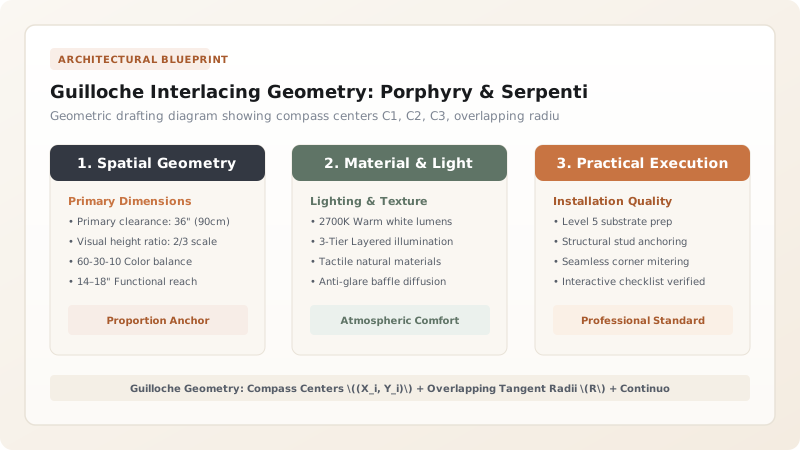
1. Mathematical Drafting: Compass-and-Straightedge Guilloche Construction
The Guilloche (Serpentine Braid) is an architectural pattern formed by two or more interlaced ribbon bands that wind continuously around a central axis. In Cosmatesque masonry, the braid is drafted using pure Euclidean Compass-and-Straightedge Geometry:
- Baseline Compass Centers: A series of collinear focal points \(C_1, C_2, C_3, \dots, C_n\) are spaced at uniform pitch \(P = 2 \cdot R_{\text{rota}}\) along the central axis of the nave or sanctuary.
- Arc Tangents & Smooth Transitions: Semi-circular arcs of radius \(R_{\text{inner}}\) and \(R_{\text{outer}}\) are struck from alternating top and bottom centers. To ensure that the ribbon transitions from a concave curve to a convex curve with mathematical smoothness (first derivative continuity \(C^1\)), the inflection points must occur precisely on the common tangent line perpendicular to the axis:
This creates the visual illusion of a single continuous marble ribbon that weaves over and under itself in an infinite serpentine motion. Explore master pavement architecture in our Cosmatesque mosaics hub.

2. Symmetrical Proportions: The Golden Ratio Quincunx
In classical Cosmatesque layouts, the size of the central porphyry roundel (rota) is not arbitrary; it is harmonically linked to the satellite roundels through the Golden Ratio (\(\Phi = \frac{1 + \sqrt{5}}{2} \approx 1.618\)):
- Central Diameter: Let the central red porphyry roundel have radius \(R_0\). The four flanking satellite roundels (typically alternating green serpentinite and red porphyry) have radius:
This mathematical hierarchy ensures the eye is naturally drawn toward the monumental central disc before circulating outward along the braided ribbons. Contrast with Portuguese geometric paving in Calçada Portuguesa wave templating.
3. Infill Trigonometry: Curvilinear Spandrels & Polygon Tessellation
Where the circular guilloche bands diverge from the roundels, they create triangular curvilinear voids called Spandrels (Reinfianchi). Filling these curved irregular pockets with stone requires advanced tessellation:
- Polar Coordinate Segmentation: The curved spandrel is divided into concentric radial arcs. Polygons within each arc taper slightly in width toward the focal center, ensuring radial seams align with the radius.
- Triangulation & Star Inlays: Smaller equilateral triangles of Giallo Antico (yellow Numidian marble), Nero Marquinia, and 24k gold smalti are fitted with hairline joints (<0.5mm). The stones are dry-assembled over the 1:1 cartoon on a workbench, taped with adhesive paper, and transferred to the wet lime mortar bed as unified modular sections. Learn smalti glass cutting in gold leaf smalti glass cutting.
Cosmatesque Geometric Pattern Hierarchy Comparison
Use this reference table to calculate exact physical dimensions, ratios, and specifications before purchasing:
| Pattern Module | The Quincunx (5-Circle Cross) | The Endless Guilloche Ribbon | The Cosmati Star (Hexagram/Octagram) |
|---|---|---|---|
| Symbolic Meaning | Divine Order & Four Cardinal Evangelists | Eternity, Infinity, and Continuous Prayer | Celestial Star of Bethlehem & Wisdom |
| Geometric Complexity | Very High (compound overlapping arcs) | High (continuous tangent calculations) | Extreme (intricate multi-point miter cuts) |
| Primary Stone Formats | Monolithic 1.0m porphyry roundels | Curved white Carrara border strips | Miniature triangular & diamond tesserae (15mm) |
| Placement in Sanctuary | Focal center of apse / altar foot | Connecting processional nave aisles | Infill within spandrel voids and roundels |
| Cutting Tolerance | ±0.5mm radial circumference | ±0.3mm tangent arc joints | ±0.15mm knife-edge dry joint fitting |
Geometric Layout & Setting Hazards
Every successful decoration project must account for physical and environmental constraints:
Accumulating Angular Error Across Repetitive Ribbons
If a curved marble ribbon piece deviates in arc angle by just 0.1 degrees, the cumulative angular error across a 20-meter guilloche run will throw the final roundel 50mm off-center. Every arc must be checked against the master laser centerline datum.
Fracture of Thin Porphyry Tips Under Cutting
Porphyry is exceptionally hard and brittle. Slicing sharp 30-degree triangular tips with high-speed saws can cause the delicate tips to shatter. Stones must be cut with continuous-rim wet diamond blades running at low RPM with abundant water cooling.
Optical Distortion from Uneven Rota Thickness
Antique salvaged column slices often vary in thickness from 25mm to 35mm across their diameter. If set without leveling the top face, the floor will have dangerous trip edges. The bottom must be gauged or bedded in deep mortar shims.
Guilloche Geometry Drafting & Installation Sequence
Execute this professional sequence to achieve flawless results without backtracking:
Substrate Centerline Survey & Grid Snapping
Establish sanctuary longitudinal centerline using optical laser transit; snap perpendicular transverse lines locating quincunx centers C0 through C4.
Full-Scale Cartone Drafting on Heavy Mylar
Draft complete geometry at 1:1 scale using precision beam compass; number every individual marble ribbon segment and tessera triangle.
Porphyry & Serpentinite Core Placement
Set central red porphyry and green serpentinite discs over pozzolanic mortar bed; verify discs are dead-level and concentric with laser crosshairs.
White Carrara Ribbon Pre-Assembly
Dry-fit curved Carrara marble ribbon segments around roundels; check tangent transitions for seamless flow; bed in hydraulic lime mortar.
Spandrel Tesserae Workshop Mosaic Assembly
Assemble miniature triangle stars on paper cartoon in workshop; glue face with water-soluble hide glue to perforated Kraft transfer paper.
Mortar Bed Transfer & Paper Washing
Trowel fresh pozzolanic mortar into spandrel voids; press pre-assembled paper-faced mosaic sheets into bed; tap flat; moisten and peel paper face.
Common Mistakes & Countermeasures
Avoid these costly errors that compromise aesthetics, ergonomics, and budget:
Drafting Arcs with Approximate Radius Points
Assembling Tesserae Directly on the Wet Job Site Floor
Using High-Porosity Soft Marbles in High-Traffic Ribbons
Project Execution Checklist
Track your physical progress. Checkboxes persist automatically on this device:
Frequently Asked Questions
Why is the guilloche pattern found in both Roman mosaics and Celtic knotwork?
The interlacing braid is an ancient universal motif found across Mediterranean, Roman, Byzantine, and Celtic cultures. While Celtic knotwork emphasizes complex interlaced ribbons representing spiritual eternity, the Roman and Cosmatesque guilloche incorporates strict Euclidean mathematical geometry centered around focal astronomical circular discs (the rotae).
How small are the individual stone triangles in a Cosmatesque floor?
In the finest 12th-century Cosmati pavements, the miniature equilateral triangles of red porphyry, serpentinite, and yellow Numidian marble measure barely 12mm to 18mm (0.5 to 0.75 inches) on each side, hand-chiseled with extraordinary sub-millimeter precision.
Can damaged sections of historic Cosmatesque floors be restored today?
Yes. Highly specialized conservation studios (such as the Opificio delle Pietre Dure in Florence) restore historic Cosmati pavements using salvaged fragments of antique porphyry, traditional pozzolanic lime mortars, and hand-cutting techniques that match original 12th-century craftsmanship precisely.


