
Roman Wire-Saw Cutting and Abrasive Slurry Shaping was the revolutionary lapidary engineering that made opus sectile possible. Ancient iron and bronze chisels could not cut ultra-hard Egyptian porphyry or dense quartz serpentines without instantly dulling. Roman stonecutters (lapidarii) overcame this by utilizing toothless iron frame saws and twisted copper wires powered by human or water-mill mechanisms. By continuously flooding the cutting kerf with an abrasive slurry of water and volcanic Naxos emery powder, the sliding wire shaved through diamond-hard porphyry, producing flat, razor-thin crustae tiles.
At a Glance: Key Takeaways
- Toothless Wire & Blade Saws: Soft iron blades and twisted copper wires acting as carriers for abrasive mineral slurry.
- Naxos Emery Abrasive Slurry: Crushed corundum (Mohs 9) and magnetite sand delivering extreme cutting power.
- Water-Powered Sawmills (Hierapolis): Early Roman industrial mechanical sawmills slicing multiple marble slabs simultaneously.
- Reverse Bevel Lapping (3° Angle): Undercutting tile edges on bronze plates to guarantee razor-tight front joint contact.
- Diamond Stylus Scribing: Scribing geometric lines with natural diamond splinters mounted in iron handles.
- Sub-Millimeter Joint Tolerances: Assembling polished marble tiles with hairline mortar joints under 0.5mm.
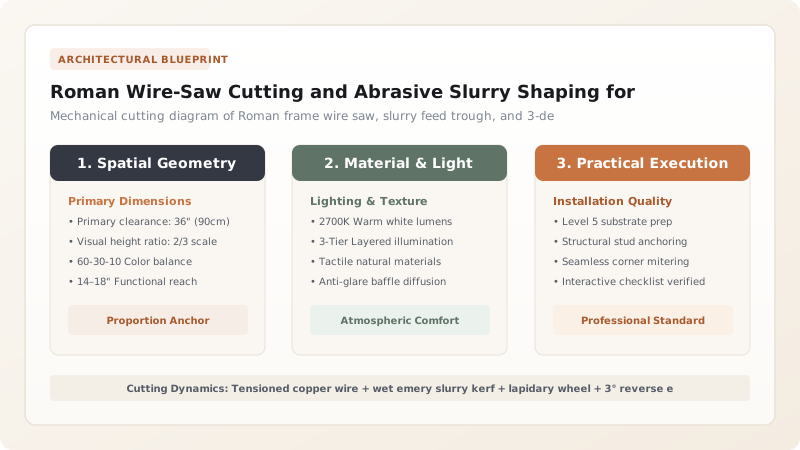
1. Lapidary Physics: Why Soft Wire Cuts Hard Porphyry
A fundamental paradox of ancient technology is that soft copper or wrought iron was used to slice through porphyry stones that blunted hardened steel chisels. The secret lies in three-body abrasive wear.
The wire or toothless iron saw blade does not cut the stone directly. Instead, microscopic abrasive grains—principally emery from the Greek island of Naxos (a natural mix of corundum, Mohs 9, and magnetite)—become embedded into the soft copper wire. As the wire reciprocates back and forth under tension, these embedded corundum micro-teeth grind away the stone grain by microscopic grain under continuous water lubrication.
2. Roman Mechanical Sawmills: The Hierapolis Breakthrough
While small crustae were cut with hand frame saws, monumental marble slicing was mechanized across the Roman Empire. The 3rd-century AD Hierapolis water-powered sawmill in modern Turkey represents the earliest known mechanical crank-and-connecting-rod mechanism in human history.
A water wheel drove parallel pairs of reciprocating iron saws through stone blocks over 2 meters long, operating 24 hours a day with automated sand-slurry drip hoppers. This industrial production drastically lowered the cost of marble veneers, allowing opus sectile floors to be installed in provincial baths, villas, and basilicas throughout the empire.
3. Edge Dressing and the 3-Degree Reverse Bevel
Once sliced, the geometric polygon (triangle, hexagon, or circular rota) was rough-shaped using iron nibbling pincers (martellina). The edges were then finished on bronze or cast-iron flat lapping plates coated with fine pumice slurry.
Master stonecutters held the tile at a precise 3-degree reverse undercut angle. This meant that the visible top surface of the marble was slightly wider than the bottom base. When adjacent crustae were pressed together on the floor, their top edges met in seamless, razor-sharp hairline contact, while the hollowed underside provided space for the hydraulic lime bedding mortar to grip the stone.
Roman Lapidary Abrasive Slurry Formulations & Cutting Rates
Use this reference table to calculate exact physical dimensions, ratios, and specifications before purchasing:
| Abrasive Mineral | Source Locality | Mohs Hardness | Average Particle Grit | Cutting Rate on Porphyry (mm/hr) |
|---|---|---|---|---|
| Naxos Emery (Corundum) | Island of Naxos, Greece | 9.0 Mohs (Extreme) | 60 - 120 Grit Coarse | 12mm - 18mm / hour |
| Quartz Dune Sand | Wadi Natrun, Egypt | 7.0 Mohs (Hard) | 80 - 150 Grit Medium | 4mm - 6mm / hour |
| Volcanic Pumice | Aeolian Islands (Lipari) | 5.5 - 6.0 Mohs | 200 - 400 Grit Fine | Lapping & fine honing only |
| Burnt Lead-Tin Ash | Campanian workshops | Sub-micron powder | Micro-polishing powder | Final mirror luster buffing |
Time & Precision Constraints
Every successful decoration project must account for physical and environmental constraints:
Tremendous Hand Cutting Duration
Hand wire-sawing a 300mm diameter porphyry column disc requires over 40 hours of continuous sawing labor.
Extreme Geometric Cumulative Error
In a 12-piece geometric star medallion, a 0.2mm edge error on each tile creates an unclosable 2.4mm gap at the center.
Protocol for Wire-Saw Slicing and Reverse Beveling Opus Sectile Tiles
Execute this professional sequence to achieve flawless results without backtracking:
Billet Mounting & Plaster Dogging
Bed rough porphyry block in gypsum plaster bed; secure onto heavy timber sawing bench with iron hold-down dogs.
Wire Saw Rigging & Tensioning
String high-tensile copper or iron wire across wooden bow-saw frame; tighten tensioning windlass until wire rings true.
Abrasive Slurry Slake Feeding
Mix Naxos emery sand with clean water in drip bucket; position drip tube directly above cutting kerf; begin reciprocating strokes.
Geometric Diamond Scribing
Lay brass geometric polygon template over sliced slab; scribe cutting boundary using diamond-tipped iron stylus.
Pincer Nibbling & Edge Trimming
Nibble excess stone along scribed lines using hand pincers (martellina) to within 1mm of final geometric boundary.
Bronze Plate Reverse Bevel Lapping
Rub tile edges against flat bronze lapping plate with fine pumice slurry, holding tile at 3° reverse bevel until edge is glass-smooth.
Common Mistakes & Countermeasures
Avoid these costly errors that compromise aesthetics, ergonomics, and budget:
Running the wire saw dry without continuous water-emery slurry
Lapping tile edges at a 90° right angle or forward outward bevel
Project Execution Checklist
Track your physical progress. Checkboxes persist automatically on this device:
Frequently Asked Questions
How did Roman stonecutters cut perfect circles from stone slabs?
They used a compass trammel with a copper tube drill (core drill) fed with abrasive emery slurry. Rotating the weighted copper tube drilled out a cylindrical core, producing a perfectly circular stone disc (rota) with glass-smooth perimeter edges.
Why was copper wire preferred over iron wire in ancient sawmills?
Copper is softer than iron, allowing the hard emery corundum particles to press deeper into the wire surface and become locked in place like teeth on a file, increasing cutting aggression on hard stone.


