
Sgraffito Cartoon Pouncing (Spolvero) and Iron Stylus Incising represent the precision craftsmanship stage of Renaissance facade decoration. Master artisans transfer intricate multi-meter decorative designs onto wet plaster using full-scale perforated paper cartoons dusted with powdered charcoal. Once the design is transferred in fine carbon dots, craftsmen use hand-forged iron styluses, steel gouges, and loop scrapers to slice through the soft white marble intonaco at a 45° bevel angle, peeling away positive or negative plaster fields to reveal the dark charcoal undercoat.
At a Glance: Key Takeaways
- Spolvero Pounce Transfer: Perforated cartoon lines dusted with fine willow charcoal powder inside muslin pounce bags.
- Precision Tooling Array: Hand-forged iron styluses, V-parting gouges, and steel ribbon wire scrapers.
- 45-Degree Beveled Carving: Cutting plaster edges at an outward bevel so rainwater sheds cleanly without pooling.
- Hatching & Chiaroscuro: Varying line densities and negative field scraping to create three-dimensional optical shading.
- Time-Critical Giornata: Executing complete transfer and cutting within the 4-to-6-hour window of soft plaster.
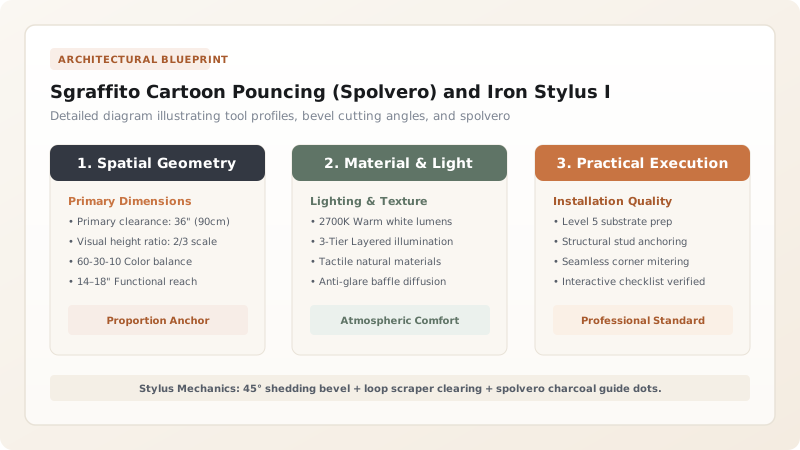
1. Drafting and Perforating the Full-Scale Cartoon
The sgraffito process begins on the drawing board. Artisans draft full-scale (1:1) compositions on heavy, wet-strength kraft paper using graphite or ink. For repeating architectural friezes, modular symmetry is established using grid quadrants.
The outlines are perforated using a toothed needle wheel (roulette) or hand awl resting atop a felt mat, producing neat punctures spaced 1.5mm to 3.0mm apart. For complex curves and figural grotesques, punch density is increased to preserve fine anatomical nuances.
2. The Spolvero Transfer Protocol on Wet Intonaco
Once the white intonaco has been troweled and gently burnished to receive the drawing, the perforated cartoon is positioned against the damp plaster and pinned using fine copper needles along the scaffolding level lines.
A porous muslin pounce bag filled with finely ground willow charcoal dust is tapped gently along every punctured line. When the cartoon is peeled away, a pristine constellation of sharp black dots is left imprinted on the damp plaster surface, serving as the master's roadmap for incising.
3. Tool Profiles and the 45-Degree Bevel Cut
Carving the wet plaster requires absolute precision. Artisans employ three primary tool geometries:
- Pointed Stylus (Stilo a Punta): Slices primary contour outlines to establish razor-sharp borders between white and black.
- V-Shaped Parting Gouge: Clears fine interior hatching lines for drapery folds and anatomical chiaroscuro.
- Ribbon Wire Loop Scraper (Raschietto ad Anello): Clears broad background areas, removing the white plaster down to the black arriccio in sweeping strokes.
Critically, every cut must be made at an outward 45° bevel angle. This prevents rainwater from sitting in right-angle pockets, ensuring water cascades harmlessly down the facade without soaking into the joints.
Sgraffito Incising Tooling Selection & Cut Profiles
Use this reference table to calculate exact physical dimensions, ratios, and specifications before purchasing:
| Tool Type | Cutting Edge Geometry | Technique / Stroke | Visual / Structural Outcome |
|---|---|---|---|
| Iron Stylus (Stilo) | Hardened steel needle point (1-2mm) | Dragging along spolvero dots | Razor-sharp contour boundary cut |
| V-Gouge (Ferro a V) | 60° acute V-channel gouge | Push stroke through white layer | Fine chiaroscuro shadow hatching |
| Loop Scraper (Raschietto) | Tempered spring steel ribbon loop (10-25mm) | Pull stroke across negative space | Broad background arriccio reveal |
| Bevel Chisel (Sgorbia) | Flat beveled scraper blade | Planar shaving of large fields | Ultra-smooth matte background surface |
Artistic & Execution Constraints
Every successful decoration project must account for physical and environmental constraints:
Irreversible Subtractive Medium
Once white plaster is scraped away, it cannot be patched or re-applied seamlessly; errors cannot be erased.
Scaffolding Reach Limits
Working on multi-story facades requires modular cartoons aligned perfectly across scaffolding lift heights.
Protocol for Cartoon Pouncing and Stylus Carving a Sgraffito Panel
Execute this professional sequence to achieve flawless results without backtracking:
Cartoon Registration & Alignment
Align perforated cartoon against chalk plumb lines on fresh intonachino; anchor top edge with drafting tape or copper pins.
Charcoal Pouncing (Spolvero)
Pounce perforated lines with willow charcoal bag; verify charcoal transfer by lifting bottom corner; peel cartoon away cleanly.
Boundary Contour Incising
Trace all charcoal dots with pointed iron stylus, holding tool at 45° angle to establish clean, beveled boundary edges.
Field Scraping of Negative Space
Peel away large areas of white plaster using steel ribbon loop scrapers until the dark charcoal arriccio is completely exposed.
Chiaroscuro Detail Hatching
Cut fine graduated shadow lines inside white figures using miniature V-gouges, creating optical three-dimensional depth.
Final Crumb Brushing & Edge Inspection
Whisk away loose plaster dust using soft goat-hair fan brush; inspect all bevels under raking light to verify clean water runoffs.
Common Mistakes & Countermeasures
Avoid these costly errors that compromise aesthetics, ergonomics, and budget:
Cutting into the plaster at a reverse 90° or undercut angle
Using plumbago (graphite) instead of charcoal dust in the pounce bag
Project Execution Checklist
Track your physical progress. Checkboxes persist automatically on this device:
Frequently Asked Questions
How do artisans repair a slip or accidental gouge in sgraffito?
In authentic lime work, a mistake cannot simply be filled with putty because the patch will dry with a different color and texture. If a major error occurs, the entire giornata section must be scraped off and replastered before the undercoat sets.
Can sgraffito styluses be made of bronze instead of iron?
Yes, bronze tools were occasionally used because they do not rust; however, hand-forged high-carbon steel is preferred because it holds a sharper razor edge when cutting through abrasive marble dust aggregates.


