
Charcoal-Pigmented Lime Undercoats and White Intonaco form the vital mineral substrate of sgraffito plasterwork. The dark undercoat is formulated with high-calcium pit-slaked fat lime, graded quartz sand, and pulverized vine or beech charcoal, yielding an intense matte black or slate-gray body. The overlying intonaco consists of lime putty blended with graded Carrara marble dust (0.1mm to 0.5mm), creating a radiant, semi-translucent white skin. Managing the moisture equilibrium between these two layers is critical to prevent delamination while enabling crisp stylus carving.
At a Glance: Key Takeaways
- Vine Charcoal Pigmentation: Natural carbon black delivering lightfast, alkali-proof, velvety black color.
- Carrara Marble Aggregate: 99% pure calcite grains conferring sparkle and crystalline strength to white topcoat.
- Differential Suction Balance: Calibrating moisture draw so topcoat adheres intimately to damp undercoat.
- Aged Slaked Fat Lime: Putty matured under water for 2+ years to maximize plastic workability.
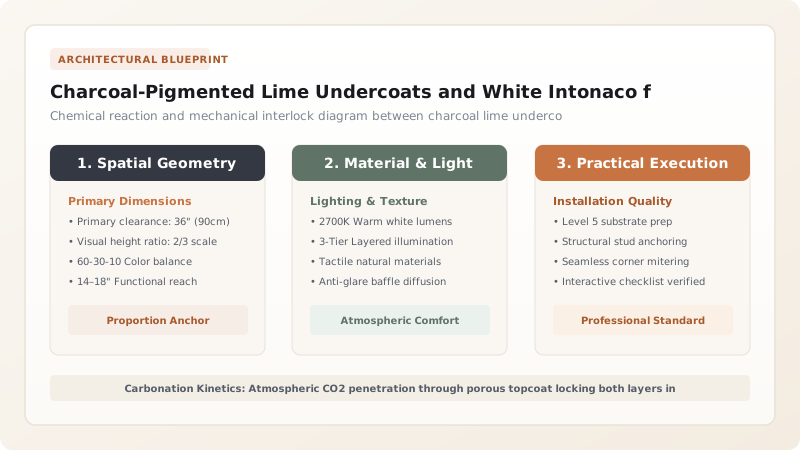
- Calcite Crystal Growth: Slow chemical transformation from Ca(OH)2 to CaCO3 binding the layers permanently.
1. Selecting and Processing Charcoal Pigments
The intensity and permanence of the dark sgraffito ground depend strictly on pigment chemistry. Modern synthetic carbon blacks often contain industrial oils that inhibit lime carbonation and reduce bond strength.
Authentic Florentine workshops use calcined vine charcoal (nero di vite) or beechwood charcoal. The charcoal is ground in ball mills and passed through a 200-mesh sieve (75 microns). Because pure carbon is completely inert, alkali-resistant, and impervious to ultraviolet sunlight, it never fades, chalks, or changes hue even across 500 years of Mediterranean weather.
2. Formulating the White Marble Dust Intonaco
The topcoat must be simultaneously opaque, brilliant white, and soft enough to cut cleanly without chipping. Master plasterers blend one part aged lime putty with one and a half parts finely crushed Carrara marble.
The marble aggregate is sieved to a controlled grain distribution: 60% medium grains (0.2mm - 0.4mm) and 40% fine powder (0.05mm - 0.1mm). The faceted calcite crystal cleavage planes reflect ambient light, creating the luminous, pearlescent glow distinctive of Renaissance palazzo facades.
3. Wet-on-Wet Application and Suction Dynamics
Delamination between the black and white layers is the most common failure in amateur sgraffito. To achieve an unbreakable monolithic bond, the white intonaco must be applied wet-on-wet (fresco-style).
The dark arriccio is allowed to stiffen until thumb pressure leaves a faint impression without transferring wet mortar (typically 4 to 12 hours after laying). The white intonaco is then troweled on in two thin passes totaling 2.0mm to 2.5mm. The hydraulic suction of the undercoat draws lime particles across the boundary, interlocking the microscopic crystals.
Sgraffito Mortar Mix Design Ratios by Weight
Use this reference table to calculate exact physical dimensions, ratios, and specifications before purchasing:
| Component / Ingredient | Arriccio Scuro (Black Undercoat) | Intonachino Bianco (White Topcoat) | Role in Mix |
|---|---|---|---|
| Aged Pit Lime Putty (CL90) | 100 parts by weight | 100 parts by weight | Primary binder (calcium hydroxide) |
| Washed River Sand (0.5 - 2mm) | 200 parts by weight | None | Structural skeleton, shrink resistance |
| Vine Charcoal Powder (75µm) | 15 - 22 parts by weight | None | Intense black mineral pigmentation |
| Carrara Marble Dust (0.1 - 0.4mm) | None | 150 parts by weight | Luminous reflective white aggregate |
| Clean Water (pH 7.0) | Added to achieve workable paste | Added to achieve creamy trowel paste | Hydration and plastic flow |
Material & Environmental Constraints
Every successful decoration project must account for physical and environmental constraints:
Wind-Driven Desiccation
High winds accelerate surface drying, causing topcoat crusting before bottom-layer hydration completes.
Water Purity Requirements
Mixing water contaminated with iron minerals will cause rust-colored staining across pure white marble plaster.
Protocol for Slaking, Pigmenting, and Laying Bicolor Sgraffito Mortars
Execute this professional sequence to achieve flawless results without backtracking:
Charcoal Wetting & Slurry Preparation
Pre-wet micronized vine charcoal with 10% ethanol solution to eliminate surface tension; stir into smooth black pigment paste.
Arriccio Scuro Batch Mixing
Paddle-mix lime putty, river sand, and black pigment slurry in mechanical mortar mixer for 15 minutes until color is uniform.
Base Coat Application & Leveling
Trowel black mortar onto pre-wetted wall at 10mm thickness; level with magnesium straightedge; score surface lightly with notched float.
Intonachino Bianco Mixing
Whisk aged lime putty and Carrara marble dust with high-shear paddle mixer until achieving a dense, silky butter consistency.
Two-Pass Topcoat Application
Trowel first 1mm skim of white intonaco firmly to wet substrate; immediately follow with second 1.5mm layer; smooth with stainless trowel.
Surface Checking & Firmness Test
Test surface firmness with fingernail; when plaster resists pressure without peeling, begin transfer of cartoon and stylus cutting.
Common Mistakes & Countermeasures
Avoid these costly errors that compromise aesthetics, ergonomics, and budget:
Adding dry charcoal powder directly into dry sand without pre-dispersing
Applying white intonaco over a bone-dry black base coat
Project Execution Checklist
Track your physical progress. Checkboxes persist automatically on this device:
Frequently Asked Questions
Why is pit-slaked lime better than bagged hydrated lime powder for sgraffito?
Pit-slaked lime putty contains hexagonal calcium hydroxide micro-platelets that remain submerged in water for months, developing superior plasticity, sticky adhesion, and slow, crack-free carbonation that cannot be replicated by dry hydrated powder.
Can black iron oxide pigment replace vine charcoal?
Yes, synthetic black iron oxide (Fe3O4) is chemically stable in lime, but traditionalists prefer vine charcoal because it produces a warm, velvety matte black with softer light absorption than the colder, bluish cast of iron oxide.


