
Classical Roman Cocciopesto Hydraulic Mortar and Cisterns represent one of antiquity's greatest civil engineering and material science triumphs. Developed across Italy and the Mediterranean from the 2nd century BC, cocciopesto (historically known as opus signinum) combined slaked non-hydraulic lime putty with finely pulverized low-fired terracotta pottery, roof tiles (tegulae), and amphorae. The amorphous aluminosilicates (metakaolin) in the fired clay reacted chemically with calcium hydroxide, synthesizing a dense hydraulic mortar that cured underwater, resisted catastrophic water pressure in monumental aqueducts and cisterns, and created indestructible waterproof linings.
At a Glance: Key Takeaways
- Fired Clay Metakaolin Reactivity: Reactive aluminosilicates in crushed terracotta reacting with lime to cure hydraulically underwater.
- Opus Signinum Cistern Linings: Multi-layer impermeable plaster coatings containing crushed ceramics and pozzolan.
- Quarter-Round Fillets (Cordoni): Continuous concave corner coves eliminating 90° hydrostatic stress concentrations in cistern tanks.
- Mutton Tallow & Linseed Polishing: Burnishing curing plaster with animal fats and hot oils to block microscopic capillary pores.
- Monumental Water Storage Engineering: Lining cisterns like the Piscina Mirabilis (12,600 m³) that supplied the imperial fleet.
- 2,000-Year Submerged Longevity: Surviving intact and watertight across Roman baths, aqueducts, and harbor piers today.
In-Depth Guides in this Directory
Explore specialized subtopic blueprints, technical dimensions, and execution checklists:
Crushed Terracotta Metakaolin Pozzolanic Reactivity in Cocciopesto
Material science guide to Roman hydraulic mortar: low-temperature clay calcining, metakaolin synthesis, aluminosilicate crystal lattices, and lime hydration.
Opus Signinum Cistern Linings and Quarter-Round Fillets
Civil engineering manual for Roman water reservoirs: subterranean cistern excavation, multi-coat opus signinum, quarter-round stress fillets (cordoni), and leak testing.
Roman Aqueduct Waterproofing and Tallow Stone Polishing
Civil engineering manual for Roman water channels: aqueduct specus channels, hydraulic cocciopesto linings, mutton tallow saponification, and smooth water flow.
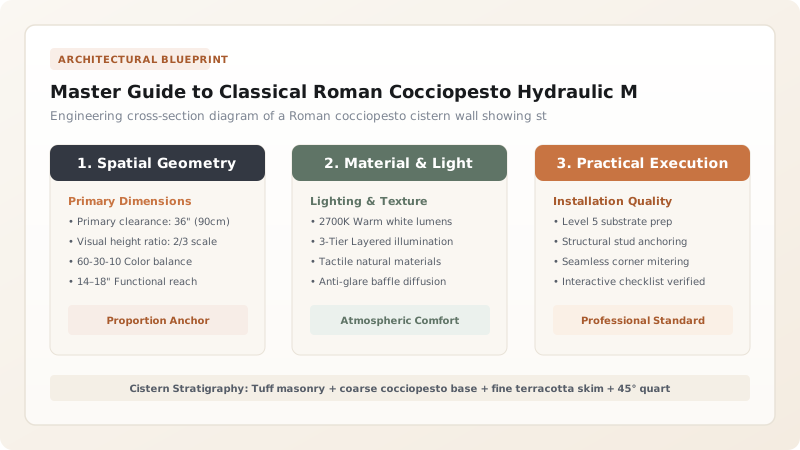
1. Vitruvian Standards: The Invention of Opus Signinum
In his 1st-century BC architectural treatise De Architectura, Roman engineer Vitruvius codified the standards for building watertight subterranean water reservoirs (cisternae). In regions lacking volcanic pozzolana sand, Roman masons solved water storage by inventing opus signinum (cocciopesto), named after the town of Signia (modern Segni) famous for its dense terracotta tiles.
By crushing rejected broken roof tiles (tegulae) and transport amphorae into graded powders and blending them with aged fat lime, Romans created an artificial pozzolanic binder that set into an impervious, glassy stone matrix capable of holding millions of gallons of drinking water without weeping or leaking.
2. Chemical Mechanics: Metakaolin and Hydrogarnet Formation
Standard fat lime (calcium hydroxide, Ca(OH)2) requires atmospheric carbon dioxide to harden and can never set underwater. When terracotta pottery is fired in a kiln at 600°C to 800°C, its natural kaolinite clay loses crystalline water, transforming into highly reactive amorphous metakaolin (Al2O3·2SiO2).
When pulverized and mixed with wet slaked lime putty, these amorphous aluminates react rapidly with calcium ions, synthesizing calcium silicate hydrates (C-S-H), calcium aluminate hydrates (C-A-H), and hydrogarnet. This dense crystalline network fills capillary voids within days, turning a soft lime paste into an impermeable, chemical-resistant hydraulic stone with a characteristic warm terracotta-pink color.
3. Hydrostatic Engineering: The Quarter-Round Fillet (Cordone)
A fatal vulnerability in water cistern design is the 90° right-angle junction where the vertical wall meets the flat floor. Hydrostatic pressure concentrates at this sharp joint, causing shear stress fractures that allow water to escape beneath the foundations.
Roman civil engineers eliminated this weakness by casting a monumental quarter-round fillet (cordone a guscio) along all wall-floor junctions. Formed from dense cocciopesto packed with coarse ceramic fragments, this sweeping convex fillet diverted hydrostatic pressure vectors smoothly into the thick floor slab, guaranteeing centuries of leak-free performance under extreme water heads.
Roman Cocciopesto Mortar Layer Specifications
Use this reference table to calculate exact physical dimensions, ratios, and specifications before purchasing:
| Plaster Layer | Latin / Italian Term | Thickness (mm) | Terracotta Particle Grading | Functional Engineering Role |
|---|---|---|---|---|
| Masonry Leveling Coat | Arriccio Grossolano | 25mm - 40mm | Coarse ceramic spalls (5mm - 12mm) | Levels rough stone & establishes hydraulic bond |
| Impermeable Body Coat | Opus Signinum | 15mm - 25mm | Medium crushed pottery (2mm - 5mm) | Primary hydrostatic water barrier |
| Fine Waterproof Skim | Intonachino Fino | 3mm - 5mm | Micro-pulverized tile dust (< 0.5mm) | Silky non-porous finish plane |
| Corner Fillet Wedge | Cordone a Guscio | 100mm - 200mm radius | High-density ceramic aggregate (5-15mm) | Eliminates 90° hydrostatic stress points |
| Tallow Burnish Seal | Lardellatura | Microscopic glaze | Mutton tallow / Linseed oil burnish | Complete surface pore occlusion |
Material & Hydraulic Constraints
Every successful decoration project must account for physical and environmental constraints:
Heavy Hand Compaction Labor
Cocciopesto requires continuous manual tamping with heavy wooden pounders to achieve the dense packing needed for water impermeability.
Water Testing Cure Timeline
Cisterns must not be filled with water until the hydraulic matrix has cured for at least 28 to 60 days under damp conditions.
Protocol for Formulating, Applying, and Burnishing Roman Cocciopesto
Execute this professional sequence to achieve flawless results without backtracking:
Terracotta Sourcing & Sieve Fractionation
Crush clean low-fired terracotta roof tiles; separate into coarse (5-10mm), medium (2-4mm), and fine (< 0.5mm) sieve bins.
Hydraulic Lime Putty Blending
Blend 1 part aged pit-slaked lime putty with 1 part pozzolanic terracotta powder and 1.5 parts sharp quartz sand; mix for 20 minutes.
Masonry Wetting & Base Coat Troweling
Saturate stone masonry with water; trowel 30mm coarse cocciopesto base; tamp aggressively with flat wooden beaters to eliminate air pockets.
Quarter-Round Fillet Casting
Pack dense cocciopesto along wall-floor corners; shape continuous concave fillet using curved wooden profile templates.
Fine Metakaolin Topcoat Application
Apply 4mm fine skim of lime and micro-pulverized red tile flour wet-on-wet; burnish vigorously with polished steel trowels.
Hot Mutton Tallow Burnishing
While plaster is firming, rub surface with warm melted mutton tallow and linseed oil using river stones to seal all micro-pores.
Common Mistakes & Countermeasures
Avoid these costly errors that compromise aesthetics, ergonomics, and budget:
Using modern vitrified porcelain or high-fired stoneware tiles (fired > 1,100°C) for cocciopesto
Applying cocciopesto coats over bone-dry stone masonry
Project Execution Checklist
Track your physical progress. Checkboxes persist automatically on this device:
Frequently Asked Questions
Why did Romans use mutton tallow (animal fat) on cistern plaster?
Mutton tallow contains saturated stearic and palmitic fatty acids. When rubbed into fresh lime plaster, the fatty acids react with free calcium hydroxide to form calcium stearate—an insoluble, hydrophobic wax that permanently waterproofs the microscopic pores of the plaster against water penetration under high pressure.
How large was the largest Roman cistern lined with cocciopesto?
The Piscina Mirabilis at Bacoli (near Naples) is a monumental subterranean reservoir measuring 70 meters long, 25 meters wide, and 15 meters high, holding 12,600 cubic meters (3.3 million gallons) of fresh water supplied by the Serino Aqueduct to supply the Roman Western Imperial Fleet at Misenum.


