
Hydraulic Lime Bedding and Pozzolan Grouting provide the essential chemical and structural foundation that allows Greek pebble mosaics to endure for millennia. Unlike modern rigid Portland cements that crack under foundation settling, ancient Aegean bedding mortars combined slaked non-hydraulic fat lime with reactive volcanic earths (such as Santorin earth or pozzolana) and pulverized terracotta (cocciopesto). This creates a hydraulic calcium-silicate-hydrate matrix that cures underwater, flexes under seasonal thermal expansion, and permanently bonds smooth river pebbles without micro-cracking.
At a Glance: Key Takeaways
- Volcanic Santorin Earth: Natural reactive pozzolana imparting underwater hydraulic setting to pure lime.
- Cocciopesto Pulverized Ceramic: Fired clay dust releasing reactive aluminosilicates to fortify mortar density.
- Micro-Elastic Flexibility: Low modulus of elasticity accommodating foundation settlement without stone detachment.
- Breathable Vapor Permeability: Permitting ground moisture to evaporate freely without salt-induced frost heave.
- Slaked Marble Dust Grout: Ultra-fine lime and marble flour slurry flowing into tight inter-pebble crevices.
1. Pozzolanic Chemistry in the Ancient Aegean
Standard fat lime (calcium hydroxide) cures exclusively through carbonation—reacting with atmospheric CO2. In thick floor beds (100mm to 150mm deep), oxygen and CO2 cannot penetrate, leaving non-hydraulic lime soft and pasty for decades.
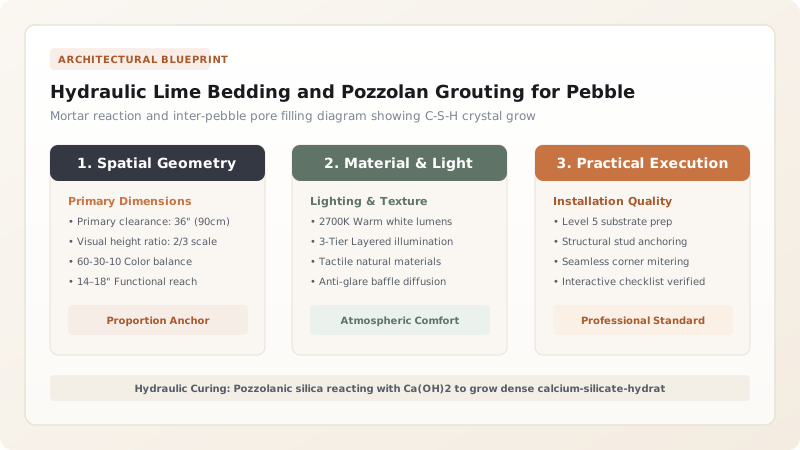
Ancient Greek builders solved this by discovering pozzolanic volcanic earths, notably from the volcanic caldera island of Santorini (Santorin earth). When mixed with slaked lime putty and water, amorphous volcanic silicates and aluminates react directly with calcium hydroxide, synthesizing calcium silicate hydrates (C-S-H). This reaction sets hydraulically throughout the entire depth of the slab, even in completely sealed subterranean basements.
2. Cocciopesto: The Hydraulic Power of Crushed Terracotta
To further fortify the bedding mortar and impart waterproof resilience against spilled wine, water basins, and rising ground damp, mosaicists added cocciopesto (crushed roof tiles and pottery sherds).
Low-fired ancient ceramics contain highly reactive amorphous metakaolin (Al2O3·2SiO2). When crushed into fine powders (0.1mm - 1.0mm) and blended into the lime matrix, it forms hydrogarnet and strätlingite crystals. This dense crystal lattice reduces capillary pore diameters from 10 microns to under 0.1 microns, creating a dense, moisture-impervious bedding slab with a characteristic warm terracotta pink hue.
3. The Slurry Grouting and Post-Cure Polishing Protocol
Once all pebbles and lead strips are positioned, the floor cannot be left with open voids between stones. Water and dirt would accumulate, destabilizing the stones during winter freezes.
Master masons prepare a liquid grouting slurry composed of aged lime putty, volcanic pozzolana sifted through a 100-mesh screen, and clean river sand. Poured across the floor and worked into every crevice with stiff esparto-grass brooms, the slurry fills the voids to within 2mm of the pebble crowns, locking thousands of stones into a unified monolithic pavement.
Classical Pebble Mosaic Mortar Mix Formulations (By Volume)
Use this reference table to calculate exact physical dimensions, ratios, and specifications before purchasing:
| Mortar Layer | Aged Lime Putty (CL90) | Volcanic Pozzolana / Santorin Earth | Crushed Terracotta (Cocciopesto) | Washed River Sand (0-3mm) |
|---|---|---|---|---|
| Rudus (Coarse Base) | 1 Part | 1 Part | 1 Part Coarse (2-5mm) | 2 Parts Coarse River Sand |
| Nucleus (Setting Bed) | 1 Part | 1.5 Parts Fine | 0.5 Parts Medium (1-2mm) | 1.5 Parts Fine River Sand |
| Grouting Slurry (Colatura) | 1 Part | 1 Part Micronized | 0.5 Parts Fine Powder (< 0.5mm) | 1 Part Marble Dust (0-0.5mm) |
| Surface Wash / Slurry | 1 Part | None | None | 2 Parts Crushed White Marble Flour |
Curing & Structural Constraints
Every successful decoration project must account for physical and environmental constraints:
Extended Curing Timelines
Hydraulic lime-pozzolan mixtures require at least 28 to 60 days to achieve full structural design strength.
Water Evaporation Control
Premature drying in hot climates halts hydraulic reactions; floors must be covered with damp burlap sacks.
Protocol for Mixing, Bedding, and Grouting a Pebble Mosaic Floor
Execute this professional sequence to achieve flawless results without backtracking:
Hydraulic Pozzolan Slurry Pre-Hydration
Pre-mix Santorin volcanic earth with slaked lime putty 24 hours in advance to activate hydraulic silica reactivity.
Rudus Base Pouring & Compaction
Pour 80mm coarse lime-cocciopesto rudus over crushed stone drainage base; compact with heavy wooden tampers; cure for 4 days.
Nucleus Layer Screeding
Trowel 30mm fine hydraulic setting bed over damp rudus; screed perfectly level using aluminum straightedge; score surface lightly.
Pebble Insertion & Tamp Seating
Embed pebbles vertically on edge into wet nucleus; tap flat using a broad timber pounding block (batten) and mallet.
Liquid Slurry Flood & Joint Packing
Flood floor with creamy lime-pozzolana slurry; squeegee diagonally across joints with rubber floats; broom deep into voids.
Surface Washing & Wax Sealing
Sponge surface clean before final set; cure damp for 28 days; buff with beeswax and olive oil emulsion to enrich stone colors.
Common Mistakes & Countermeasures
Avoid these costly errors that compromise aesthetics, ergonomics, and budget:
Using dry powdered lime without pozzolana in thick indoor pebble beds
Acid washing newly completed pebble mosaic floors with muriatic acid
Project Execution Checklist
Track your physical progress. Checkboxes persist automatically on this device:
Frequently Asked Questions
Can natural hydraulic lime (NHL 3.5) replace lime putty and volcanic earth?
Yes. Modern conservators and builders frequently use commercially bagged Natural Hydraulic Lime (such as NHL 3.5 or NHL 5), which contains naturally occurring hydraulic silicates that mimic ancient pozzolanic mixtures with consistent factory quality control.
Why did ancient mosaics incorporate beeswax on the surface?
After full carbonation, ancient craftsmen rubbed the floor with melted beeswax (punice wax) and warm oils. This sealed microscopic pores against red wine stains and enhanced the deep optical refractive colors of black basalt and red chert pebbles.


