
Opus Signinum Cistern Linings and Quarter-Round Fillets represent the civil engineering design grammar of ancient Mediterranean water storage. To contain millions of liters of water under continuous hydrostatic head without cracking, Roman engineers lined subterranean stone or concrete tanks with three dense coats of opus signinum. Crucially, all 90° internal wall-floor corners were eliminated by casting sweeping concave quarter-round fillets (cordoni a guscio), distributing hydrostatic shear stress evenly across the foundation slab.
At a Glance: Key Takeaways
- Three-Coat Water Barrier: Successive layers grading from coarse leveling mortar to dense, burnished terracotta skim.
- Concave Quarter-Round Fillets (Cordoni): Sweeping 150mm-200mm radius corner fillets eliminating hydrostatic stress points.
- Hydrostatic Vector Dissipation: Converting horizontal wall water thrust into downward foundation compression.
- Hand Tamping Densification: Beating wet plaster with heavy wooden mallets (battidori) to expel microscopic air voids.
- Subterranean Vaulted Basins: Barrel and groin-vaulted underground chambers keeping stored water cool and algae-free.
- Seamless Crack Bridging: Low elastic modulus accommodating subtle foundation settling without developing leaks.
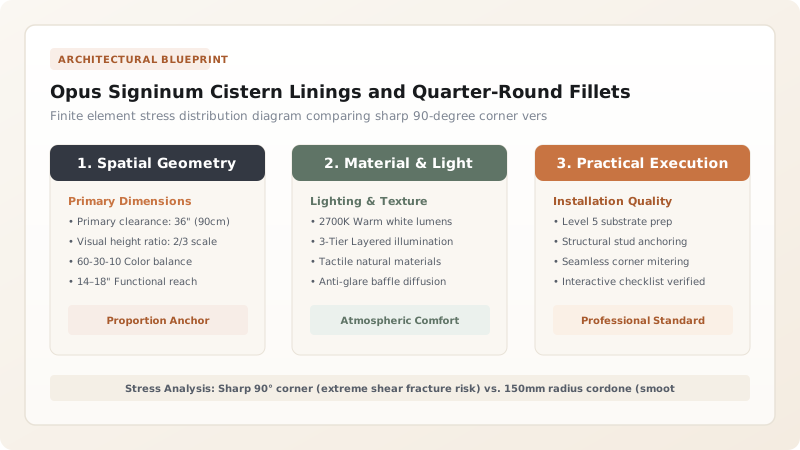
1. Hydrostatic Stress Physics: The Quarter-Round Fillet
When a subterranean cistern is filled with water to a depth of 5 to 10 meters, water exerts monumental hydrostatic pressure (up to 100 kPa) against the base of the walls. In a sharp 90° corner, the structural intersection is subjected to severe bi-axial shear stresses.
Roman engineers eliminated this vulnerability by casting the cordone a guscio (quarter-round cove fillet). Running continuously along the entire perimeter where walls meet the floor, this 150mm to 250mm radius concave molding redirects outward horizontal water thrust smoothly into the massive floor slab, ensuring the impermeable cocciopesto lining never fractures along the corner seam.
2. Three-Coat Stratigraphy: From Rough Bed to Glass Skim
Vitruvius specified that waterproof cistern plastering must be executed in three progressive, monolithic layers, applied wet-on-wet:
- First Coat (Arriccio - 25mm to 35mm): Formulated with coarse crushed tile fragments (5mm-12mm) to key into the rough volcanic tuff masonry and bridge structural irregularities.
- Second Coat (Corpo d'Intonaco - 15mm to 20mm): Packed with medium terracotta grains (2mm-4mm) and quartz sand, forming the primary impermeable hydraulic barrier.
- Third Coat (Intonachino - 3mm to 5mm): Blended with ultra-fine, sieved ceramic flour (< 0.5mm) and aged lime putty, burnished to a glassy, non-porous plane that repels water penetration.
3. The Tamping Ritual: Beating Out the Micro-Voids
The impermeability of Roman cocciopesto was achieved not only through chemistry, but through extreme mechanical compaction. Freshly troweled plaster was not simply smoothed with a float.
Teams of masons used heavy flat wooden beaters called battidori (or tampions). Striking the wet plaster systematically in overlapping grids, they compressed the mortar bed by 20% to 25%. This mechanical beating expelled all trapped air bubbles, forced the angular terracotta fragments into interlocking physical contact, and drew a rich, creamy hydraulic paste to the surface for final burnishing.
Roman Cistern Hydrostatic Pressure vs. Lining Specifications
Use this reference table to calculate exact physical dimensions, ratios, and specifications before purchasing:
| Water Depth Head (Meters) | Hydrostatic Pressure (kPa) | Total Cocciopesto Thickness | Corner Fillet Radius (mm) | Tamping Compaction Required |
|---|---|---|---|---|
| Up to 2.5m (Domestic) | 25 kPa (Low) | 35mm - 45mm (2 coats) | 100mm Radius | Double manual hand-float compaction |
| 2.5m - 5.0m (Public Baths) | 50 kPa (Medium) | 50mm - 65mm (3 coats) | 150mm Radius | Heavy battidore wooden mallet tamping |
| 5.0m - 10.0m (Aqueduct Basin) | 100 kPa (High) | 70mm - 90mm (3-4 coats) | 200mm Radius | Two-man heavy rammer compaction |
| 10.0m - 15.0m (Piscina Mirabilis) | 150 kPa (Extreme) | 100mm+ Multi-layer | 250mm Reinforced Radius | Mechanical ramming + tallow stone burnish |
Subterranean & Engineering Constraints
Every successful decoration project must account for physical and environmental constraints:
Confined Space Safety
Working inside deep subterranean cisterns requires continuous mechanical ventilation to purge carbon dioxide released during lime carbonation.
Hydrostatic Ground Uplift
Empty subterranean cisterns in high water tables can float like a boat; tanks must be engineered with pressure-relief valves or heavy concrete lids.
Protocol for Lining a Water Cistern with Opus Signinum and Cordoni
Execute this professional sequence to achieve flawless results without backtracking:
Substrate Deep Raking & Pre-Wetting
Rake masonry joints 30mm deep; scrub away organic dirt; saturate stone walls with clean water for 24 hours prior to plastering.
First Coarse Arriccio Application
Trowel 30mm coarse cocciopesto base coat over damp walls and floor; tamp with flat wooden beaters; score surface with wavy comb.
Quarter-Round Fillet Sledding
Pack dense ceramic mortar along all wall-floor junctions; shape continuous 150mm concave fillet using curved wooden profile templates.
Intermediate Body Coat Application
While base is firm, trowel 18mm medium-aggregate cocciopesto over walls, floor, and fillet; beat aggressively with battidori mallets.
Fine Metakaolin Finish Burnishing
Apply 4mm superfine terracotta-lime skim; burnish with steel trowels and smooth river pebbles until surface has a glassy luster.
Damp Hydration Curing & Leak Testing
Mist walls daily and keep cistern sealed under damp conditions for 45 days; fill with water gradually; monitor water level gauges.
Common Mistakes & Countermeasures
Avoid these costly errors that compromise aesthetics, ergonomics, and budget:
Leaving sharp 90° corners at the junction of walls and floor
Filling the cistern with water before the hydraulic mortar has fully cured
Project Execution Checklist
Track your physical progress. Checkboxes persist automatically on this device:
Frequently Asked Questions
How did Romans clean sediment out of cocciopesto cisterns?
The floor of the cistern was built with a gentle 1% slope draining toward a central or corner sump depression called a 'piscina limaria' (settling basin). Silt and mud settled into this depression, allowing maintenance workers to shovel out sediment through access manholes without draining the entire water supply.
Can cocciopesto be used to waterproof modern concrete swimming pools?
Yes. Historic restoration specialists and eco-conscious architects frequently line modern concrete pools and cisterns with traditional cocciopesto. It provides an all-natural, non-toxic, chemical-free waterproof lining with a breathtaking natural pink-terracotta glow that modern blue epoxy paints cannot match.


