
Roman Quincunx Geometric Schemata and Basilica Sectile Design represent the mathematical and spiritual grammar of ancient and medieval imperial floors. Rooted in Pythagorean and Platonic geometry, the quincunx features a monumental central stone disc (rota)—usually cut from Egyptian purple porphyry—surrounded by four orbiting discs interconnected by undulating, interwoven ribbons (guilloche) filled with thousands of triangular and rhomboid marble inlays. In imperial basilicas and papal chancels, the quincunx marked sacred ceremonial axes where emperors and popes stood during state coronations.
At a Glance: Key Takeaways
- The Sacred Quincunx Schema: Five-fold symmetrical matrix of circular roundels interconnected by fluid ribbons.
- Imperial Porphyry Rotae: Monumental circular discs sliced from ancient columns anchoring room focal centers.
- Guilloche Interlaced Ribbons: Flowing bands of white marble framing dense geometric infill of colored triangles.
- Ceremonial Coronation Discs: The Rota Porphyretica marking the exact spot where Holy Roman Emperors were crowned.
- Mathematical Platonic Tessellation: Rotating equilateral triangles, squares, and hexagons to generate infinite optical patterns.
- Cosmatesque Christian Evolution: 12th-century Roman rebirth integrating ancient pagan marbles into Christian liturgical space.
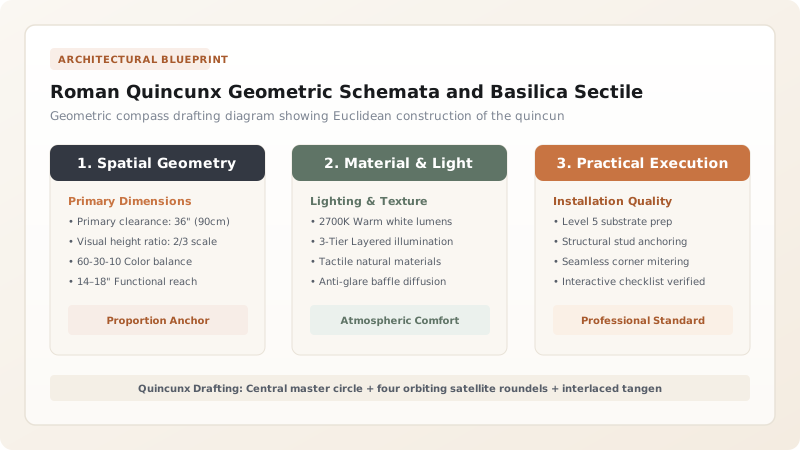
1. Mathematical Anatomy of the Quincunx
The foundational design schema of classical and medieval sectile is the quincunx (cinquefoil). Constructed purely with compass and straightedge, the layout begins with an outer square divided into nine equal quadrants.
A massive circular disc, or rota, occupies the center. Four secondary discs occupy the corner quadrants, linked to the center by continuous, curving ribbons of white marble called guilloches. The ribbons weave over and under one another in continuous infinity, framing dense triangular inlays of porphyry, serpentine, and gilded smalti glass.
2. Liturgical Symbolism: The Rota Porphyretica and Coronations
In Christian basilicas, the quincunx was not merely decorative; it was a sacred theatrical stage. The central porphyry disc, known as the Rota Porphyretica, represented Christ as the central axis of the cosmos, surrounded by the Four Evangelists.
Most famously, in Old St. Peter's Basilica in Rome, a monumental red porphyry disc set into the floor marked the spot where Charlemagne was crowned Holy Roman Emperor on Christmas Day in 800 AD. Subsequent emperors stood upon this precise stone disc to receive imperial unction, physically linking their political authority to ancient Roman imperial majesty.
3. The Basilica Floor Grammar: Organizing Sacred Space
In classical Roman basilicas and early Christian churches, opus sectile articulated the architectural hierarchy of the building:
- The Nave (Schola Cantorum): Lined with monumental square carpet panels filled with orthogonal tessellations of squares, lozenges, and hexagons.
- The Chancel Arch (Bema): Transitioned into dynamic, undulating quincunx medallions that guided the processions of clergy toward the altar.
- The High Altar (Presbytery): Elevated on stone steps, adorned with the rarest circular rotae of imperial porphyry, marking the holy of holies where the divine sacrifice took place.
Cosmatesque Opus Sectile Geometric Unit Classification
Use this reference table to calculate exact physical dimensions, ratios, and specifications before purchasing:
| Geometric Unit | Italian Name | Underlying Geometry | Lithotypes Used | Symbolic / Architectural Role |
|---|---|---|---|---|
| Porphyry Roundel | Rota / Ruota | Solid circle (300mm - 1.8m dia) | Imperial Red Porphyry / Green Serpentine | Imperial coronation station, Christ cosmos |
| Interlaced Ribbon | Guilloche | Continuous undulating S-curves | Carrara white marble framing bands | Infinite divine eternity, spatial connection |
| Triangular Tessera | Tarsia Triangolare | Equilateral 60° micro-triangles | Porphyry, Giallo Antico, Palombino | Dense optical mosaic texture inside ribbons |
| Checkerboard Carpet | Scacchiera | Orthogonal 45° rotated squares | Alternating black and white marbles | Nave side aisles, rhythmic procession pacing |
Scale & Historical Constraints
Every successful decoration project must account for physical and environmental constraints:
Monumental Component Weight
An authentic 1.5-meter diameter porphyry rota weighs over 150 kilograms, requiring 4-man lifting straps and gantry rigging.
Extreme Triangle Count
A complete 5-meter quincunx panel contains over 15,000 individually cut stone triangles, requiring months of workshop cutting.
Protocol for Laying Out and Setting a Basilica Quincunx Pavement
Execute this professional sequence to achieve flawless results without backtracking:
Axial Survey & Central Datum Scribing
Establish main longitudinal basilica nave axis; locate optical focal center using laser levels; scribe center point for master rota.
Geometric Compass Layout on Plaster Floor
Draft master quincunx circles and tangent guilloche arcs directly onto cured screed floor using heavy trammel compass.
Bedding the Central Porphyry Rota
Spread 30mm hydraulic lime-pozzolan bed; lower heavy porphyry rota into center; tamp perfectly level with wooden tamper.
White Marble Guilloche Ribbon Setting
Bed carved curved Carrara marble ribbon frames; maintain continuous 100mm wide channels between ribbons for triangular inlays.
Micro-Intarsia Triangle Assembly
Pack geometric ribbons with thousands of pre-cut 25mm porphyry and serpentine triangles bedded in pure lime putty with 0.5mm joints.
Pumice Honing & Hot Beeswax Buffing
Hone entire pavement with pumice stone and water to eliminate lip page; allow to dry; buff with hot beeswax and olive oil.
Common Mistakes & Countermeasures
Avoid these costly errors that compromise aesthetics, ergonomics, and budget:
Laying out quincunx roundels with hand tapes rather than Euclidean geometric trammels
Using modern dark gray tile grout to fill micro-triangular inlays
Project Execution Checklist
Track your physical progress. Checkboxes persist automatically on this device:
Frequently Asked Questions
What is the famous Cosmati pavement in London?
The Great Pavement in front of the High Altar at Westminster Abbey, commissioned by King Henry III in 1268 and executed by Italian Cosmati master Odericus using imported purbeck marble and ancient Roman porphyry spolia; it serves as the coronation spot for British monarchs.
How did medieval Cosmati craftsmen get porphyry if the quarries were closed?
They engaged in extensive spolia recycling. Rome was filled with ruins of ancient imperial baths and palaces containing thousands of porphyry and marble columns; Cosmati craftsmen bought or excavated these ruined columns and sliced them into roundels and triangles.


