
Imperial Porphyry, Giallo Antico, and Cipollino Marble Sourcing formed the lifeblood of Rome's imperial decorative economy. Extracted from state-owned quarries spanning Egypt, North Africa, Greece, and Anatolia, these legendary stones were quarried by convict and military labor under the Office of the Emperor's Patrimony (Marmora Romana). Transported across the Mediterranean via specialized heavy-displacement cargo ships (naves lapidariae), these marbles were processed in imperial marble yards along the Tiber River into standard architectural crustae.
At a Glance: Key Takeaways
- Mons Porphyrites (Egypt): Remote desert mountain quarry producing imperial purple-red and black porphyry.
- Chemtou (Numidia / Tunisia): Ancient quarries yielding brilliant golden-yellow Giallo Antico breccia.
- Karystos (Euboea / Greece): Coastal quarries producing folded, green-veined Cipollino onion marble.
- Marmora Romana Administration: Imperial bureaucratic monopoly tracking every block with carved administrative inscriptions.
- Naves Lapidariae Transport: Massive Roman merchant galleys capable of transporting 300-tonne stone cargoes across the Mediterranean.
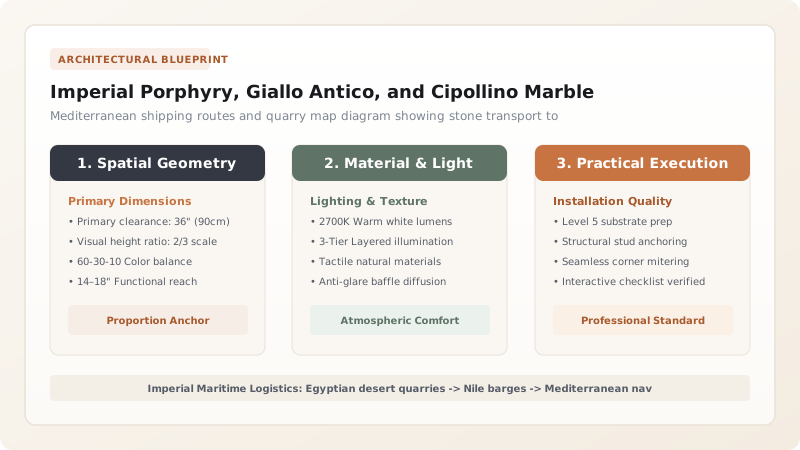
1. Mons Porphyrites: The Sacred Mountain of Egypt
Located in the Red Sea mountains of the Eastern Egyptian desert, Mons Porphyrites (Gebel Dokhan) was the only known source of true red imperial porphyry in the world. Operating under brutal desert conditions 150 kilometers from the Nile, Roman quarry masters extracted blocks using iron wedges, heavy sledgehammers, and fire-setting.
Geologically an andesite-dacite volcanic rock filled with white plagioclase feldspar phenocrysts, its hardness made it nearly impervious to weathering. Monopolized exclusively by the Emperor, porphyry blocks were dragged across paved desert roads (via Porphyrites) on massive multi-wheeled wagons pulled by dozens of oxen to the Nile, then floated downstream to Alexandria.
2. Giallo Antico and Cipollino: African Sun and Greek Sea
Complementing the dark purple of porphyry were two vital chromatic stones:
- Giallo Antico (Marmor Numidicum): Quarried at Simitthus (Chemtou, Tunisia), this brecciated limestone ranges from soft buttercup yellow to fiery saffron with deep reddish veins. Its radiant warmth illuminated dark Roman interiors and contrasted sharply with purple porphyry.
- Cipollino (Marmor Carystium): Sourced near Karystos on the Greek island of Euboea, this metamorphic marble features wavy, undulating bands of white calcite and green chlorite mica, resembling the concentric layers of a cut onion (cipolla). Sawn along the grain, it simulated undulating sea waves or bookmatched architectural mirrors.
3. Imperial Logistics, Quarry Marks, and Medieval Spolia
Every rough block extracted in the provinces was cataloged by Roman imperial bureaucrats. Quarry officers incised inscriptions directly into the rock faces (quarry marks), detailing the year, consular date, quarry pit number (brachium), and supervising slave or centurion name.
When Mediterranean shipping collapsed in the early Middle Ages, these ancient quarries were lost and abandoned. For the next millennium, Roman opus sectile survived exclusively through spolia (architectural cannibalization). Byzantine and Cosmatesque artisans carefully excavated ancient Roman ruins, extracting Roman columns and sawing them into thin slices to create new basilica floors.
Classical Mediterranean Imperial Marble Sourcing Guide
Use this reference table to calculate exact physical dimensions, ratios, and specifications before purchasing:
| Stone Variety | Modern Geological Origin | Quarry Name | Mineral Hardness (Mohs) | Historical Cargo Route |
|---|---|---|---|---|
| Porfido Rosso Antico | Red Sea Mountains, Egypt | Mons Porphyrites | 6.5 - 7.0 (Extreme) | Overland via Nile to Alexandria -> Rome |
| Giallo Antico | Chemtou, Tunisia | Simitthus | 3.0 - 3.5 (Soft) | Bagradas river to Utica -> Portus |
| Cipollino Verde | Euboea, Greece | Karystos Quarries | 3.5 - 4.0 (Medium) | Aegean coastal loading directly to ship |
| Pavonazzetto | Afyonkarahisar, Turkey | Docimium | 3.0 - 3.5 (Medium) | Overland to Ephesus -> Mediterranean |
| Africano / Lucullan | Teos, Turkey | Sigacik Quarries | 4.0 - 4.5 (Medium-Hard) | Ionian coast directly to Portus |
Legal & Antiquities Constraints
Every successful decoration project must account for physical and environmental constraints:
Severe Antiquities Laws
Genuine Roman spolia marbles are strictly protected under Italian and international cultural heritage legislation; uncertified trading is a federal crime.
Extreme Material Scarcity
Authentic antique porphyry slabs command prices exceeding $15,000 per square meter among museum-grade conservators.
Protocol for Sourcing and Verifying Authentic Historic Imperial Marbles
Execute this professional sequence to achieve flawless results without backtracking:
Petrographic Mineralogical Verification
Sample stone chip for thin-section microscopy; verify characteristic epidote, piemontite, and plagioclase crystals of Mons Porphyrites.
Mohs Scratch Hardness Calibration
Perform scratch hardness testing; verify soft calcites (Mohs 3) versus igneous porphyries (Mohs 7) to plan sawing regimes.
Spolia Column Salvage & Core Boring
Identify salvaged Roman column shaft fragments; inspect for interior frost cracking using ultrasonic pulse velocity testing.
Slab Slicing Orientation Planning
Align stone bedding planes: cut Cipollino perpendicular to grain for wave effect; cut porphyry across phenocryst clusters.
Secondary Color Matching & Grading
Wet sliced slabs under raking light; sort into chromatic harmony batches, ensuring uniform color saturation across the project.
Documentation & Provenance Archiving
Record quarry provenance or spolia origin in conservation registry per UNESCO and national antiquities guidelines.
Common Mistakes & Countermeasures
Avoid these costly errors that compromise aesthetics, ergonomics, and budget:
Mistaking modern synthetic reconstituted porphyry for antique imperial porphyry
Slicing soft Giallo Antico with aggressive high-pressure porphyry saw blades
Project Execution Checklist
Track your physical progress. Checkboxes persist automatically on this device:
Frequently Asked Questions
Can antique Egyptian porphyry still be quarried today?
No. The ancient quarries at Mons Porphyrites lie in an uninhabited, hyper-arid protected national park in Egypt; they have been completely inactive since the 5th century AD, making existing ancient blocks and spolia the only available material on Earth.
Why did Romans call Giallo Antico 'Marmor Numidicum'?
The Romans named marbles after their geographic province of origin; Giallo Antico came from Numidia (modern-day northern Tunisia), which became a Roman province following the defeat of Carthage and King Jugurtha.


