
Classical Roman Opus Sectile Marble Intarsia Pavements represent the absolute zenith of luxury, engineering, and imperial prestige in ancient Roman and Byzantine interior design. Unlike standard mosaic (opus tessellatum) composed of tiny uniform cubes, opus sectile ('cut work') precisely cuts, bevels, and fits large slabs of the most precious imperial marbles, serpentines, and porphyries into complex geometric inlays (intarsia). Adorning imperial palaces on the Palatine, Hadrian's Villa, and monumental basilicas, opus sectile conveyed divine cosmic sovereignty through razor-tight marble joints and Euclidean geometric matrices.
At a Glance: Key Takeaways
- Precious Imperial Lithotypes: Egyptian Red Porphyry, Numidian Giallo Antico, Spartan Green Porphyry, and Phrygian Pavonazzetto.
- Precision Wire-Saw Slicing: Cutting ultra-hard porphyries into 8mm-15mm thin crustae using copper wire and carborundum slurries.
- Razor-Tight Hairline Joints: Dry-ground marble facets meeting with sub-millimeter tolerances without visible mortar lines.
- Sacred Quincunx Schemata: Concentric circular guilloche ribbons enclosing central monumental porphyry discs (rotae).
- Cosmic Imperial Sovereignty: Visual manifestation of Roman geopolitical conquest through the assemblage of stones from across the empire.
- 2,000-Year Architectural Durability: Surviving intact in the Pantheon, Roman curias, and early Christian basilicas.
In-Depth Guides in this Directory
Explore specialized subtopic blueprints, technical dimensions, and execution checklists:
Imperial Porphyry, Giallo Antico, and Cipollino Marble Sourcing
Geological and historical sourcing manual for Roman marbles: Mons Porphyrites quarries, Numidian yellow breccia, Euboean Cipollino, and ancient logistics.
Roman Wire-Saw Cutting and Abrasive Slurry Shaping for Sectile
Ancient lapidary engineering manual: cutting hard porphyry slabs with toothless wire saws, Naxos emery abrasives, iron template lapping, and edge beveling.
Roman Quincunx Geometric Schemata and Basilica Sectile Design
Geometric and theological design guide to Roman and Cosmatesque opus sectile: the sacred quincunx, serpentine guilloche bands, rotae roundels, and basilica floor grammar.
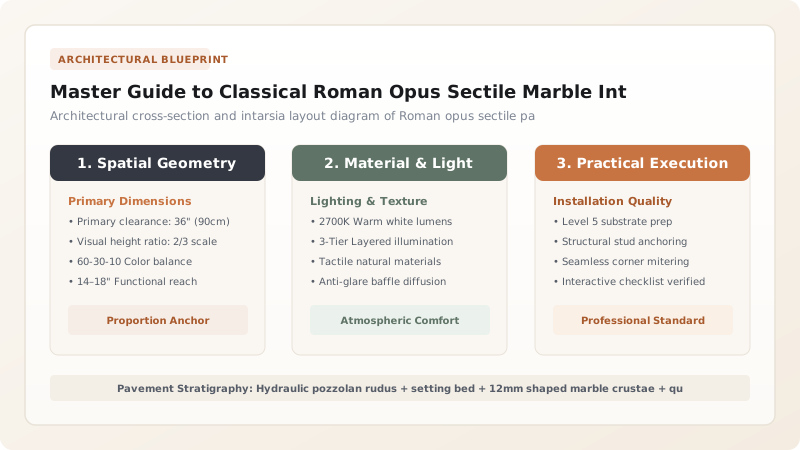
1. Geopolitics of Stone: The Imperial Power of Opus Sectile
In the Roman Empire, opus sectile was the supreme decorative status symbol, vastly more expensive and prestigious than standard mosaics or fresco. To walk across an opus sectile floor was to walk across the conquered provinces of Rome.
Emperors from Augustus to Constantine monopolized the quarries of the Mediterranean: purple porphyry from the remote eastern desert of Egypt (Mons Porphyrites), yellow marble from Numidia (modern Tunisia), emerald-green serpentine from Sparta, and purple-veined pavonazzetto from Asia Minor. Gathering these impossibly rare stones into a single hall visually proclaimed Rome's dominion over the known cosmos.
2. Stereotomy and Cutting Mechanics: The Wire Saw
Unlike tesserae, which were snapped with a hammer and hardie into rough cubes, opus sectile demanded extreme stereotomic precision. Slabs of marble, called crustae, were sawn to uniform thicknesses of 8mm to 15mm.
For extremely hard stones like Egyptian porphyry (Mohs 7), iron toothless blades or twisted copper wires were drawn back and forth by teams of slaves while an abrasive slurry of water and emery sand (from the island of Naxos) was fed into the kerf. The edges were then beveled and hand-ground against bronze plates until adjoining geometric tiles met with hairline tolerances measuring less than 0.5mm.
3. Geometric Schemata: The Quincunx and Cosmatesque Lineage
Opus sectile layouts were governed by advanced Hellenistic geometry. The most sacred configuration was the quincunx (cinquefoil): four circular medallions orbiting a massive central disc (rota), bound together by continuous interlaced serpentine ribbons of polychrome marble triangles and trapezoids (guilloche).
This Roman imperial tradition survived the fall of the Western Empire, preserved in Byzantine Constantinople and later resurrected in medieval Rome by the Cosmati guild, whose dazzling 12th-century 'Cosmatesque' opus sectile pavements still adorn the Papal basilicas of St. John Lateran, Santa Maria in Cosmedin, and Westminster Abbey.
Classical Imperial Roman Opus Sectile Lithotypes
Use this reference table to calculate exact physical dimensions, ratios, and specifications before purchasing:
| Classical Latin Name | Modern Italian Name | Geological Provenance | Color Profile & Veining | Symbolic Imperial Meaning |
|---|---|---|---|---|
| Porfido Rosso Antico | Imperial Porphyry | Gebel Dokhan, Egypt | Deep imperial purple with white phenocrysts | Imperial majesty, divine emperors |
| Giallo Antico | Marmor Numidicum | Chemtou, Tunisia | Vibrant golden yellow with dark brecciated veins | Sun, wealth, African dominion |
| Pavonazzetto | Marmor Phrygium | Docimium, Turkey | Milk white ground with intense purple/violet veins | Ecclesiastical and regal authority |
| Cipollino | Marmor Carystium | Euboea, Greece | Onion-like parallel green and white laminar bands | Verdant life, Aegean waters |
| Serpentino / Lapis Lacedaemonius | Porfido Verde Antico | Sparta, Greece | Dark emerald green with pale pistachio crystals | Spartan military endurance |
Rarity & Mechanical Constraints
Every successful decoration project must account for physical and environmental constraints:
Extinction of Imperial Quarries
Authentic Egyptian Imperial Porphyry and Numidian Giallo Antico quarries were exhausted in antiquity; authentic restoration requires salvaging ancient spolia.
Extreme Cutting Hardness
Egyptian porphyry has a Mohs hardness of 7; cutting modern replacements requires specialized water-cooled diamond CNC wire saws.
Protocol for Slicing, Fitting, and Bedding Roman Opus Sectile
Execute this professional sequence to achieve flawless results without backtracking:
Wire-Saw Slab Slicing
Saw porphyry and marble boulders into 12mm thin slabs using toothless copper wire fed with abrasive Naxos emery slurry.
Geometric Template Scribing
Scribe geometric polygons onto marble slabs using iron templates and diamond or hardened-steel scriber points.
Edge Dressing & Bevel Lapping
Grind edges against rotating cast-iron wheels with water and abrasive sand; bevel rear edges 3° to ensure razor-tight front joints.
Dry-Fit Workshop Assembly
Pre-assemble the full geometric medallion on workshop layout floor; check joints under raking light for < 0.5mm gap tolerance.
Hydraulic Pozzolan Bedding
Spread 25mm bedding mortar of slaked lime putty, volcanic pozzolana, and marble dust; butter backs of slabs with lime milk.
Tamping & Surface Stone Polishing
Tap marble slabs into mortar using broad wooden pounders; level coplanar; hone with pumice and buff with olive oil and lead wool.
Common Mistakes & Countermeasures
Avoid these costly errors that compromise aesthetics, ergonomics, and budget:
Using wide 3mm to 5mm grout joints like modern ceramic tile
Bedding opus sectile over flexible or unreinforced timber subfloors
Project Execution Checklist
Track your physical progress. Checkboxes persist automatically on this device:
Frequently Asked Questions
What is the difference between opus sectile and Cosmatesque mosaic?
Opus sectile is the broad classical Roman tradition of cut-marble geometric and figural intarsia dating from the 1st century BC. Cosmatesque mosaic is a specific medieval Roman evolution (12th-13th century) practiced by the Cosmati family guild, characterized by intricate geometric quincunx guilloches made from recycled ancient Roman porphyry spolia set in white marble bands.
Why was Egyptian Red Porphyry reserved strictly for Roman Emperors?
The deep purple-red color of porphyry mirrored the imperial purple dye (Tyrian purple) extracted from murex snails. In Roman and Byzantine law, porphyry was a sacred stone representing imperial birth ('born in the purple' / Porphyrogenitus); only emperors could commission porphyry columns, sarcophagi, and throne pavements.


